a look at 30 years of game innovation, and what fans can expect next
- Written by: Steven Conway, Senior Lecturer - Games and Interactivity, Swinburne University of Technology
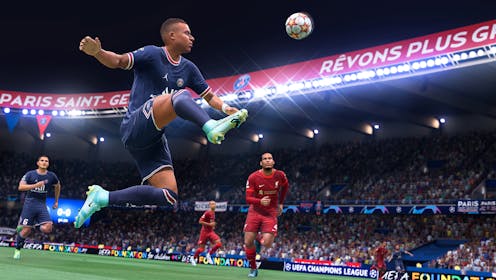
EA Sports and FIFA will part ways after almost 30 years of collaboration. This is surprising for a number of reasons, not least because it is such a large part of EA’s success: FIFA, a video game franchise using the world governing body of soccer’s official licence, is regularly played by 35 million people[1]. 325 million copies[2] of the game have been sold since it was launched in 1993.
The American gaming company EA openly acknowledges its dependency upon the series. A 2020 regulatory document[3] stated their US$5.6 billion in revenue was “primarily driven” by FIFA 21 and FIFA 20.
As one might expect, this powerhouse relationship seems to have soured over money. According to the New York Times, FIFA wanted double its usual licence fee, from US$500 million every four years to US$1 billion[4].
EA will release its new brand[5] of soccer video game, EA Sports FC, in 2023. FIFA are also outlining plans to introduce its own set of digital games. FIFA President, Gianni Infantino, remarked[6] this week:
I can assure you that the only authentic, real game that has the FIFA name will be the best one available for gamers and football fans.
This series has always revolved around an amorphous insistence upon authenticity and reality.
Read more: Are esports the next major league sport?[7]
Welcome to the real
EA Sports’ famous motto, “if it’s in the game, it’s in the game”, is not your average marketing braggadocio: it’s a declaration of intent. Even at its inception, the publisher was claiming to be more authentic than its competition.
It always wanted to be associated with established sports media. Its first game, based on America’s National Football League, was endorsed by NFL legend John Madden, credited as “co-designer” for 1988’s John Madden Football[8].
By the early 90s, EA Sports had reached agreement with the relevant governing bodies for NFL, American hockey, golf and lastly, in 1993, soccer.
On the back covers of these early games you’ll see words such as “actual”, “authentic” and “realistic” plastered liberally. These are, rather paradoxically, aligned with phrases such as “just like TV”, detailing features such as live commentary, instant replays and a host of camera angles.
In our heavily mediated society, signs of mediation are signs of reality.
The early FIFA games were filled with innovations. FIFA International Soccer in 1993 was the first soccer game to give the impression of three-dimensions, rather than the flat, two-dimensional appearance of competing games.
Graphical flourishes abound from 1996’s FIFA 97, featuring multi-dimensional players (instead of 2D sprites) and motion-captured animations provided by cover star David Ginola. This iteration also introduced live commentary provided by John Motson and Andy Gray, familiar voices to any English soccer fan.
Its successor, FIFA: Road To World Cup 98, would introduce a “title song” (Blur’s Song 2), beginning a tradition fusing musicians with the series, now an aspiration for many bands[9].
FIFA Football 2002 provided the now familiar convention of “power bars”, where the power of a shot (and later pass) is determined by how long the player holds the button. This expanded the skill curve for the game, paving the way for mechanics in later years such as dribbling controls and tricks.
FIFA 09 inaugurated the multiplayer “Clubs” mode, allowing players to compete against one another online. This edition also introduced user-controlled goal celebrations: an infamous feature among online players for the rage induced by taunting, elongated routines.
FIFA 19 was perhaps the nail in the coffin for the dominance of the FIFA licence. EA Sports was able to secure an exclusive licence with the Union of European Football Associations, introducing enormously popular competitions such as the European Champions League, Europa League and Super Cup to the game.
Read more: Why does crowd noise matter?[10]
Road to Wembley?
It’s interesting to look back now at how proud EA Sports were when teaming up with FIFA. The back cover for 1993’s FIFA International Soccer read:
EA Sports has teamed up with the governing body of international soccer to bring you the most realistic soccer game ever created.
This is a far cry from contemporary pronouncements, such as EA CEO Andrew Wilson’s recent dismissal[11] that FIFA’s only contribution to the series’ success was “four letters on the front of the box”.
While Wilson’s comments on FIFA are condescending, they aren’t too far off the mark. Outside of “those four letters”, the game series has never really seemed to care too much about that particular endorsement.
EA Sports’ claims to authenticity and reality have centred upon two things: domestic representation, and expanding the simulation claims of its game.
The first is evident in the series’ emphasis on expanding from international teams in the first game to include leagues such as England’s Premiership, Spain’s LaLiga and Germany’s Bundesliga with the painstaking recreation of their stadiums, team kits and player likenesses.
The second is illustrated by EA Sports’ concentrated efforts to implement familiar sports media conventions into the unfamiliar territory of video games.
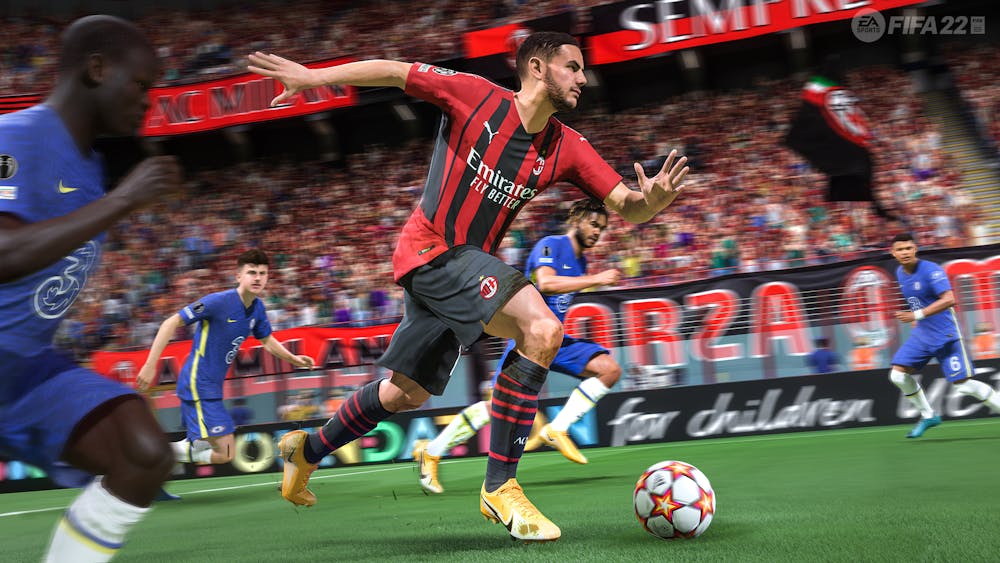
Tack onto this constant improvements in the physics engine[12], player motion capture and team statistics, and EA Sports’ value is obvious for your average fan.
In recent years, EA Sports have even adopted mechanics from older media such as trading cards. Players can purchase “card packs” which provide a random selection of footballers to use in the game. (This has drawn the eye[13] of legislators concerned EA is promoting gambling.)
The road forward for EA Sports’ series is clear; FIFA’s plans are much less defined.
EA Sports’ new series has the rights[14] to “19,000+ players, 700+ teams, 100+ stadiums and 30 leagues”, including the English Premiership and UEFA Champions League. It’s an extraordinarily strong defence. If FIFA really want to compete, it will need to field a formidable attack.
Read more: World Cup 2022: if Qatar can silence critics with a strong tournament, an Olympic bid could be next[15]
References
- ^ 35 million people (news.ea.com)
- ^ 325 million copies (www.forbes.com)
- ^ regulatory document (d18rn0p25nwr6d.cloudfront.net)
- ^ US$1 billion (www.nytimes.com)
- ^ new brand (news.ea.com)
- ^ remarked (www.fifa.com)
- ^ Are esports the next major league sport? (theconversation.com)
- ^ John Madden Football (en.wikipedia.org)
- ^ aspiration for many bands (www.bbc.com)
- ^ Why does crowd noise matter? (theconversation.com)
- ^ recent dismissal (www.videogameschronicle.com)
- ^ physics engine (en.wikipedia.org)
- ^ drawn the eye (www.theguardian.com)
- ^ has the rights (www.ea.com)
- ^ World Cup 2022: if Qatar can silence critics with a strong tournament, an Olympic bid could be next (theconversation.com)