Considering an IUD but worried about pain during insertion? Here’s what to expect
- Written by: Deborah Bateson, Clinical Associate Professor, Discipline of Obstetrics, Gynaecology and Neonatology, University of Sydney
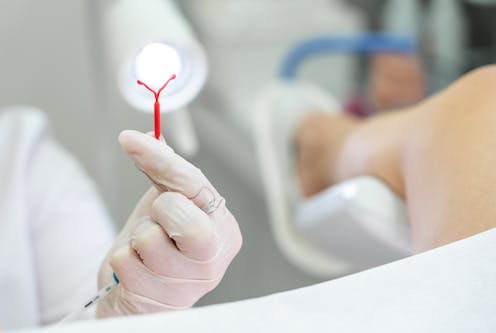
Intrauterine devices (IUDs) are small T-shaped plastic devices containing either copper or a low dose of progestogen hormone. Lasting five to ten years, they provide highly effective contraception[1] and are chosen by increasing numbers of users of all ages[2] from adolescence to perimenopause.
The main device sold in Australia is the Mirena Hormonal IUD, which is also used to manage heavy periods and can be part of hormonal menopause therapy[3]. While insertion is usually well tolerated, it can also cause discomfort and pain, or severe pain for a small number of women. So it’s important to know what to expect during and after the procedure, and what pain relief options are available.
Read more: Don't want to take a contraceptive pill every day? These are the long-acting alternatives[4]
What happens during an IUD insertion procedure?
The procedure lasts about ten minutes. Once positioned on the clinic bed, the doctor (either a GP or gynaecologist) or nurse performs what’s called a bimanual examination by inserting gloved fingers into the vagina while the other hand is on the lower abdomen to check the size, position and shape of the uterus.
An instrument called a speculum is then inserted into the vagina to allow the cervix to be seen. This is usually not uncomfortable or painful, though some conditions may make it more difficult, including vaginismus (an involuntary tightening of the pelvic muscles during vaginal penetration) and vaginal dryness. These can usually be treated before insertion to reduce discomfort.

The speculum is generally in place for around two to five minutes. To ease the insertion, most practitioners place an instrument called a tenaculum on the cervix to steady the uterus and straighten the cervix. This can sometimes cause a quite sharp pain, which usually settles in a few seconds.
A small fine instrument called a sound is passed through the cervix to measure the length of the uterus, and the IUD is then placed at the top of the uterus. This part of the procedure can cause cramping pain and make some people feel a bit lightheaded.
Lastly, the threads attached to the bottom of the IUD are shortened, so they gently wind around the cervix. The speculum is removed and the IUD insertion is complete.
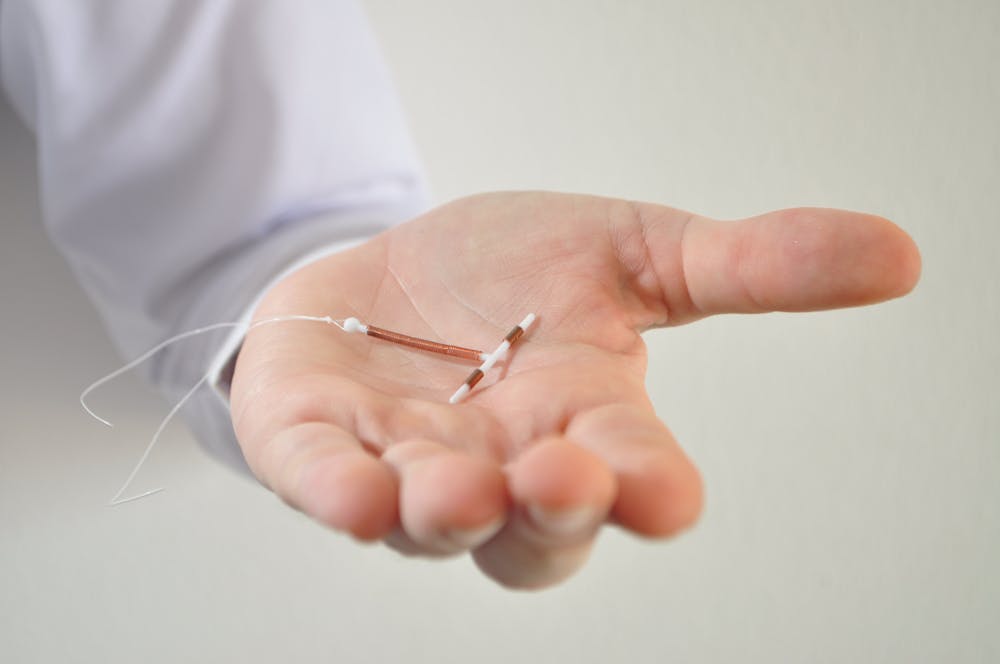 The IUD has threads at the end to aid removal.
Shutterstock
The IUD has threads at the end to aid removal.
Shutterstock
Why do some people experience more pain than others?
Despite many online reports of severe pain from insertion, a study[5] (with partial funding from the manufacturers) which surveyed more than 1,800 women from 11 European countries having a hormonal IUD inserted found the majority experienced mild or moderate pain. Severe pain was experienced by 15.5% of those who had never given birth, 4.5% of those who had caesarean sections and 1.9% of those who had vaginal deliveries.
Overall, the pain during insertion of a Mirena IUD in 413 women in Brazil, of whom one-third had never given birth, was rated at around[6] 4.4 to 6.6 out of ten, where ten is the worst pain possible. Apart from having given birth, other predictors of experiencing greater levels of pain include having painful periods[7] and fear of pain[8], although people without risk factors may nevertheless experience pain and people with risk factors may remain free of pain.
Read more: For women, even a small co-pay for contraception can be a big deal[9]
There is also some evidence[10] the newer hormonal IUD (brand name “Kyleena”), which is slightly smaller than the Mirena IUD, is easier to insert and causes less pain. A recent community study[11] of Kyleena insertion showed that around two-thirds of those who had never given birth experienced no or mild pain while around 8% experienced severe pain.
What pain relief options are available?
Evidence-based recommendations for reducing insertion pain are limited but more research is underway. Most practitioners recommend taking an anti-inflammatory medication an hour before insertion. Stronger pain relief may be considered[12] for those with particularly painful periods, a history of endometriosis or severe worries about the procedure.
An anti-nausea tablet can be helpful if there is vomiting with menstruation. Application of a local anaesthetic spray or cream to the cervix can decrease insertion pain[13], although this will add to the cost and time of the procedure and may not be offered by all practitioners.
Read more: Why women aren't getting long-acting contraception when they need it most[14]
The “green whistle” Penthrox inhaler, an anaesthetic drug used in ambulances for trauma-related pain, is also being trialled.
Less commonly, some people choose to have their IUD inserted under twilight sedation which means staying in a day surgery or hospital for around four hours. While some family planning services offer sedation at low cost, it is not universally available due to long public hospital waiting lists or costly private clinic fees.
Being aware of this option and its pros and cons is important to help informed decision-making. Sedation risks, extra time off work and costs need to be balanced against the evidence that most people tolerate the procedure without sedation, experiencing mild or moderate pain. As local anaesthesia has proven benefits for IUD insertion-related pain relief, finding a practitioner who routinely offers this option can be important.
What to expect after the procedure
After insertion, people are asked to stay at the clinic for around 20 minutes and while most will be able to get home themselves, it’s better to arrange to be picked up or to catch a taxi in case there is pain that is not settling. Once home, hot packs and over-the-counter analgesics such as naproxen, ibuprofen or paracetamol can be helpful, and taking it easy for a day or two is usually advised.
Although intermittent cramps[15] can last for a few months as the IUD “settles in”, our own clinical experience has shown this is particularly around menstruation.
 Talk to your doctor or nurse about what to expect during the procedure.
Shutterstock
Talk to your doctor or nurse about what to expect during the procedure.
Shutterstock
But if pain is getting worse, is not helped by simple analgesics, or accompanied by a smelly or profuse vaginal discharge or fever, it is essential to seek medical advice.
An ultrasound would be organised and if the IUD is shown to be in the correct position, and there is no evidence of an infection, it would become a personal choice whether or not, or for how long, to persist. Around 11.5% of Mirena users and 17.5% of copper IUD users who have the IUD removed early cited pain[16]) as part of their decision for premature IUD removal.
Knowledge is power
Seeking out credible information about the IUD insertion process from family planning websites, and talking to your doctor or nurse about what to expect during the procedure, including the available pain relief options, is essential. This can help overcome the anxiety that may come about from relying solely on online scare stories.
References
- ^ highly effective contraception (www.nejm.org)
- ^ users of all ages (srh.bmj.com)
- ^ hormonal menopause therapy (www.ebs.tga.gov.au)
- ^ Don't want to take a contraceptive pill every day? These are the long-acting alternatives (theconversation.com)
- ^ study (pubmed.ncbi.nlm.nih.gov)
- ^ was rated at around (www.tandfonline.com)
- ^ having painful periods (srh.bmj.com)
- ^ fear of pain (www.tandfonline.com)
- ^ For women, even a small co-pay for contraception can be a big deal (theconversation.com)
- ^ some evidence (pubmed.ncbi.nlm.nih.gov)
- ^ recent community study (pubmed.ncbi.nlm.nih.gov)
- ^ Stronger pain relief may be considered (pubmed.ncbi.nlm.nih.gov)
- ^ decrease insertion pain (www.sciencedirect.com)
- ^ Why women aren't getting long-acting contraception when they need it most (theconversation.com)
- ^ intermittent cramps (pubmed.ncbi.nlm.nih.gov)
- ^ cited pain (pubmed.ncbi.nlm.nih.gov)