How does Australia's voting system work?
- Written by: Malcolm Mackerras, Distinguished Fellow, PM Glynn Institute, Australian Catholic University
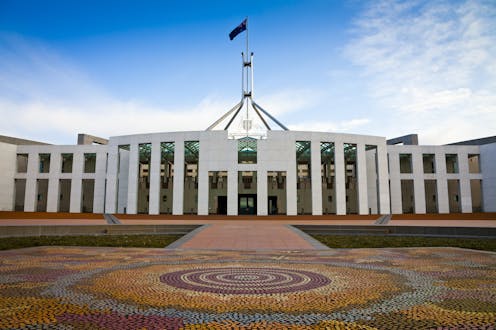
As you head to your local polling place this Saturday, or cast your ballot in an early vote, it’s worth pondering: how does Australia’s voting system really work, anyway?
The fundamentals of our electoral system have been shaped by democratic values enshrined in Australia’s Constitution and pragmatic decisions made by federal politicians since 1901.
I’ve been studying elections and electoral systems for some 65 years.
Here’s what you need to know to understand how the vote you cast this election fits into the bigger picture.
How long are politicians’ terms?
For members of the House of Representatives – three years.
Section 28 of the Constitution says:
Every House of Representatives shall continue for three years from the first meeting of the House, and no longer, but may be sooner dissolved by the Governor-General.
Since the prime minister advises the governor general, it means he or she makes the exact choice of date. Many people object to that, but I don’t. That power hasn’t been abused.
The now dissolved term (the 46th Parliament) was elected in May 2019, so it has run a full term.
Why do we have more seats in the House than the Senate?
The Constitution says there must be approximately double the number of seats in the House compared to the Senate.
Section 24 says:
The House of Representatives shall be composed of members directly chosen by the people of the Commonwealth, and the number of such members shall be, as nearly as practicable, twice the number of the senators.
The September 1946 election saw 74 members of the House of Representatives elected to the 18th Parliament (1946-49). There were 36 senators then, six from each of the six states.
Since 1984 there have been 76 senators, 12 from each state and two from each territory.
There are currently 151 seats in the House, which therefore meets the requirement “as nearly as practicable twice the number” of senators.
How are electoral boundaries drawn?
Electoral boundaries are drawn so there are similar numbers of voters in each seat.
Section 24 of the Constitution reads:
The number of members chosen in the several States shall be in proportion to the respective numbers of their people…
The number of 151 electorates was determined mid-way during the 45th Parliament (2016-19). In August 2017 the electoral commissioner, Tom Rogers, issued the latest population statistics and determined there should be 47 members from New South Wales, 38 Victoria, 30 Queensland, 16 Western Australia, 10 South Australia, five Tasmania, three ACT and two for the Northern Territory.
Where necessary, electoral boundaries are re-drawn according to the principle of “one vote, one value” or, as I prefer to say, equal representation for equal numbers of people.
In July 2020, Rogers acknowledged population growth was above average in Victoria and below average in Western Australia.
That is why the forthcoming election will see 39 members elected in Victoria (up one) and 15 in WA (down one). New boundaries will apply in those two states and the redistributions have been done fairly and with maximum transparency, as always.
Elsewhere the boundaries will be the same as in May 2019.
Read more: Explainer: how do seat redistributions work?[1]
How are Senators elected?
Since 1949 the system has been one of proportional representation.
That means within each state six Senate seats are roughly distributed according to a party’s share of the vote. So a party getting about 12% of the vote would win one seat, about 26% two seats, about 40% three seats and so on.
This is why the Greens do so well at Senate elections compared to the House of Representatives. With about 10% of the vote for both houses, they presently have nine senators but only one member of the House of Representatives.
This differs from preferential voting for the House of Representatives, introduced in 1918, where voters number candidates in the order of their preferences – first choice, second choice and so on.
How long are senators’ terms?
Senators from the states serve six year terms, and those from the territories serve three year terms.
However, a system of rotation means half the senators’ terms end every three years. So in most elections, half the Senate spots are contested.
But there’s an exception to this rule. Every so often there’s a “double dissolution”, where the entire Senate is elected. That happened most recently in 2016. This parliament was dissolved early because there was a dispute between the two houses, so the entire parliament faced the people.
In a double dissolution, half the senators from the states get three year terms instead of six. This is based on the number of votes.
One Nation’s Pauline Hanson and Larissa Waters of the Greens are good examples of how it works.
Both were elected among the 12 Queenslanders at the 2016 election. However, Hanson was one of the six more popular vote winners, and Waters one of the six less popular vote winners. So, Hanson got a six-year term and Waters a three-year term.
Waters won a higher proportion of votes in the 2019 election, so was elected to a six-year term, expiring on June 30 2025.
Hanson is up for re-election this year, and I predict she will be elected to a six-year term, and therefore her term would expire on 30 June 2028.
Issues with our voting system
About 16.5 million votes will be cast for each house of parliament.
Based on the last two federal elections, I estimate the informal vote will be roughly 800,000 for the House of Representatives (4.9%) and 650,000 for the Senate (3.9%).
By world standards that’s a high number of informal votes, which is thought by many to be a blot on our democracy.
Two reasons for this are because we have compulsory voting, and because ballot papers are unnecessarily complex and voter unfriendly, particularly for the Senate.
The United Kingdom, Ireland, Canada and New Zealand have voluntary voting and simple one-house ballot papers, and the rate of informal voting is negligible. Some argue we should copy them.
Read more: To Australians sick of the election: this is why voting is not a waste of your time[2]
There’s also a lack of rules around campaign finance – the stand-out case being the obscene spending[3] by Clive Palmer’s United Australia Party.
I argue there’s no need to reform the Constitution and the democratic values it upholds. But there should be legislative changes to improve the system. I expect some democratic reforms during the next term, 2022-25, the 47th Parliament.
These changes wouldn’t require a referendum, just negotiation to ensure passage through both houses. By contrast, changes to the Constitution require a referendum. For that reason reforms by referendum are rare.
References
- ^ Explainer: how do seat redistributions work? (theconversation.com)
- ^ To Australians sick of the election: this is why voting is not a waste of your time (theconversation.com)
- ^ obscene spending (theconversation.com)
Read more https://theconversation.com/how-does-australias-voting-system-work-177737