


In the animal kingdom, mating calls and pheromones can attract a mate – or a canny predator
- Written by: Thomas White, Senior lecturer, University of Sydney
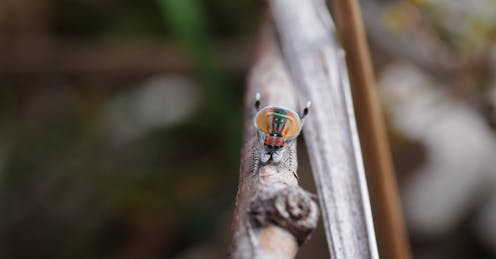
Reproduction is the ultimate goal in life for most animals, but securing a mate is hard work. You must not only find a potential suitor, but hold their attention, identify yourself, and advertise your quality.
To achieve this, animals use “sexual signals”. These conspicuous displays or ornaments help beat out the competition in the contest for mates. And some of the most beautiful aspects of the animal world have evolved for this purpose.
Sexual signals are costly, though, and not just in terms of the energy it takes to sing or dance. One seemingly obvious and profound cost is predation. The idea is simple. Just as your private phone call may be overheard by nosy passersby, so too may the bright colours and loud calls of sexual displays catch the eyes and ears of predators seeking a meal.
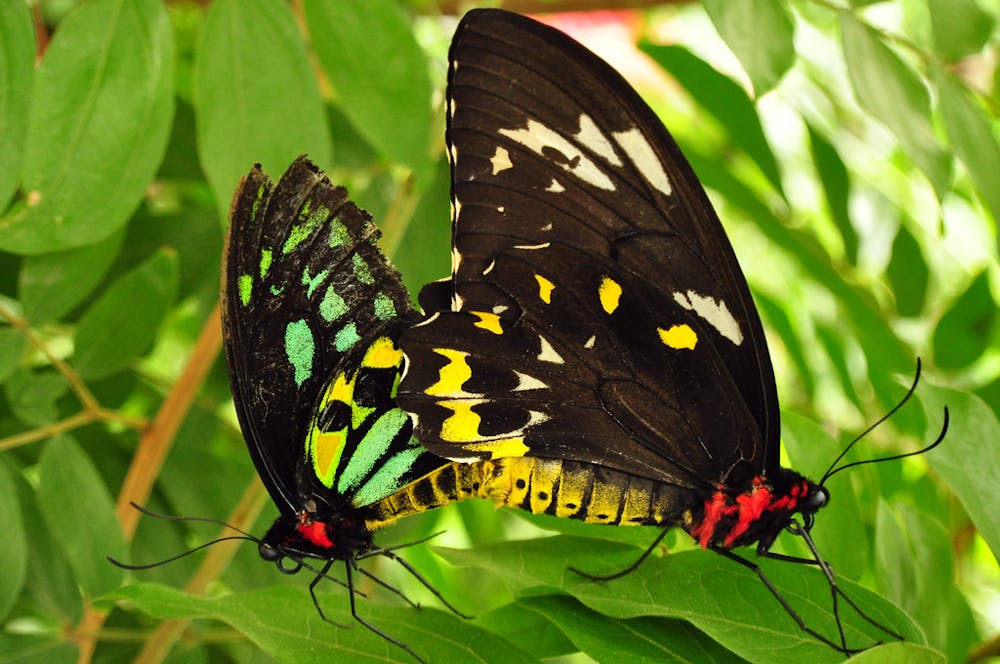
From the shimmering wings of butterflies, to the sweet songs of birds, we admire these signals in other species daily – even though they’re not meant for us. So how often are they intercepted by predators? And is the risk equal across all kinds of signals?
My colleagues and I sought to answer these questions in a recent publication[1]. We found the dangers to signallers are real, although much more varied than we once thought.
Eavesdropping on private conversations
Biologists describe the illicit interception of sexual signals as “eavesdropping”, and it has been formally studied since at least Charles Darwin. The Tungara frogs of Central and South America are a classic example; their loud mating calls attract[2] the unwanted attention of parasitic flies in search of a blood meal.
To make sense of the wealth of work available on this topic we scoured the literature for every published study of predatory eavesdropping, and found 78 in total. Most were similar in design, in that they placed fake models of animals or their signals out in the wild and recorded how often these were attacked by predators.
After statistically combining the results of these studies we found that, as expected, communicating with mates does increase the risk of being predated. Animals bearing sexual signals were roughly five times more likely to be attacked than those that were not actively signalling.
Digging deeper, however, we discovered the risk of being eaten depends on how the animals are communicating with each other. Those that use calls or pheromones to attract mates are in far greater danger than those using visual displays, which surprisingly experience no increased risk at all.
Read more: Here's how we proved that tropical birds are more colourful – and why colour helps them survive[3]
Not-so-risky business
The dangers of booming calls or strong pheromones are intuitive enough, but why do bold colours not raise the risk of being eaten? We suspect there are two related reasons.
One is that most predators are fussy eaters. Even those with broad diets such as insect-eating birds and lizards prefer to eat familiar prey, and only rarely try new things. Since most animals present their sexual displays intermittently, colourful ornaments may be unfamiliar to predators, who will then avoid them out of caution.
The other possible reason is that many animals use vivid colours as warning signals. Consider the striking black and red abdomens of redback spiders, which advertise the fact that they are dangerous and well defended[4]. Predators may be generally wary of conspicuous patterns, then, since the animals bearing them are often more trouble than they’re worth.
So what do these results tell us about the evolution of communication? For one, we might expect visual displays to be more conspicuous and elaborate than other types of signals such as calls or pheromones, given predators pose little threat in the face of extravagance.
And in populations where predation is a persistent threat, we should expect to find that adaptive evolution favours the use of less risky signals, such as colour or motion (or the abandonment of signalling altogether). We can see this take place among the Pacific field crickets of Hawaii, where males have lost the ability to sing in response to intense predation by parasitic flies[5].
Read more: Tug of war between survival and reproductive fitness: how chameleons become brighter without predators around[6]
Weaponizing the language of sex
Predators aren’t the only ones interested in eavesdropping on prey; humans are too. Pests such as aphids and grasshoppers are not only a nuisance in our gardens, but also wreak havoc on Australian crops to the tune of hundreds of millions of dollars[7] each year.
 Aphids cause hundreds of millions of dollars’ worth of damage to Aussie crops each year.
Shutterstock
Aphids cause hundreds of millions of dollars’ worth of damage to Aussie crops each year.
Shutterstock
Enterprising researchers have shown we can hijack the sexual signals of these pests to combat them in two ways. One is by using said signals to attract and trap the pests themselves, as in the case of artificial acoustic signals mimicking field crickets and grasshoppers[8].
Or we can tap into the existing interests of predators to lure them toward pests in greater numbers. This has proven effective in managing aphids, for example, where we now commercially synthesise the sex pheromones of females. This attracts predatory wasps which lay their eggs inside the aphids[9], and ultimately kill them.
Of course, our study only offers a brief guide to bio-inspired pest management. More generally, it shines new light on what was thought to be a fundamental cost of sex, and shows that while attracting mates can be a dangerous game, it depends entirely on how you play.
References
- ^ a recent publication (royalsocietypublishing.org)
- ^ mating calls attract (doi.org)
- ^ Here's how we proved that tropical birds are more colourful – and why colour helps them survive (theconversation.com)
- ^ dangerous and well defended (doi.org)
- ^ predation by parasitic flies (doi.org)
- ^ Tug of war between survival and reproductive fitness: how chameleons become brighter without predators around (theconversation.com)
- ^ hundreds of millions of dollars (doi.org)
- ^ field crickets and grasshoppers (dx.doi.org)
- ^ lay their eggs inside the aphids (dx.doi.org)










