Hanson wins easily, but Labor still on track for a friendly Senate
- Written by: Adrian Beaumont, Honorary Associate, School of Mathematics and Statistics, The University of Melbourne
Buttons have now been pressed to electronically distribute preferences for the May 21 federal election in the Senate for South Australia, Tasmania and Queensland. I discussed the ACT and NT results that elected David Pocock to the Senate on Tuesday.
Read more: ACT Senate result: Pocock defeats Liberals in first time Liberals have not won one ACT Senate seat[1]
All states have 12 senators, with six up for election at half-Senate elections. A quota is one-seventh of the vote, or 14.3%. State senators are elected for six-year terms beginning July 1, barring a double dissolution.
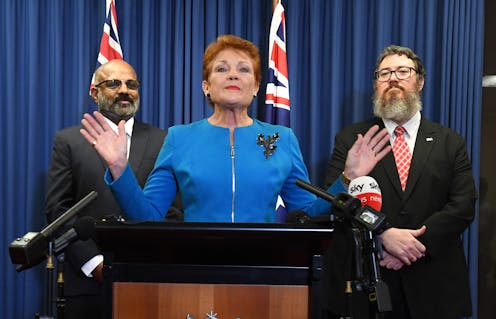
Final primary votes in Queensland[2] were 2.47 quotas for the LNP, 1.73 Labor, 0.87 Greens, 0.52 One Nation, 0.38 Legalise Cannabis and 0.29 UAP. The result was two LNP, two Labor, one Green and one One Nation. The change from the previous parliament was the Greens winning a seat from the LNP.
Preferences were distributed on Friday. ABC election analyst Antony Green[3] said after the exclusion of Clive Palmer (UAP), 57% of his preferences flowed to One Nation’s Pauline Hanson, putting Hanson ahead of Labor’s second candidate, Anthony Chisholm.
Final results were 0.996 quotas for Hanson, 0.974 Labor and 0.720 for the LNP’s third candidate, Amanda Stoker. Hanson was elected fifth, Chisholm sixth and Stoker was defeated.
Final primary votes in South Australia were 2.37 quotas for the Liberals, 2.26 Labor, 0.84 Greens, 0.28 One Nation, 0.21 UAP and 0.21 Nick Xenophon. Rex Patrick, who defected from Xenophon’s Centre Alliance, won just 0.15 quotas.
Preferences were distributed on Wednesday. The Poll Bludger[4] said the third Liberal won the final seat over One Nation by 0.87 quotas to 0.67. At the previous count, Labor was excluded behind One Nation, with 0.56 quotas to 0.61 for One Nation and 0.67 for the Liberals. The Liberals would have won even if Labor had made the final two.
At the 2016 double dissolution[5] election, Xenophon won three seats with two getting long terms that expire on June 30. Labor and the Liberals were each defending two seats. So the Greens and Liberals each gained a seat with Centre Alliance losing their two seats (one a defector).
Final primary votes in Tasmania gave the Liberals 2.24 quotas, Labor 1.89, the Greens 1.08, the Jacqui Lambie Network (JLN) 0.61 and One Nation 0.27.
Preferences were distributed Thursday[6]. The second Labor candidate and the JLN’s Tammy Tyrrell reached quota, with Tyrrell joining Lambie and increasing the JLN’s Senate representation from one to two. This was a gain for the JLN from the Liberals. At the final count, Tyrrell had 1.05 quotas and One Nation 0.63, with the third Liberal excluded before One Nation.
The third Liberal was Eric Abetz[7], who has been a senator since 1994. At this election, he was demoted to third on the Liberal Tasmanian ticket. Analyst Kevin Bonham[8] said Abetz easily won the biggest share of 39s (last preference) out of all below the line voters who numbered every box.
Remaining states
Twenty-two of the 40 Senate seats up for election have now been formally decided, and have gone as expected. I expect the remaining states early next week. Primary votes in NSW are 2.57 quotas for the Coalition, 2.13 Labor, 0.80 Greens, 0.29 One Nation and 0.24 UAP. This will result in three Coalition, two Labor and one Green.
The Coalition has 2.26 quotas in Victoria, Labor 2.20, the Greens 0.97, UAP 0.28, Legalise Cannabis 0.21 and One Nation 0.20. Complete data files on every vote cast in Senate contests are available soon after the distributions. From this data, the Poll Bludger[9] said One Nation preferences flowed far better to the UAP in SA than in 2019.
If this pattern is repeated in Victoria, he said UAP has a much better chance of winning the final seat than 2019 preference flows would suggest. So Victoria will be two Coalition, two Labor, one Green, with the final seat leaning to the UAP instead of the Coalition.
Labor has 2.42 quotas in WA, the Liberals 2.22, the Greens 1.00, One Nation 0.24, Legalise Cannabis 0.24 and the Christians 0.15. Labor is likely to win three senators in WA, the Liberals two and the Greens one, but it’s still possible Labor loses the last WA seat to either the Liberals or One Nation.
If results in the remaining states are as expected, the outcome of this half-Senate election would be 15 Coalition out of 40, 15 Labor, six Greens and one each for One Nation, UAP, JLN and David Pocock.
The Coalition would hold 32 of the 76 total senators, Labor 26, the Greens 12, One Nation two, the JLN two and Pocock and UAP one each. To pass legislation opposed by the Coalition, Labor would need support from the Greens and any one of the six others.
If Labor loses the final WA seat, their path to legislation is more difficult. They would then need the Greens and two of the six others, and would likely depend on the JLN.
House: independent in Groom makes final two on just 8.3% primary vote
In the House of Representatives, primary votes in Groom[10] were 43.7% LNP, 18.7% Labor, 9.6% One Nation, 8.3% for independent Suzie Holt, 7.1% for another independent, 5.9% Greens and 5.1% UAP. After a distribution of preferences, Holt jumped over both One Nation and Labor to make the final two, but she still lost decisively to the LNP.
Analyst Peter Brent[11] said Holt had the third lowest primary vote percentage, and the lowest when both major parties contested, to make it to the final two at a federal election or byelection, and is the first to make the final two from fourth or lower on primary votes.
In Australia the two top candidates on primary votes are not guaranteed to be the final two. The distribution of preferences starts by excluding the lowest polling candidate, and their votes are distributed to all remaining candidates. This is followed until there are two candidates remaining.
In past elections, the Australian Electoral Commission has not released the full distribution of preferences for all seats until months after the election.
Essential poll: Albanese surges to 59% approval
Essential is the first Australian pollster to poll Anthony Albanese’s ratings[12] since the election. In this week’s poll, he had a 59% approval for his performance as prime minister, and just an 18% disapproval (net +41). In Essential’s final poll before the election, Albanese was at +1 net approval for his performance as opposition leader (42-41 approval).
By 44-34, voters supported Australia becoming a republic, down from a 49-28 margin in March 2021.
References
- ^ ACT Senate result: Pocock defeats Liberals in first time Liberals have not won one ACT Senate seat (theconversation.com)
- ^ Queensland (www.abc.net.au)
- ^ Antony Green (antonygreen.com.au)
- ^ Poll Bludger (www.pollbludger.net)
- ^ 2016 double dissolution (en.wikipedia.org)
- ^ Thursday (tallyroom.aec.gov.au)
- ^ Eric Abetz (www.theguardian.com)
- ^ Kevin Bonham (kevinbonham.blogspot.com)
- ^ Poll Bludger (www.pollbludger.net)
- ^ Groom (tallyroom.aec.gov.au)
- ^ Peter Brent (twitter.com)
- ^ Anthony Albanese’s ratings (essentialreport.com.au)