The Times Australia
Google AI
The Times World News

.

After decades of loss, the world's largest mangrove forests are set for a comeback

  • Written by Benjamin Brown, Postdoctoral research associate, Charles Darwin University
After decades of loss, the world's largest mangrove forests are set for a comeback

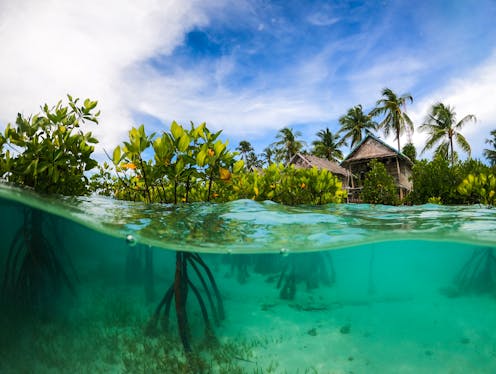
Mangroves ring the shores of many of Indonesia’s more than 17,000 islands. But in the most populated areas, the world’s largest mangrove forests have been steadily whittled away, and with them, the ability to store blue carbon.

As the world’s fourth-most populous nation has grown, pressure on the mangroves has too. More than 756,000 hectares of mangroves have been cleared and turned into brackish ponds to farm water shrimp and milkfish.

Every year for the past three decades, another 19,000 hectares[1] has been ripped out for aquaculture and increasingly, for oil palm plantations. As of 2015, an estimated 40% of the country’s mangroves had been degraded or lost[2].

Is this another predictable bad news story about the environment? No. This is a good news story. That’s because Indonesia’s government is, rising to the challenge of conserving its mangroves – and restoring lost forests.

Government investment in mangroves is rising and the political will is in place. Indonesia’s ambitious goal is to restore almost all of what’s been lost, rehabilitating 600,000 hectares of mangroves by 2024.

Why have Indonesia’s mangroves been hard hit?

In a 2012 interview[3], former Indonesian forestry official Eko Warsito explained why his country’s mangroves were disappearing:

More than 50% of Indonesia’s population lives in coastal areas, and most of them are poor. An ordinary plot of mangroves is worth $84 a hectare. But if it’s cleared and planted with oil palms, it can be worth more than $20,000 a hectare.

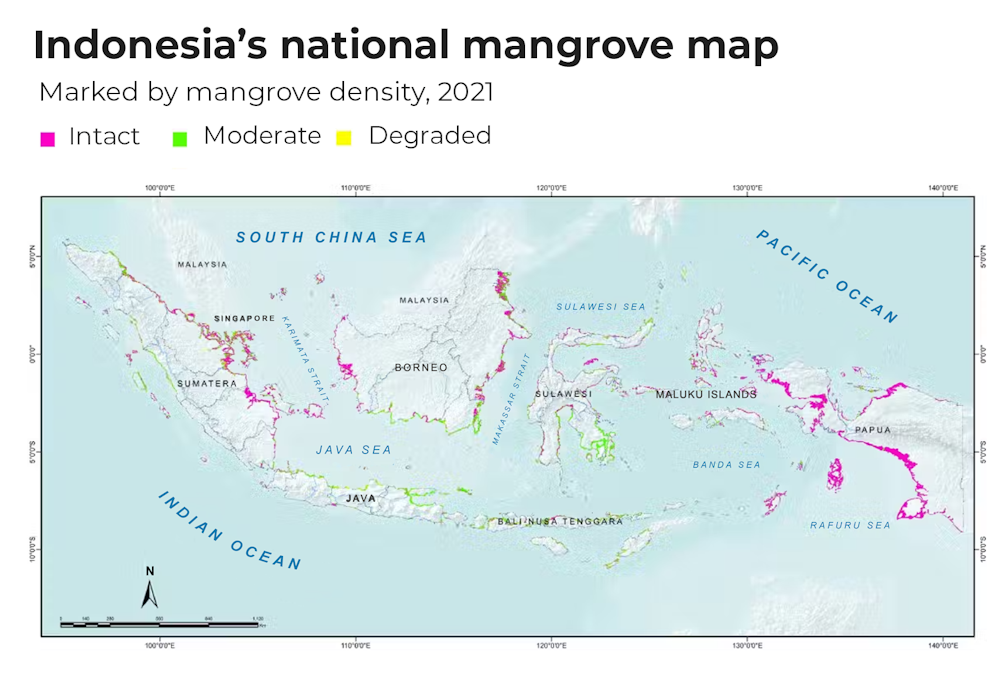
Unfortunately, this difference in perceived value has seen mangroves degraded or replaced. You can glimpse the current state of Indonesia’s 3.3 million hectares of mangrove area in the map below, which was released last year by Indonesia’s environment and forestry ministry.

Mangroves are broadly in good condition in the provinces of Papua and West Papua. But in the more populated areas – especially around the densely populated island of Java – mangroves have been largely deforested and degraded.
Adapted from a Ministry of Environment and Forestry, Republic of Indonesia map Recent analysis by the World Bank puts the value of mangrove ecosystems at between A$21,000 to $70,000 per hectare per year. Similarly, a 2020 cost-benefit analysis[4] of mangrove conservation versus conversion to shrimp aquaculture in Indonesia’s Papua province estimated the direct and indirect value of mangroves at A$34,000 per hectare per year. But these valuations are heavily influenced by the role mangroves play in providing ecosystem services. Without these services, mangroves are worth two orders of magnitude less, at around A$340 per hectare. Their real value lies in their ability to store large amounts of carbon, averaging almost 4000 tonnes of carbon dioxide equivalents per hectare. Until now, however, policy bottlenecks at the national level have stopped Indonesia from investing in better mangrove management and producing new revenue streams from stemming mangrove losses. Mangroves like these from a village forest in Sumatra store an average of 1083 tonnes of carbon in their living tissues and the soil beneath. Benjamin Brown Indonesia’s mangroves have suffered because of this disconnect between their real value and government policies and institutions. Over 20 institutions have some level of responsibility for mangrove management in Indonesia. It’s no wonder their agendas often conflict. Read more: Indonesia's vast mangroves are a treasure worth saving[5] But progress is being made. Two years ago, President Joko Widodo added mangroves to the mandate of the country’s peatland restoration agency, after its success at restoring[6] damaged peatlands. The goal for mangroves is to restore 600,000 hectares of mangroves by 2024. There are alternatives to aquaculture You might think it’s too hard to restore mangroves once they’ve been turned into shrimp farms. Previously, this has been true[7], with an over-reliance on simply planting more seedlings rather than tackling the harder work[8] of social and economic reliance on former mangrove habitat. In response, Indonesia’s government has mapped around 77,000 hectares of the best restoration candidate areas across 300 villages in Sumatra and Kalimantan (Indonesian Borneo), working in full collaboration with coastal villagers. Restoring mangroves requires human labour and machinery, as in this image of villagers in Sulawesi improving water flow and drainage into disused shrimp ponds. Rio Ahmad (Director of Yayasan Hutan Biru) 5° 1'59.95 This Google Earth image shows how quickly mangroves can rebound after hydrological restoration to make water flows more natural. Google Earth To create alternatives to aquaculture, Indonesia’s national farmer field school program will expand to include hundreds of coastal villages. These coastal field schools help local villages improve their management of the coasts and develop alternative sources of income. These include learning to use Nypah palms[9] alongside mangroves, to allow villagers to harvest the valuable sugar from the sap. This species is the only palm considered a true mangrove. They can produce 800,000 litres of sap per hectare per year, forming a sustainable commodity base for organic palm sugar production as well as bio-ethanol. Other options include encouraging production of honey, gluten-free flour, tea, juice, jam, and cosmetics. For some villages, eco-tourism could be an option, or shifting to more sustainable aquaculture[10]. Ratna Fadillah, an expert in non-timber forest product use, harvests holly mangrove leaves to make herbal green tea. These teas offer a low-cost opportunity to create a business, which many women and youth across Indonesia are adopting. Benjamin Brown What’s next? Indonesia’s government is drafting a new mangrove policy, focused on balancing mangrove protection, sustainable use and restoration. We’re already seeing welcome realignment between the nation’s ministries. These efforts are being funded by a $A573 million loan from the World Bank and a $A27 million grant for the policy reforms and investment in coastal livelihoods. This loan will be repaid with credits from blue carbon. Indonesia’s government is seeking more financial support from other governments and multilateral organisations to scale up their mangrove management to a national scale. Indonesia’s work to turn around the fate of their ailing mangroves will be shown on the world stage at the G20 summit in Bali in November. By then, there will be a public dashboard to represent progress captured by field-based and satellite monitoring. Read more: Can blue carbon help Indonesia meets its 2030 emission targets?[11] World Bank natural resources expert André Rodrigues de Aquino contributed to the research underlying this article References^ another 19,000 hectares (maps.coastalresilience.org)^ had been degraded or lost (www.cifor.org)^ 2012 interview (www.npr.org)^ 2020 cost-benefit analysis (www.climatelinks.org)^ Indonesia's vast mangroves are a treasure worth saving (theconversation.com)^ success at restoring (news.mongabay.com)^ has been true (doi.org)^ harder work (www.nature.com)^ Nypah palms (en.wikipedia.org)^ more sustainable aquaculture (enaca.org)^ Can blue carbon help Indonesia meets its 2030 emission targets? (theconversation.com)

Read more https://theconversation.com/after-decades-of-loss-the-worlds-largest-mangrove-forests-are-set-for-a-comeback-182951

Times Magazine

Narwal Freo Z Ultra Robotic Vacuum and Mop Cleaner

Rating: ★★★★☆ (4.4/5)Category: Premium Robot Vacuum & Mop ComboBest for: Busy households, ha...

Shark launches SteamSpot - the shortcut for everyday floor mess

Shark introduces the Shark SteamSpot Steam Mop, a lightweight steam mop designed to make everyda...

Game Together, Stay Together: Logitech G Reveals Gaming Couples Enjoy Higher Relationship Satisfaction

With Valentine’s Day right around the corner, many lovebirds across Australia are planning for the m...

AI threatens to eat business software – and it could change the way we work

In recent weeks, a range of large “software-as-a-service” companies, including Salesforce[1], Se...

Worried AI means you won’t get a job when you graduate? Here’s what the research says

The head of the International Monetary Fund, Kristalina Georgieva, has warned[1] young people ...

How Managed IT Support Improves Security, Uptime, And Productivity

Managed IT support is a comprehensive, subscription model approach to running and protecting your ...

The Times Features

Small, realistic increases in physical activity shown to significantly reduce risk of early death

Just Five Minutes More a Day Could Prevent Thousands of Deaths, Landmark Study Finds Small, rea...

Inside One Global resorts: The Sydney Stay Hosting This Season of MAFS Australia

As Married At First Sight returns to Australian screens in 2026, viewers are once again getting a ...

Migraine is more than just a headache. A neurologist explains the 4 stages

A migraine attack[1] is not just a “bad headache”. Migraine is a debilitating neurological co...

Marketers: Forget the Black Box. If You Aren't Moving the Needle, What Are You Doing?

Two years ago, I entered the digital marketing space with the mindset of an engineering student ...

Extreme weather growing threat to Australian businesses in storm and fire season

  Australian small businesses are being hit harder than ever by costly disruptions...

Join Macca’s in supporting Clean Up Australia Day

McDonald’s Australia is once again rolling up its sleeves for Clean Up Australia Day, marking 36...

IFTAR Turns Up The Heat With The Return of Ramadan Nights From 18 February

Iftar returns to IFTAR, with the Western Sydney favourite opening after dark for Ramadan  IFTA...

What causes depression? What we know, don’t know and suspect

Depression is a complex and deeply personal experience. While almost everyone has periods of s...

5 Cool Ways to Transform Your Interior in 2026

We are at the end of the great Australian summer, and this is the perfect time to start thinking a...