Anthony Albanese has a lot on the go in the 'back office' of government
- Written by: Michelle Grattan, Professorial Fellow, University of Canberra
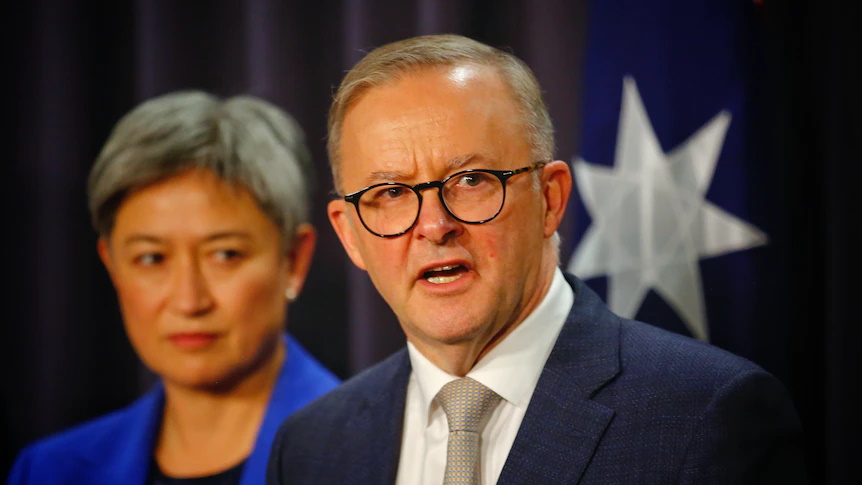
Anthony Albanese will be on the international road again next week. He’ll be at the NATO summit in Madrid, where the war in Ukraine will obviously dominate the discussions, which will also canvass China and climate change.
Albanese, who earlier attended the QUAD in Tokyo and visited Indonesia, isn’t going to be a minimalist when it comes to spending time overseas.
International conferences give an opportunity for the new PM to meet multiple leaders, gather information and signal continuities and change (for example on climate policy) in Australia’s national priorities.
A just-elected prime minister must be careful in deciding how much foreign travel to undertake, especially when there are problems at home and many ordinary people are doing it tough on their cost of living. At some point, being away too much stirs criticism.
But with NATO inviting four non-member countries – Japan, South Korea and New Zealand, as well as Australia – it would have been a hard invitation to turn down.
The trip includes Paris, in the wake of the Labor government settling compensation for the aborted submarine contract. This stop does seem something of an indulgence, although it could give an opportunity to explore co-operation with France in the Pacific.
Albanese clearly also wants to visit Ukraine. He indicated on Wednesday this would depend on advice from Australian security agencies.
The PM has been equally peripatetic domestically. He’s already been to all states and territories since the election.
Ministers have also been early overseas travellers: among them Foreign Minister Penny Wong, whose second home now seems to be the Pacific, and Defence Minister Richard Marles, who had what was seen as that (maybe) ice-breaking meeting with his Chinese counterpart in Singapore, before a visit to India.
A particularly important trip was Home Affairs Minister Clare O'Neil’s visit to Sri Lanka this week. One of Labor’s fears has materialised as people smugglers start to test the border. The government acted quickly, with O'Neil’s diplomacy and a $50 million humanitarian aid package for the country. Australia will also fund, as announced by the Coalition government, thousands of GPS trackers to be installed on Sri Lankan fishing boats.
The trickle of boats, none of which has reached the Australian mainland, is not serious so far, but the government knows the risks if it is not quickly cut off.
In general, we’re seeing the new government highly active on multiple fronts, driven by circumstances, particularly with the energy crisis, as well as by choice. It was notable this week that after months of the former government playing down COVID despite the significant number of deaths, Health Minister Mark Butler stepped up the messaging about vaccination and treatment, including launching a public campaign.
Beside the intense front-of-shop activity, a good deal of change is being set in train in the government’s back office, the public service.
Labor signalled in the campaign it wanted to remuscle the bureaucracy, after it had been run down and demoralised by the Coalition government.
Read more: Albanese government mobilises diplomacy and aid in effort to counter Sri Lanka people smugglers[1]
Scott Morrison downplayed the bureaucracy’s advisory role, outsourced much of its work to consultants, failed to implement some of the more important recommendations of the Thodey review of the service, and arbitrarily sacked a number of departmental secretaries.
This week Albanese wielded a small axe of his own, removing the secretary of the Foreign Affairs Department, Kathryn Campbell (Penny Wong was no fan, and Campbell had a history with Robodebt), and the head of infrastructure, Simon Atkinson.
Immediately after the election Albanese appointed Glyn Davis to head his own department, indicating he’s determined to leave the public service in better shape than he has found it. Davis is a policy wonk with extensive administrative experience and a reform bent; he was a member of the Thodey review.
The changes this week reinforced the point. A former senior bureaucrat, Gordon de Brouwer, also a member of the Thodey review, is returning as “secretary for public sector reform”.
In this context, on Thursday night one of Australia’s most distinguished recent public servants had some advice. Frances Adamson is a former ambassador to China, served as foreign affairs adviser in PM Malcolm Turnbull’s office, and later headed the Foreign Affairs Department. Adamson – who is now South Australian governor – knows the bureaucracy inside out.
In an oration named in her honour, she outlined what she described as four “encouragements” and one “entreaty” to public servants. They amount to an agenda for improvement.
Read more: Head of Foreign Affairs Kathryn Campbell ousted in public service shake-up[2]
First, she urged the full implementation of the Thodey review “in letter and in spirit”. The effect of the recommendations that were not taken up would be to give senior public servants more independence and protection.
Second, Adamson exhorted public servants to “think more broadly about our times and what they require of you”.
“This is a time for steadiness, for listening and consultation, close collaboration, and a renewed appreciation of and respect for expertise in policy development – whether on the economy, climate change, China or homelessness,” she said.
“A time to grow that expertise in a purposeful way through recruiting and development and to share it widely. And, certainly, time for frank, fearless, well-informed, creative and constructive advice.”
Her third “encouragement” related to the culture of the public service: the importance of fostering “a genuine sense of belonging that goes beyond the ways we typically think about diversity, equity and inclusion”.
“Belonging,” she said, “is about meaningful work, relationships, agency and accountability.”
Fourthly, Adamson stressed the importance of public servants having good relationships with counterparts in other levels of government. Although she didn’t go down this path, co-operation between federal and state governments will be vital if the Albanese government is to secure its aim of improving productivity.
Adamson’s “entreaty” was about integrity. “The 2022 election campaign should not leave us in any doubt about the importance the Australian people attach to integrity and the structures required to support it,” she said.
“Acting with integrity is how the service maintains the confidence and trust of the public. Indeed, integrity is one thing that does shift community attitudes and trust in government, so it is one of the tools that public servants have in strengthening public institutions.”
Adamson concluded that “the quality of public service contributes to a nation’s strategic weight […] Australia’s strategic weight in turn contributes to the stability, security, prosperity and development of our region and its character.”
The better the quality and robustness of the advice coming from the public service, the greater the chance of the Albanese government leaving the sort of “legacy” to which its prime minister says he aspires.
References
- ^ Albanese government mobilises diplomacy and aid in effort to counter Sri Lanka people smugglers (theconversation.com)
- ^ Head of Foreign Affairs Kathryn Campbell ousted in public service shake-up (theconversation.com)