Our flood predictions are getting worse as the climate changes. We have to understand how hills shape floods
- Written by: Sally Thompson, Associate professor, The University of Western Australia
Protecting people from floods requires many technical professionals to make good predictions and decisions.
Meteorologists predict the risk of extreme rainfall. Hydrologists translate this rainfall into predictions about what the flood will be like in terms of depth, flow and speed. Engineers design roads, bridges and buildings to cope with the likely conditions, while planners ensure new development is compatible with flood risks.
No step in this process is easy – and most are getting harder. Climate change is worsening flooding, because a hotter atmosphere can hold more water vapour which supercharges clouds. A hotter climate provides more energy to lift wet air high into the atmosphere, where it cools, becomes liquid and forms extreme rainfall. In Australia’s north, the intensity of heavy rainfall events has already increased by 10%[1] since 1979.
While it is difficult to adapt to unpredictable rainfall events, we can improve our flood predictions. We focused on improving[2] a common flood prediction technique called the Rational Method.
While simple to use, it can also get some things very wrong – such as underestimating flood peaks by 200%. To fix this, we worked with the developers of Arc Hydro, a popular software package used by stormwater and flood planners, to better describe[3] how the shape of hillslopes affects floods. We hope this can help planners gain a better understanding of the true flood risks in specific areas.
Why do we need better flood predictions?
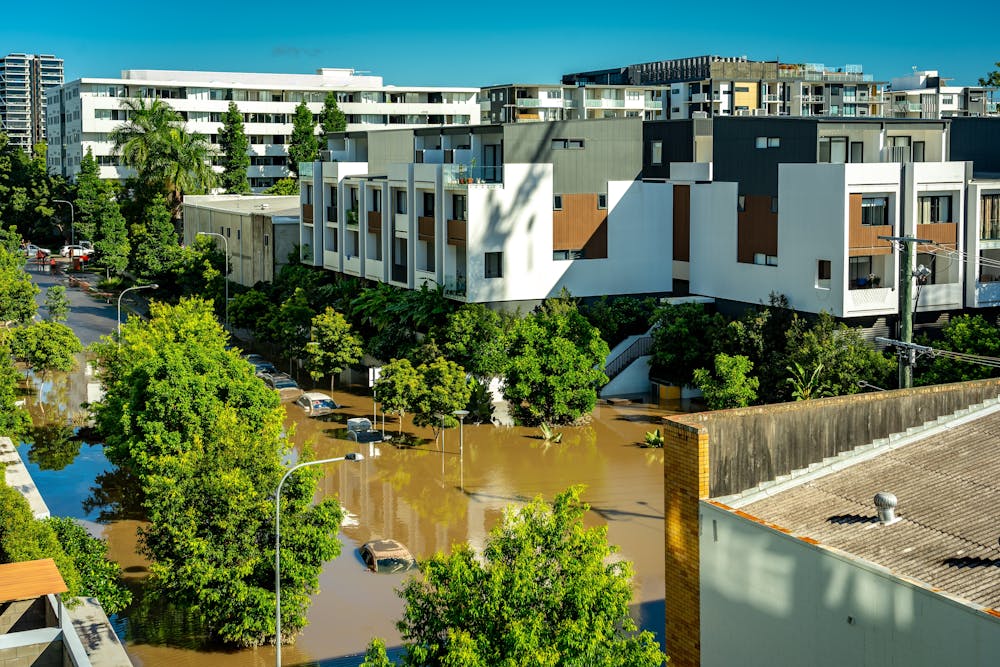
It’s particularly hard to predict the risk of extreme storms – like those that drove devastating flooding in parts of New South Wales and Queensland earlier this year – because for these storms, the past is not a good guide to the future. Those floods came from a “rain bomb” which dumped 60% of south east Queensland’s normal annual rainfall in just three days[4].
Managing flood risks is hard, given the cost of flood protection, evacuation and resilience in developed areas and challenges in restricting development in high-risk areas. In recent years, there has been intense pressure on planners in Australian cities to provide new housing stock. The land development sector also makes substantial political donations[5]. Unsurprisingly, these pressures have led to development on flood-prone land. Flooding during the ongoing La Niña events has paused development[6] in some areas.
Australia has robust guidance available to predict flood risk. The federal government’s Australian Rainfall and Runoff[7] guidance is world-leading. Unfortunately, to use this properly, you need to undertake high quality analysis, detailed physical modelling, and thoughtful exploration of uncertainty. This can be expensive, requiring specialised software, highly trained experts, and enough data and time. That’s why many planners in Australia and globally still turn to simpler methods of flood assessments like the Rational Method.
Read more: Why flooding is still so difficult to predict and prepare for[8]
Simpler is not always better
While appealing, simpler methods are more likely to be inaccurate. Although there are longstanding concerns about the reliability[9], the method remains stubbornly popular and recommended in design standards globally. Rather than scolding engineers for using the Rational Method, we aimed to improve it.
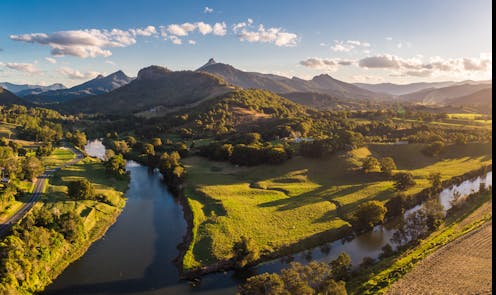
To maintain simplicity, the Rational Method overlooks many factors affecting how floods form. We looked at one vital factor – the shape of the landscape. When rain falls on sloping land, it flows to the bottom of valleys where stream channels form. But hillslopes aren’t “flat” like a sheet of cardboard – they curve in different ways.
We were worried about divergent hillslopes, which fan out from a short section of ridge to a long stretch of stream. Under these conditions, the Rational Method overestimates how long rain needs to fall to produce a worst-case flood. By overestimating how long a storm will last, the Rational Method underestimates rainfall extremes. That can lead to very significant errors, such as underestimating the flood peak by 200%[10].
To fix this issue, we developed a mathematical theory to correct flood predictions based on the shape of the hillslope. We tested our new theory using experiments run on carefully engineered model hillslopes and found it worked as expected[11].
From theory to practice
Sadly, mathematical theories aren’t usually popular outside academic circles. To share our new approach with users, we worked with Esri, the developer of the globally popular Arc Hydro GIS package[12] used by stormwater and flood planners.
Together, we built new tools[13] for the package which map hillslopes, describe the hillslope shape mathematically, and use our new theory to improve predictions produced by the Rational Method.
So does it work? When we applied our tool to test watersheds in California and New Mexico, we found about 40% of the hillslopes were divergent – wider at the bottom than the top. For these areas, using our new methods would improve flood predictions by up to 270%.
Floods are a difficult challenge for societies to deal with around the world. That’s because coping with floods requires us to make long-term decisions about where we live, how we live, and what we build in the face of a rapidly changing climate.
To fully address these problems is an international, multidisciplinary task for scientists, engineers, planners, policymakers and decision makers. We hope our improvement to the Rational Method will be a small, but useful, part of this great endeavour.
Read more: One in 1,000 years? Old flood probabilities no longer hold water[14]
References
- ^ increased by 10% (www.bom.gov.au)
- ^ focused on improving (www.sciencedirect.com)
- ^ better describe (community.esri.com)
- ^ just three days (www.climatecouncil.org.au)
- ^ political donations (publicintegrity.org.au)
- ^ paused development (www.theguardian.com)
- ^ Australian Rainfall and Runoff (arr.ga.gov.au)
- ^ Why flooding is still so difficult to predict and prepare for (theconversation.com)
- ^ the reliability (onlinelibrary.wiley.com)
- ^ by 200% (ascelibrary.org)
- ^ worked as expected (onlinelibrary.wiley.com)
- ^ Arc Hydro GIS package (www.esri.com)
- ^ new tools (community.esri.com)
- ^ One in 1,000 years? Old flood probabilities no longer hold water (theconversation.com)