


Some see NZ's invite to the NATO summit as a reward for a shift in foreign policy, but that's far from accurate
- Written by: Robert G. Patman, Professor of International Relations, University of Otago
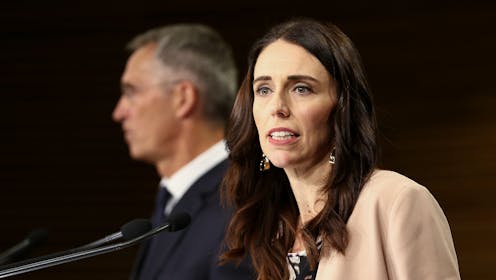
Prime Minister Jacinda Ardern’s acceptance of an invitation to speak at this week’s NATO leaders’ summit[1] in Madrid has fuelled a narrative that New Zealand’s independent foreign policy is falling victim to a new Cold War[2].
According to this view, Ardern’s participation is a reward for recently aligning New Zealand’s foreign policy more closely with the US[3] and its allies against Russia and, to a lesser extent, China.
This narrative claims this shift has been exemplified by sanctions against Putin’s Russia[4], humanitarian and military assistance[5] to Ukraine and public questioning of China’s growing involvement in the Pacific[6].
These developments purportedly show American power has forced New Zealand to abandon its preferred strategy of hedging between the two superpowers and instead follow Washington at the expense of its own national interests and the country’s crucial relationship with China.
But this reading of the current international situation and its impact on New Zealand foreign policy is wide of the mark.
There is no new Cold War
The post-Cold War era is fundamentally different from the period between 1947 and 1989 and its rival global economic systems and competing but comparable alliance systems. Those features simply do not exist in the globalising world of the 21st century.
China’s rise to superpower status has been based on full-blooded participation in the global capitalist economy and its dependence on key markets like America, the European Union and Japan.
At the same time, the Ardern government has distinctive reasons, beyond simply following America’s lead, for opposing Putin’s Ukraine invasion and expressing public reservations about the China-Solomon Islands security deal[7].
Since the second world war, New Zealand has been a firm supporter of a strengthened international rules-based order, enshrined in institutions such as the United Nations and embodied in norms such as multilateralism.
Read more: Ukraine war: Nato summit to meet in a world reordered by Russian aggression and Chinese ambition[8]
Putin’s invasion of Ukraine was a flagrant violation of the UN Charter[9]. It confirmed what has been clear for much of the post-Cold War era – the UN Security Council is no longer fit for purpose.
Ukrainian President Volodymyr Zelenskyy has pledged to campaign for a reformed Security Council that can more effectively hold aggression in check. The Ardern government believes it has a big stake in helping Kiev defeat Putin’s expansionism.
By framing concerns about China’s “militarisation” of the Pacific region as a possible breach of the 2000 Biketawa Declaration[10], the Ardern government is seeking to foster local resilience against China’s assertiveness in a region considered as New Zealand’s neighbourhood.
Read more: Ukraine might be far away, but a security crisis in Europe can still threaten Aotearoa New Zealand[11]
New Zealand’s worldview remains distinctive. It shares many of the concerns of close allies about the threat of authoritarian states to an international rules-based order. But it also rejects the view any great power should enjoy exceptional rights and privileges in the 21st century.
Here New Zealand’s foreign policy parts company with that of its traditional allies. New Zealand not only seeks to defend the international rules-based order, it wants to strengthen it.
New Zealand’s strategic positioning
There are other important strategic and economic reasons for Ardern to make this five-day visit to Europe.
She will have the chance to emphasise to so-called realists within NATO that ceding Ukrainian territory to Putin to bring peace is delusional, only likely to invite more territorial demands from the Kremlin.
China will also loom large in the discussions. Xi Jinping’s regime has diplomatically backed the Kremlin and recently declared Putin’s Ukraine invasion was “legitimate[12]”.
Ardern has said China should not be “pigeonholed[13]” with Moscow. But she will also be mindful a failure to strongly counter Putin’s assault on the rules-based order in Ukraine could increase China’s pressure to incorporate Taiwan, a state with vibrant trade and cultural ties with New Zealand.
Ardern should tell leaders in Madrid the best China strategy at this time is to make sure Putin’s invasion is rebuffed. If Putin’s army is defeated and ejected from Ukraine, it will be a serious blow to Xi’s leadership and could complicate any plans he might have for annexing Taiwan.
Chance to advance bilateral trade talks
The NATO meeting will also facilitate bilateral meetings with European leaders on some crucial trade questions.
In Brussels, Ardern and Trade Minister Damien O’Connor will seek to progress already advanced talks for a New Zealand-EU Free Trade Agreement (FTA). The EU single market remains the world’s largest and most prosperous. It offers New Zealand the prospect of enhanced trade links with an important like-minded partner.
In London, Ardern and O’Connor will meet UK Prime Minister Boris Johnson to build on a “gold-standard” New Zealand-UK FTA[14] negotiated earlier this year.
Read more: What New Zealand should win from its trade agreement with post-Brexit Britain[15]
The UK government has applied to join the Comprehensive Progressive Trans-Pacific Partnership (CPTTP[16]). Ardern may warn Johnson that breaching the EU withdrawal agreement in relation to the Northern Ireland protocols could jeopardise this goal.
Ardern’s participation in the NATO summit and bilateral discussions in Europe at a time of geopolitical uncertainty mirror New Zealand’s key national goals of promoting an international rules-based order and diversifying trade links.
References
- ^ NATO leaders’ summit (www.nato.int)
- ^ falling victim to a new Cold War (democracyproject.nz)
- ^ more closely with the US (www.nzherald.co.nz)
- ^ sanctions against Putin’s Russia (www.mfat.govt.nz)
- ^ humanitarian and military assistance (www.beehive.govt.nz)
- ^ China’s growing involvement in the Pacific (www.theguardian.com)
- ^ China-Solomon Islands security deal (www.newshub.co.nz)
- ^ Ukraine war: Nato summit to meet in a world reordered by Russian aggression and Chinese ambition (theconversation.com)
- ^ violation of the UN Charter (unsdg.un.org)
- ^ 2000 Biketawa Declaration (pacificsecurity.net)
- ^ Ukraine might be far away, but a security crisis in Europe can still threaten Aotearoa New Zealand (theconversation.com)
- ^ legitimate (www.smh.com.au)
- ^ pigeonholed (www.newshub.co.nz)
- ^ New Zealand-UK FTA (www.beehive.govt.nz)
- ^ What New Zealand should win from its trade agreement with post-Brexit Britain (theconversation.com)
- ^ CPTTP (www.mfat.govt.nz)










