


Drought increases rural suicide, and climate change will make drought worse
- Written by: Ivan Charles Hanigan, Director, WHO Collaborating Centre for Environmental Health Impact Assessment and Senior Lecturer in Climate Change and Health, , Faculty of Health Science, School of Population Health, Curtin University., Curtin University
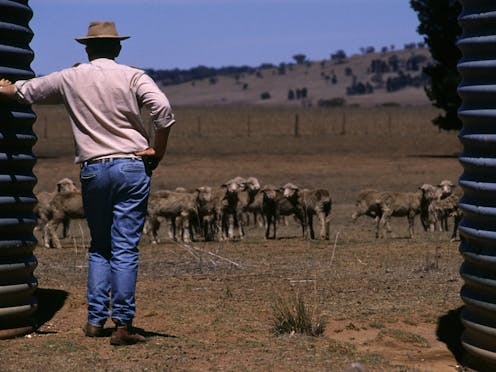
New research[1] has found suicide increases[2] during drought among men in Australia’s rural communities, and the problem may be exacerbated due to climate change.
Our findings call for urgent plans for adaptation, and global action to mitigate climate change and avoid impacts on vulnerable communities who are at risk of worsening natural hazards.
Read more: Farmer suicide isn't just a mental health issue[3]
What did our study find?
By looking at drought data and suicide data from 1971-2007, we found[4] suicides among working-age rural men increase as drought worsens.
We then used this correlation to calculate how many deaths can be attributed to drought in every month over the 37-year study period.
We used this statistic to calculate a total number of suicides, and because some years are drought years and some are not, we calculated an annual average figure. We found on average each year, 1.8% of suicides among rural working-age men could be attributed to drought.
We sought to quantify the risks of climate change under potential future scenarios, and its association with impacts to mental health.
We compared three climate models for New South Wales available from the Bureau of Meteorology and CSIRO, which estimated rainfall by month between 2006 and 2100. The three models ranged from the hottest and driest to a low-warming, wetter scenario.
Using the same method as above for calculating suicides due to drought for each of the climate change scenarios, we showed the annual average number of drought-related suicides under the driest future scenario would increase to 3.3%.
All three scenarios showed increasing drought and suicide levels, with the lower-warming/wetter scenario increasing the proportion to around 2%.
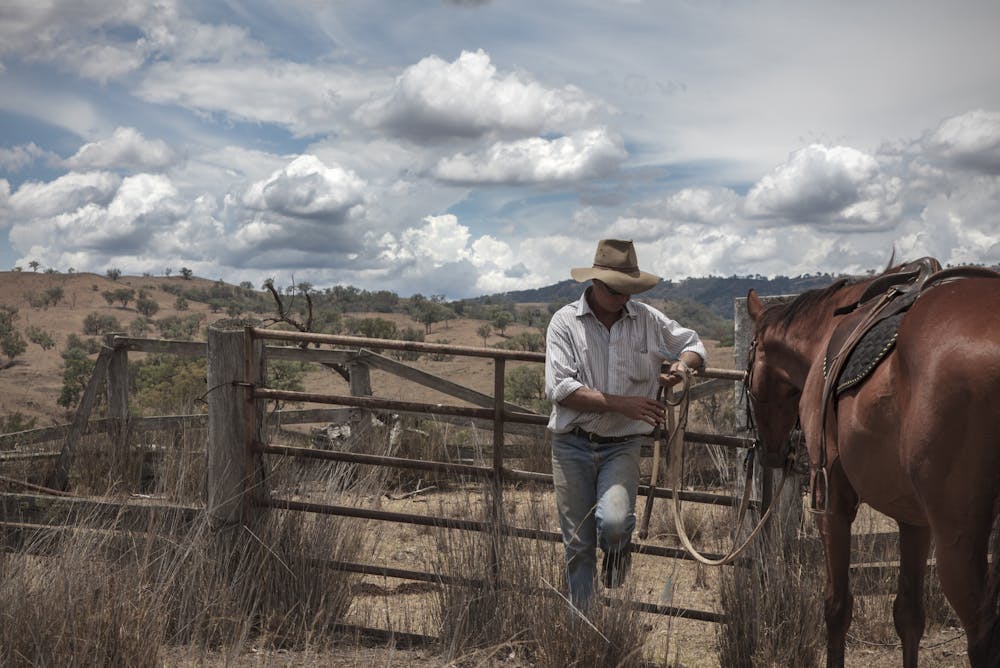
Read more: Bushfires, drought, COVID: why rural Australians' mental health is taking a battering[5]
Managed retreat is one option
Fourteen years ago, the federal government sponsored the Garnaut Climate Change Review[6], which investigated the mental health impacts of climate change in rural Australia. This report raised the unsettling concept of a “planned and orderly closure of community”.
It noted that for some high-risk rural communities, potential downturns in agriculture could be so substantial that farming may not be feasible. Extraordinary adaptation would be required as the communities may need to change the mix of their industry base to largely exclude agriculture or move away entirely.
There are precedents in Australia, including in agricultural and mining communities, of the abandonment of towns and farms. The best known is the retreat of farming north of the Goyder line[7] in South Australia in the 1880s, driven by a ten-year boom followed by drought and depressed wheat prices.
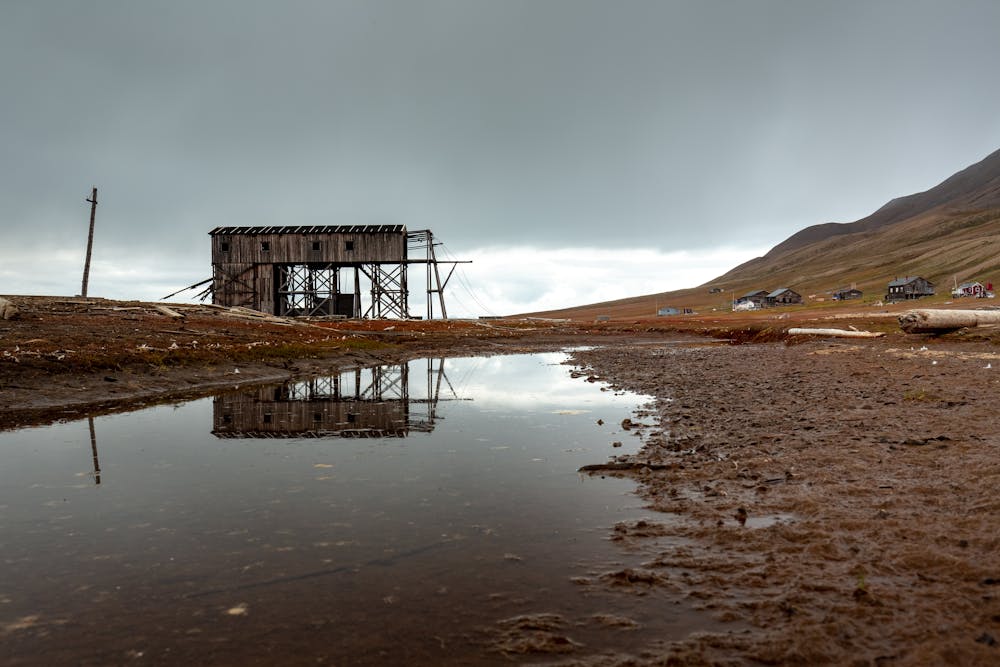 There are precedents of mining and agricultural towns being abandoned.
Shutterstock
There are precedents of mining and agricultural towns being abandoned.
Shutterstock
A forced retreat is a tragedy. Is it possible to design a planned and managed closure of such communities? Might this help prevent adverse mental health impacts due to climate change, or does it produce a different set of problems?
This dilemma is increasingly relevant globally, including to many low-lying coastal regions and small island developing states such as in the Pacific Islands. Not only are sea levels rising, so too is the rate of its rise[8].
Read more: Decline in young male suicide hides rise in remote areas[9]
Although adaptation in the form of sea walls enables millions of Dutch to continue living below sea level, such a response cannot be expanded on the required scale. Sea-level rise is already a reality in many Pacific communities, affecting drinking water and agriculture through saltwater intrusion into water tables and erosion and loss of land through inundation.
Mitigating climate change is the best option
It is clear that careful attention to interventions such as farm and town planning are an important part of adapting to climate change. We should avoid placing people in harm’s way. However, we should also put more effort into mitigation so we avoid the worst climate change scenarios entirely.
Governments should ensure we avoid runaway global warming through stronger national policies on reducing greenhouse gas concentrations in the atmosphere while also pursuing adaptation strategies such as investments that also build climate resilience across vulnerable communities. This would provide the co-benefit of preventing the public health burden due to climate change, of which suicides are but one example.
If this article has raised issues for you, or if you’re concerned about someone you know, call Lifeline on 13 11 14.
References
- ^ research (www.mdpi.com)
- ^ increases (www.pnas.org)
- ^ Farmer suicide isn't just a mental health issue (theconversation.com)
- ^ we found (www.mdpi.com)
- ^ Bushfires, drought, COVID: why rural Australians' mental health is taking a battering (theconversation.com)
- ^ Garnaut Climate Change Review (apo.org.au)
- ^ north of the Goyder line (doi.org)
- ^ so too is the rate of its rise (public.wmo.int)
- ^ Decline in young male suicide hides rise in remote areas (theconversation.com)










