


The Manly pride jersey furore is not as simple as a choice between inclusivity and homophobia
- Written by: Gina Louise Hawkes, Research associate, University of Wollongong
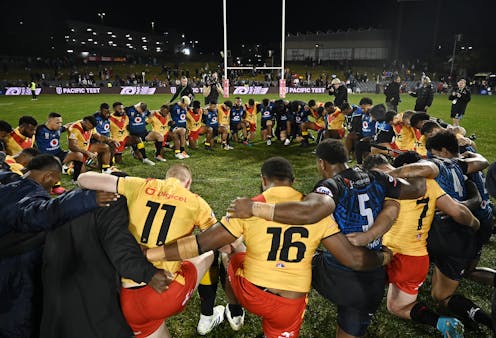
This week, seven NRL players boycotted a potentially crucial season game over their club’s introduction of a “pride” jersey celebrating inclusivity and the LGBTQIA+ community.
Six of these players are of Pacific Island heritage. There has been much discussion of the players’ culture and religion in the aftermath of the bungled jersey release. But as Fijian scholar Jioji Ravulo has argued[1], homophobia is not “part of” Pasifika cultures, but rather part of ongoing colonial legacies.
I have previously conducted research[2] on how “masculine” sports such as rugby league were used in the Pacific to promote the British ideology of “muscular Christianity”. This in turn helped create the contemporary relationship between family, faith and football for the Australian Pasifika diaspora.
In times like this, when high-profile sporting entities are thrown into the identity politics spotlight, it is important to try to understand some of the historical connections between the sport and gender and sexual diversity in the Pacific Islands.
What is ‘muscular Christianity’?
“Muscular Christianity” is the belief that by participating in sports, young men would become imbued with positive character traits enabling them to be as capable in the classroom or workforce as they were on the field. The concept migrated to the Pacific through British colonialists, particularly the British school boy system and its use of sports to create the “good” Christian.
While the field became a place men could let off steam, Indigenous men were often limited to this physical realm only and pushed away from intellectual pursuits, creating the manual workforce needed for Empire building. Māori scholar Brendan Hokowhitu’s work[3] shows how British colonialists in Aotearoa symbolically and physically moved Māori out of the classroom and into manual labour. This construction of Māori men as purely athletic was being similarly fostered across the Pacific, where the illusion of the “noble savage” was taking hold.
Read more: Explainer: the myth of the Noble Savage[4]
The impact of colonial masculinity
This colonial reframing of Pasifika masculinity also sought to classify “right” and “wrong”, particularly when it came to gender and sex. An important aspect of colonial masculinity was the suppression of sexual complexity and qualities that were deemed “feminine”.
In the Pacific Islands, this included introducing distinct boundaries between men and women, and the delegitimising of anything in between. Before colonialism, gender was understood in what we may think is a very modern, Western way, but what has actually been understood amongst many Indigenous cultures for centuries[5]: that is, a “gender spectrum” or the idea that there are many gender identities.
In Samoa and Tonga, for example, the gender fluid fa‘afafine and fakaleiti were merged with European understandings of homosexuality with such success that we now know very little about their roles pre-contact. At the same time, homosexuality was condemned as un-Christian, perverted and wrong – both symbolically, and in many cases, legally.
This combination of muscular Christianity, sports, and the moralisation of gender meant that to be a “good” man was to be not only strong and disciplined, but heterosexual and God-fearing.
Individual freedoms vs family and faith
In my interviews with second-generation Pasifika people in Australia, the phrase “faith before footy” was common. However, the nature of faith was changing, with family becoming more central than the institution.
Pasifika scholars have explained that rather than the individualistic philosophy of “I think therefore I am” governing how they see themselves, Pasifika and Māori people work more within a framework of “I belong therefore I am”.
Relationships are where strength and identity are created, which is what makes it so difficult to go against family beliefs. It might be hard for people who have a strong sense of individual freedom to comprehend the complex pull of family and faith to one’s very existence, but for many Pasifika people, not belonging could feel utterly catastrophic.
Sport has always been a political space, and in Australia it has a symbolic potency that makes it a powerful arena for spreading positive messages.
Hopefully the conversations this latest controversy has started outweigh the negative effects, particularly on young, vulnerable queer people. It is hoped we might soon reach a space where gender and sexual diversity in rugby league can be as celebrated as racial and ethnic diversity has been for some time.
With their large and conspicuous presence on the field, Pasifika people play a role in this, but it’s not solely their responsibility. It is up to the decision makers at all levels of the game to learn how to foster inclusion for all.










