savanna burning under Australia's carbon credit scheme is harming human health
- Written by: Penelope Jones, Research Fellow in Environmental Health, University of Tasmania
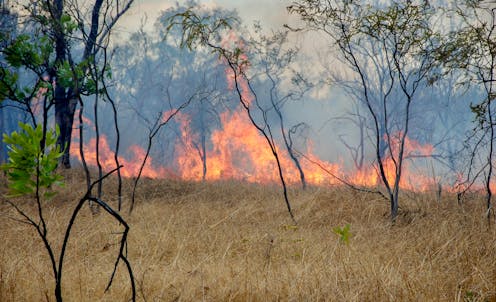
Savanna burning projects in northern Australia provide economic benefits[1] to Indigenous communities and claim to reduce[2] greenhouse gas emissions. But our research suggests smoke from these projects is harming human health.
Northern Australia’s savannas cover about 25%[3] of Australia’s land mass. They’re among the most flammable regions in the world and comprise 70%[4] of Australia’s fire-affected area each year.
Savanna fire management involves strategically burning grasslands early in the dry season, purportedly to reduce the chance of large, intense, more carbon-intensive fires later in the season. Under Australia’s Emissions Reduction Fund, land managers who undertake savanna burning receive financial rewards in the form of carbon credits.
But our research, focused on Darwin, has shown[5] savanna burning under the fund is making air pollution worse. A review[6] of the fund now underway must consider these unacceptable costs to human health.
The Top End’s smoke problem
Savanna fire management is currently a topic of substantial global interest – much of it stemming from its potential to reduce carbon emissions.
The underlying premise[7] is that early dry season burning releases fewer emissions than late dry season burning. This is because the fuel is moister and weather conditions milder — hence fires will be less extensive, less fuel will combust and less carbon will be released.
In Australia, savanna burning programs for carbon abatement were developed in the mid-2000s and integrated into the carbon market. Land managers are offered financial incentives to burn large amounts of savanna before the end of July[8] each year.
The scheme has proved popular: registered projects now cover some 25%[9] of Australia’s 1.2 million km² tropical savannas, including 55%[10] of land within 500km of Darwin.
Australia now touts itself as a world leader[11] in savanna burning. We are sharing the practice with other regions around the world, and savanna burning programs linked to carbon markets have been proposed elsewhere[12].
Yet the smoke pollution consequences of such programs are rarely considered. In Australia’s Top End, for example, thick and prolonged smoke blankets communities every dry season. Darwin, a city of 158,000 people, regularly exceeds[13] the Australian air quality standard for particulate matter.
In Darwin, smoky days bring more hospital admissions for lung and heart disease[14], and more emergency department presentations for asthma[15]. These impacts disproportionately[16] affect Indigenous people.
Almost all Darwin’s particulate pollution is caused by landscape fires. In the early dry season, almost all of this is generated by prescribed burning - and there’s been a marked increase in burning in recent years linked to carbon abatement schemes.
Read more: We blew the whistle on Australia's central climate policy. Here's what a new federal government probe must fix[17]
What our research found
Our research considered the relationship between prescribed burning and smoke pollution in Darwin from 2004 to 2019.
We first assessed the very small particles found in smoke known as PM2.5. We then analysed fire activity within a 500km radius, and assessed the links between pollution, weather and fire.
The results showed[18] air quality worsened in Darwin in the early dry season (particularly in June and July), with an increase in the annual number of severely polluted days.
Perhaps surprisingly, air quality did not change substantially in other seasons. In other words, shifting savanna burning to the early dry season did not appear to lead to better air quality later in the season.
Our findings highlight a complex story. Despite a substantial expansion of savanna burning for carbon abatement over our study period, net annual PM2.5 concentrations in Darwin did not decline. In fact, there was an increase in the number of times the national air quality standard was exceeded.
So what’s driving these results? One important factor involves large areas of savanna burned for carbon abatement to the southeast of Darwin in the early dry season. At that time of year, a steady south-easterly trade wind hits Darwin, bringing much of the smoke from these fires with it.
Fuel dynamics may also be at play. Native and non-native grasses which are highly flammable in the early dry season have been expanding[19] on frequently burned savannas. Higher temperatures may be drying fuel out earlier in the dry season. These factors may make early dry season fires as extensive and intense as savannas burnt later in the season.
Our research comes with caveats. For example, we drew only broad inferences about the geographic sources of smoke over Darwin. Notwithstanding this, our results clearly demonstrate Darwin’s already significant air quality problem is worsening, rather than improving, in association with increased early dry season burning.
Read more: Air pollution causes more than 3 million premature deaths a year worldwide[20]
A balancing act
None of this means savanna burning should cease, nor that traditional owners should not be paid to manage fire on country. But it does mean policies should be designed so unintended harm is minimised and the benefits are maximised.
Policymakers must consider how to regulate burning to avoid smoke pollution exposure. In Darwin, particular attention may be needed in locations southeast of the city. One solution may be to regulate how much smoke can be released in a specific area on a given day.
Other factors should be considered too. For example, savanna burning in Australia may[21] risk harming biodiversity[22].
But the Emissions Reduction Fund is a blunt tool which doesn’t consider these hidden costs and other[23] nuances[24].
The new Labor government has ordered an independent review of the fund. For this review to fulfil its brief[25], all unintended harms must be taken into account.
Read more: Australia’s central climate policy pays people to grow trees that already existed. Taxpayers – and the environment – deserve better[26]
References
- ^ economic benefits (www.sciencedirect.com)
- ^ reduce (esajournals.onlinelibrary.wiley.com)
- ^ about 25% (onlinelibrary.wiley.com)
- ^ comprise 70% (theconversation.com)
- ^ shown (link.springer.com)
- ^ review (www.theguardian.com)
- ^ underlying premise (www.cleanenergyregulator.gov.au)
- ^ July (www.cleanenergyregulator.gov.au)
- ^ 25% (www.sciencedirect.com)
- ^ 55% (link.springer.com)
- ^ world leader (www.minister.industry.gov.au)
- ^ elsewhere (www.nature.com)
- ^ exceeds (www.sciencedirect.com)
- ^ lung and heart disease (link.springer.com)
- ^ for asthma (www.mja.com.au)
- ^ disproportionately (ehjournal.biomedcentral.com)
- ^ We blew the whistle on Australia's central climate policy. Here's what a new federal government probe must fix (theconversation.com)
- ^ results showed (link.springer.com)
- ^ expanding (www.ncbi.nlm.nih.gov)
- ^ Air pollution causes more than 3 million premature deaths a year worldwide (theconversation.com)
- ^ may (pubmed.ncbi.nlm.nih.gov)
- ^ harming biodiversity (conbio.onlinelibrary.wiley.com)
- ^ other (www.publish.csiro.au)
- ^ nuances (onlinelibrary.wiley.com)
- ^ its brief (www.theguardian.com)
- ^ Australia’s central climate policy pays people to grow trees that already existed. Taxpayers – and the environment – deserve better (theconversation.com)