

Media coverage of Queen Elizabeth's death began well, but quickly descended into farce
- Written by: Denis Muller, Senior Research Fellow, Centre for Advancing Journalism, The University of Melbourne
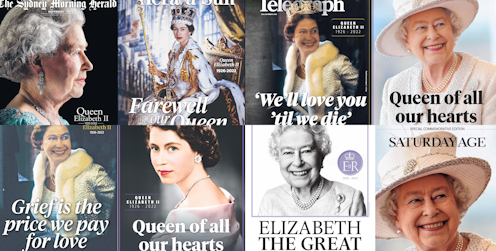
In Australia, as in Britain and the United States, professional mass media are part of the Establishment. This status even has its own name: the fourth estate. So at times like the death of Queen Elizabeth II, the pressure to conform to political and social expectations is intense.
Those expectations include treating such a story as being of overwhelming importance, and preferring to promote unity over divisiveness, respectfulness over criticism, the status quo over radical change, politesse over frankness, and sentimentality over hard-headedness.
It is a time when the fourth estate puts aside its fundamental role of holding power to account so as not to risk being pilloried for betraying those expectations.
The end result is what we have seen in abundance since Queen Elizabeth II died on September 8 2022. If it looks like a reflection of Establishment interests, that’s because it is.
But it is also, to an immeasurable but unmistakable extent, a reflection of public expectations too.
Queen Elizabeth was the only head of state any Australian not in their seventies has ever known. The esteem in which she was held has been obvious for many years simply by virtue of the accepted political wisdom that the prospect of Australians voting for a republic in her lifetime was nil.
It is only fair, then, that any critique of the coverage be set against the background of those realities.
The Australian media certainly treated this as a story of overwhelming importance. On the Friday and Saturday immediately following the Queen’s death this was amply shown by rolling television coverage, commemorative lift-outs and wraparounds in the newspapers, followed by extensive coverage on inside pages.
There is a fixed routine to covering events like this – a trunk story summarising the main news points, reaction from political leaders, tributes, stories of ordinary people’s encounters with the queen, a potted history of her reign, reminiscences of her visits to Australia. It was all there.
So was the shmaltzy tone. From the Sydney Morning Herald: her “lasting love for the harbour city” and “We did but see her passing by […]”.
However, there was also in the SMH and elsewhere clear-eyed analyses of the fragile state of the United Kingdom and the contrast between the two Elizabethan eras. In the late 16th century, England was growing into a mighty military and commercial power; the reign of Elizabeth II was a period of long-run decline.
Read more: The Queen has left her mark around the world. But not all see it as something to be celebrated[1]
A striking aspect of the television coverage was that on the Friday night, Seven’s and Nine’s news bulletins heavily outrated the ABC’s. OzTAM TV ratings, from Australia’s five biggest cities, showed Seven News attracting 852,000 viewers, Nine News 736,000 and the ABC’s Queen Elizabeth II (1926-2022), only 201,000.
Even allowing for the fact the commercial bulletins usually out-rate the ABC’s, on a story like this it might be expected that the national broadcaster would at least close the gap.
However, over the weekend none of the networks’ news specials attracted many viewers. Seven’s coverage of the proclamation of Charles III attracted 279,000, its tribute to the Queen 279,000, and the ABC’s continuing coverage 206,000.
There is a lesson here. Public expectations about how stories of overwhelming importance are covered have clearly shifted. Rolling television coverage now loses impetus swiftly unless there is new material continuously replenishing it, as with the September 11 attacks on the US or bushfire emergencies. The same lesson probably applies to the print media also.
The steam had started to go out of the royal story by Saturday evening. The death of the Queen and the proclamation of the King had been done.
By Sunday, the only development was the start of the journey bringing the Queen’s body from Balmoral Castle to London.
Read more: Beheaded and exiled: the two previous King Charleses bookended the abolition of the monarchy[2]
Yet the ABC’s 7pm bulletin stuck with this for 24 minutes, nearly all of it rehashed from the previous day, and on Monday the newspapers were still giving over six or more forward news pages to it.
The coverage has just got more bizarre and banal by the day: clouds containing visions of the queen’s head or the queen on a horse; the new king losing his temper over a leaky fountain pen; a little girl who dresses up like the queen when she rides her horse; another little girl cuddling a corgi.
Meanwhile, in Ukraine there has been a decisive thrust by Ukrainian forces, which has pushed the Russians out of a substantial part of the Donbas region.
There comes a point at which editors and news directors need to recognise that expectations about the big story have been met. That point was reached by Saturday evening. Then was the time to cut back hard and wait for the funeral.
The fact that thousands of dollars have been spent sending teams to London doesn’t justify clogging up the news with non-stories.










