why the monarchy is safe in Aotearoa New Zealand – for now
- Written by: Richard Shaw, Professor of Politics, Massey University
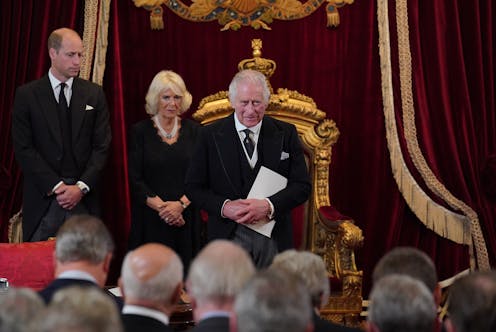
New Zealanders with republican or just plain anti-monarchy sympathies will have been disappointed (though maybe not surprised) that the Queen’s death has not triggered a more critical conversation about the country’s constitutional future.
Quite the opposite, in fact, if the prime minister is right. Far from representing a possible inflexion point in the nation’s post-Elizabethan development, Jacinda Ardern has suggested the nation’s close connection to the royal family would continue and strengthen[1] under Charles III.
If so, it would put New Zealand in the vanguard of colonial loyalty. Barbados[2], of course, has recently taken the republican route, as have 35 other former British colonies or dependencies. Antigua and Barbuda[3], Jamaica[4] and other Caribbean nations are setting off down that path, and there is also the prospect Australia[5] will join them at some point.
Indeed, of the 56 nations that are part of the Commonwealth, only 14 still retain the British monarch[6] as head of state.
And yet, despite the future of the monarchy fast becoming a subject of debate around the remainder of the Commonwealth, it seems unlikely that much republican chatter will be heard any time soon in Aotearoa New Zealand.
Republican residues
This lack of enthusiasm for a debate is a little perplexing. It’s not as if republicanism is unknown in Aotearoa[7]. The New Zealand Republican Party was even briefly (and unsuccessfully) involved in electoral politics in the late 1960s.
At the Labour Party’s 1973 national conference, a remit to declare the country a republic was debated but scuttled. And in 1994, then prime minister Jim Bolger suggested New Zealand should look to achieve republican status by 2001. He was clearly ahead of his time.
There has been at least one more recent attempt to get the republican ball rolling. In late 2009, Green MP Keith Locke had his Head of State Referenda Bill[8] drawn from the parliamentary ballot.
Read more: From evolving colony to bicultural nation, Queen Elizabeth II walked a long road with Aotearoa New Zealand[9]
Had Locke’s bill been successful (it wasn’t, dipping out at the first reading by 15 votes), there would have been a referendum on remaking the governor-general as the ceremonial head of a parliamentary (rather than a presidential) republic.
And it is not that New Zealand isn’t constitutionally innovative or reluctant to have constitutional conversations. In 1951, it jettisoned its second parliamentary chamber[10] and in the mid-1990s adopted proportional representation[11] for national elections.
Debates about the place of Te Tiriti o Waitangi[12] are a regular feature of public life, in which consideration has long been given to alternative constitutional structures[13] that fit Aotearoa’s unique history and society.
Constitutional consistency
There may be several reasons why republicanism has not captured the public mood here the way it has elsewhere[14]. For a start, there are simply always more pressing political priorities – right now including the cost of living[15], entrenched income[16] and wealth[17] inequalities, and the return of inflation[18].
Not many prime ministers would voluntarily expend political capital on a debate few New Zealanders appear to find especially relevant.
Read more: Charles III: the difficult legacy and political significance of the new king's name[19]
Second, it may be that in an age of political polarisation, the idea of a head of state who is not only unelected but also happens to live a long way away[20] appeals to those for whom politics has become distastefully partisan. In trying times, the pull of tradition and constancy is strong for some people.
A third reason lies in the significance of the relationship between Māori and the Crown, provided for by the cornerstone of the nation’s constitutional architecture, Te Tiriti o Waitangi.
The particulars of that relationship are hotly debated[21], but there is a view that replacing the Crown (as an institution) with something homegrown would disrupt the partnership it represents. The Crown may well be the historic coloniser, but for that very reason it is the Crown which must engage in the conversation about decolonisation.
If not now, when?
Of course, there are many New Zealanders for whom republicanism makes perfectly good sense. In part, that’s because, since the advent of responsible government in 1856, “the Crown” has effectively meant the political executive, not the person of the monarch. It is the prime minister and cabinet who govern, not the head of state.
There is, too, the basic weirdness of retaining a monarch who becomes head of state by virtue of having been born into one very particular English family[22] domiciled on the other side of the world.
Read more: How Queen Elizabeth II made the British monarchy into a global brand[23]
Which means, of course, that no actual New Zealander (nor for that matter anyone who is not a Protestant[24]) can ever be the head of state of New Zealand. (Happily those proscriptions do not apply to the monarch’s representative, the governor-general[25].)
This quirk of history notwithstanding, there is little to suggest the accession of a new monarch is about to generate a wave of republican sentiment in Aotearoa. And yet, the republican conversation has already been held in India, Barbados and Fiji, and is well under way across the Caribbean.
When and if that discussion heats up in Australia[26] again, the promise – or spectre – of republicanism will be right next door. By then, memories of a monarch who ruled over the end of empire for 70 years will have started to fade. All bets will be off.
References
- ^ continue and strengthen (www.theguardian.com)
- ^ Barbados (www.aljazeera.com)
- ^ Antigua and Barbuda (www.reuters.com)
- ^ Jamaica (www.essence.com)
- ^ Australia (www.theguardian.com)
- ^ retain the British monarch (www.newsroom.co.nz)
- ^ republicanism is unknown in Aotearoa (www.republic.org.nz)
- ^ Head of State Referenda Bill (www.parliament.nz)
- ^ From evolving colony to bicultural nation, Queen Elizabeth II walked a long road with Aotearoa New Zealand (theconversation.com)
- ^ jettisoned its second parliamentary chamber (www.parliament.nz)
- ^ proportional representation (www.theguardian.com)
- ^ Te Tiriti o Waitangi (www.nzstory.govt.nz)
- ^ alternative constitutional structures (nwo.org.nz)
- ^ the way it has elsewhere (www.essence.com)
- ^ cost of living (www.stats.govt.nz)
- ^ income (www.parliament.nz)
- ^ wealth (www.wgtn.ac.nz)
- ^ return of inflation (www.stats.govt.nz)
- ^ Charles III: the difficult legacy and political significance of the new king's name (theconversation.com)
- ^ long way away (www.distance.to)
- ^ hotly debated (www.newsroom.co.nz)
- ^ very particular English family (www.theguardian.com)
- ^ How Queen Elizabeth II made the British monarchy into a global brand (theconversation.com)
- ^ not a Protestant (www.royal.uk)
- ^ the governor-general (gg.govt.nz)
- ^ heats up in Australia (www.independent.co.uk)