Government announces inquiry into childcare costs, while Chalmers promises 'conversation' about budget challenges
- Written by: Michelle Grattan, Professorial Fellow, University of Canberra
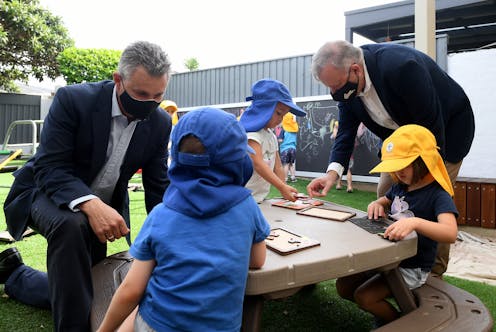
The Albanese government will set up an inquiry into the increasing cost of child care, which will start in January and run for a year.
Childcare costs have risen by 41% over the last eight years.
The inquiry will be done by the Australian Competition and Consumer Commission. Next month’s budget will include $10.8 million to fund it. Government sources emphasised the probe would be very rigorous and operators would be put on the spot to explain high fees.
Meanwhile treasurer Jim Chalmers on Tuesday announced the budget outcome for the financial year just ended will be nearly $50 billion better than anticipated at the time former treasurer Josh Frydenberg’s delivered his budget in March. But Chalmers insisted this was largely due to temporary factors and next month’s budget would be difficult.
Figures (to be finalised and released in detail next week) would show a deficit for 2021-22 of “a little bit north of $30 billion” – compared with the earlier projected deficit for 2021-22 approaching $80 billion.
Chalmers said the deficit in the October budget for the current financial year was expected to be higher than last financial year’s outcome.
Labor’s more generous child care scheme starts mid-next year, and is being promoted by the government as both easing cost-of-living pressures and encouraging workforce participation. The government resisted pressure from some participants at the jobs summit to bring the start forward to January. It said that would be both expensive and present operational difficulties.
Next week Education Minister Jason Clare will introduce the legislation for the scheme, which Labor promises will make childcare more affordable for 96% of families with children in the system.
Chalmers said Labor’s plan would cheapen childcare for more than a million families. This meant “parents will be able to work more hours if they want to”.
“It shouldn’t cost parents more than they earn to put their kids through childcare. But for many families, that’s the challenge they face – when it’s sometimes cheaper to stay at home and take care of the kids than it is to go to work.”
Chalmers said for many families, childcare costs were “an incredible burden” and it was “important that we deliver responsible cost-of-living relief that delivers a long-term benefit to our economy”.
Clare said the cost of childcare was ‘a massive disincentive to work more hours or more days.
“At the moment about 60% of mothers of children under six who work, do part-time hours. A lot of Australians would want to work more, but if they did all of that pay would be gobbled up by the childcare bill. It means it’s not worth it.”
Giving an outline of the budget outcome and prospects at a news conference with Finance Minister Katy Gallagher, Chalmers said the almost $50 billion improvement in the deficit “is welcome, but the bulk of it is driven by temporary factors”.
In 2021-22 there had been an improvement in revenue of about $28 billion, while on the outlays side, the improvement was about $20 billion from lower than budgeted payments.
There had been a “substantial but temporary lift in taxes”, and commodity prices remained higher for longer than expected. And “billions of dollars that were promised weren’t delivered”.
There had been “a one-off boost in revenues from lower take-up of COVID business support measures – which has the effect of boosting revenues last year, but lowering them in the out-years compared to what was expected because of the accumulation of the deductions that businesses accumulate.”
“The large payment underspends are all about delays in COVID-related spending including the procurement of vaccines and PPE, also delays in infrastructure spending arising from supply chain disruptions and industry constraints, as well as lower payments across health and social security.”
Chalmers said commodity prices had already begun to drop, while much of the undelivered spending would spill over into this financial year and into subsequent years.
The government is set to ditch some of the former government’s undelivered commitments where it can but some will flow through to the coming budget.
Chalmers reaffirmed the petrol excise cut will end next week, but said prices should not immediately reflect the full amount of the restoration because a lot of petrol was in storage.
“There are hundreds of millions of litres of fuel underground in tanks that was purchased at the lower price,” he said. “And so the ACCC and the government expect that the price of petrol shouldn’t shoot up at the bowser on Wednesday night by the full 23 cents if the normal market pressures are in operation.”
Chalmers said the October budget would be “pretty standard”.
But, agreeing with sentiments expressed by Reserve Bank Governor Phil Lowe last week, Chalmers also said “we need to have a national discussion about the structural position of the budget, and how we fund the expectations that Australians legitimately have”.
He pointed to “the five big growing areas of spending in the budget, which are creating pretty substantial structural concerns – health, NDIS, aged care, defence, and the cost of servicing a trillion dollars in debt – all of those costs are growing fast.
"And that’s a combination of the unavoidable and the desirable, and so we do need to have a conversation about that.
"The first budget in October will be pretty standard, pretty solid, a bread-and-butter budget. But there are multiple opportunities in multiple budgets over the course of the next three years or so, for us to properly engage the people in a proper national conversation about the services that we provide, and how we fund them.”