

Peppa Pig has introduced a pair of lesbian polar bears, but Aussie kids’ TV has been leading the way in queer representation
- Written by: Damien O'Meara, PhD Candidate, Media and Communications, Swinburne University of Technology
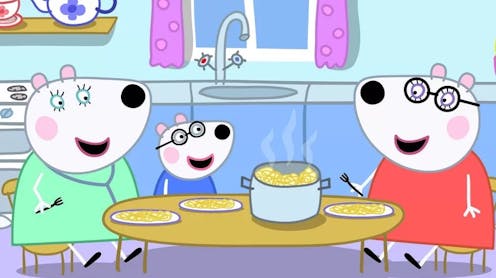
Peppa Pig’s first same-sex couple, a pair of lesbian polar bears, were recently introduced after a petition to include a same-sex family[1] received nearly 24,000 signatures.
Children’s television has often been a place to push the boundaries of diverse representations onscreen. In particular, Australian children’s TV has been a global leader in screen diversity, including gender and queer representation.
Emmy-winning Australian series First Day[2] (2020-22) tells the story of a transgender girl starting high school.
Another Emmy-winner, Hardball[3] (2019-21) includes gay dads for one of the lead characters.
Even recent updates to The Wiggles’ line-up has placed a greater emphasis on gender diversity, including adding a non-binary unicorn[4].
Diverse representation
Children’s TV is often less risk averse than programming aimed at adults.
The ABC is empowered[5] to take risks with representations of gender and sexuality in children’s programming because of its publicly funded role.
But such progressive portrayals can sometimes chafe with outdated expectations of children’s television. In 2004, Play School faced controversy[6] for showing lesbian mothers.
As social acceptance has progressed, Australian children’s TV has been able to achieve more queer representations.
Talking to the Queering Australian Screens research project[7], television professionals often praised the genre for its openness to new ideas, representations and bringing in new talent.
Tony Ayres, Creator of Nowhere Boys[8] (2013-18), observed those who commission children’s TV are “generally very open to diverse representation”.
This representation happens behind the scenes, too, with Ayres describing how these shows often give new talent their first credit.
David Hannam, who has written for several kids’ TV shows including Dance Academy[9] (2010-13), said children’s television “has led the way”.
Speaking of his time at the Australian Children’s Television Foundation, Hannam noted the foundation had an “almost charter responsibility” to show diversity on screen, “with great caution and responsibility”.
Julie Kalceff created First Day, which starred a young trans actor, Evie McDonald, as a trans girl starting high school.
When she was developing the show, Kalceff shared that she was initially concerned about what would be allowed on children’s TV:
There were no trans people on television. There were no TV shows with trans actors in the lead role. I thought there’s no way the ABC is going to do this. And there’s no way they’re going to do it with kids’ TV. But to their credit, the ABC was so supportive, and was so behind the project from the beginning.
What audiences want
It is not only TV producers who are eager to widen representation in children’s television. Audiences are also seeking out more inclusive content.
Just like Peppa Pig in the UK, there have been calls in Australia for more diversity in animated hit Bluey, with the show adding its first Auslan signing character[10] in June.
One of our research projects, Australian Children’s Television Cultures’ 2021 survey[11] found 90% of Australian parents believe diverse representation is an important element of children’s TV.
As one father explained:
Diversity on screen helps children learn about people with different upbringings from their own, expanding their empathy for and curiosity about other people.
In contrast to the controversy Play School received nearly 20 years ago for its inclusion of same-sex parents, a mother praised the show for “doing a fantastic job” of depicting diversity in relationships.
Not everyone believes Australian television is doing enough. One survey respondent praised the way shows like Bluey reflect Australian culture, but said he would “love to see more LGBT representation […] It would be nice as a kid to know you’re valid.”
Uncertain futures
The streaming era has changed how families and children watch TV. This raises concerns about the future of Australian children’s content.
The recent removal of quotas[12] for Australian networks to air a minimum number of hours of children’s television, alongside the absence of quotas on streaming services, has led to a reduction[13] in the production of local kids’ TV.
From Play School to Bluey, children’s TV has reflected the richness of Australian cultural life. There is a risk that if Australian child audiences need to rely on international content, future generations will not see themselves on screen.
With the loss of local voices, Australian kids’ TV may also lose its ability to push boundaries of diversity and inclusion.
Read more: Cheese 'n' crackers! Concerns deepen for the future of Australian children's television[14]
We are conducting a survey of parents and guardians with children aged up to 14 about how families watch kids’ TV in the streaming era. You can participate here[15].
References
- ^ a petition to include a same-sex family (www.theguardian.com)
- ^ First Day (www.imdb.com)
- ^ Hardball (www.imdb.com)
- ^ adding a non-binary unicorn (www.news.com.au)
- ^ empowered (journals.sagepub.com)
- ^ faced controversy (www.tandfonline.com)
- ^ research project (djomeara.com)
- ^ Nowhere Boys (en.wikipedia.org)
- ^ Dance Academy (en.wikipedia.org)
- ^ first Auslan signing character (10play.com.au)
- ^ 2021 survey (www.swinburne.edu.au)
- ^ removal of quotas (theconversation.com)
- ^ a reduction (tvtonight.com.au)
- ^ Cheese 'n' crackers! Concerns deepen for the future of Australian children's television (theconversation.com)
- ^ here (swinuw.au1.qualtrics.com)










