Federal Labor's honeymoon continues in Resolve poll; can the Liberals regain office without those 'lefties'?
- Written by: Adrian Beaumont, Election Analyst (Psephologist) at The Conversation; and Honorary Associate, School of Mathematics and Statistics, The University of Melbourne
A federal Resolve poll[1] for Nine newspapers, conducted October 5-9 from a sample of 1,604, gave Labor 39% of the primary vote (steady since September), the Coalition 30% (down two), the Greens 12% (up two), One Nation 5% (down one), the UAP 3% (up one), independents 9% (up one) and others 2% (down one).
Resolve does not give a two party estimate until close to elections, but using 2022 election preference flows gives Labor a 59-41 lead, a two-point gain for Labor since the September poll.
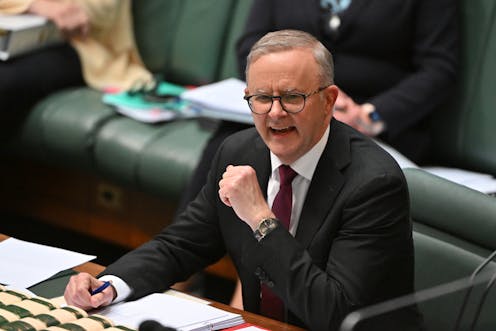
On Prime Minister Anthony Albanese, 60% thought he was doing a good job and 24% a poor job, for a net approval of +36, unchanged since September. Opposition Leader Peter Dutton’s net approval was -10, up two points. Albanese led Dutton by 53-18 as preferred PM (53-19 in September).
Labor led the Liberals by 36-30 on economic management[2] (33-30 in September). On keeping the cost of living low, Labor led by 30-20 (31-23 previously).
The polling now is not predictive of the next election that is due by 2025, but for the moment Labor’s honeymoon is continuing.
Tax and spending questions
Respondents were told that the federal budget was in deficit[3], and that this is needed to maintain current levels of spending, but means the national debt is increasing. 37% thought we should reduce spending to end deficits earlier, 14% increase taxes and 28% live with the debt and deficit levels.
Asked to select the top priority for spending reduction, 33% chose defence, 14% the NDIS, 11% the health system and 4% aged care.
By 38-20, voters supported “delivering on the stage 3 tax cuts in 2024, which would mean everyone earning between $45,000 and $120,000 per year would pay a single 30% income tax rate”. This does not mention high-income earners would benefit most, and so is a skewed question.
By 34-13, voters supported repealing stage three if the government were to increase tax revenue. But increasing the corporate tax rate (61-10 support) and an increased tax on resource companies’ profits (56-9 support) were far more popular.
I previously covered[4] polling of both the Indigenous Voice to parliament and the republic in the last Resolve poll. The Voice led by 64-36, while the republic trailed by 54-46.
Essential poll: Australia ‘not doing enought’ on climate change drops
In last week’s Essential poll[5], conducted in the days before October 4 from a sample of 1,050, 43% thought Australia was not doing enough to address climate change (down four since May), 32% thought we were doing enough (steady), and 13% doing too much (up two). The Coalition was still in government at the May poll.
By 63-21, respondents said they had not been personally affected by the recent Optus data breach. 53% said they were very concerned about scammers being able to steal their identities to access their bank accounts.
By 51-29, respondents supported stronger restrictions on the amount of personal infromation companies can collect, and by 46-27 they supported more restrictions on governments collecting personal information.
Respondents were pessimistic about the future of humanity, with more undecided at longer time intervals. Asked whether life would be better or worse for humanity in ten years, worse led by 42-33. At 100 years, worse led by 39-28. At 1,000 years, worse led by 36-22. At 10,000 years, worse led by 35-20.
Australia Institute poll: support for axing stage three tax cuts
Dynata conducted a survey for the left-wing Australia Institute[6] in early September from a sample of 1,409. By 41-22, respondents supported Labor repealing the stage three income tax cuts. 46% said high-income earners would benefit most from these cuts, 18% middle-income earners and just 8% low-income earners.
Respondents were read a brief statement about the stage three tax cuts, and asked which was more important: keeping election promises regardless of changes in economic circumstances, or adapting economic policy to suit changing circumstances even if that means breaking an election promise. By 61-27, respondents supported the latter proposition.
A new poll for The Australia Institute[7], conducted October 4-7 from a sample of 1,003, had support for scrapping the stage three tax cuts up seven from September to 48%, with opposition unchanged at 22%.
Morgan poll: 55-45 to Labor
In last week’s Morgan poll[8], Labor led by 55-45 from polling conducted September 26 to October 2. This was a 0.5-point gain for Labor since the previous week, and Labor’s best result in this poll since the election.
Can the Liberals regain government without those ‘lefties’?
Federal Liberal vice-president Teena McQueen recently told the Australian Conservative Political Action Conference that: “The good thing about the last federal election is a lot of those lefties are gone. We should rejoice in that.”
Read more: View from The Hill: Without those 'lefties' the Liberals can't regain government[9]
At the May federal election, the seats held by more moderate Liberals in inner metro regions were lost to teal independents. It will be difficult for the Coalition to regain these seats as independents, once established in a seat, are usually re-elected easily.
However, as I said in my article on the final results of the election[10], the Coalition’s best chance to regain government in 2025 is if economic conditions are lousy, and they can win outer metro seats from Labor.
The next election probably depends on the outer metro, not the inner metro. The Coalition can do without its inner city moderates if it wins the rest of Australia by a large enough margin.
There may be a long-term electoral problem for the Coalition: Australia’s population is far more concentrated in cities than either the United States or the United Kingdom. I argued before the election that this urban concentration helps Labor, and the election results validated this argument.
Read more: Will a continuing education divide eventually favour Labor electorally due to our big cities?[11]
Polls understated Bolsonaro at Brazilian election
I covered the October 2 first round of the Brazilian presidential election for The Poll Bludger[12]. The leftist Luiz Inácio Lula da Silva (called “Lula”), who was president from 2003 to 2010, led the far-right inucmbent Jair Bolsonaro by a 48.4-43.2 margin. But as nobody won over 50%, it goes to an October 30 runoff between Lula and Bolsonaro. Pre-election polls understated Bolsonaro’s support.
I wrote about the November 8 US midterm elections on September 30, at which Democratic gains have recently stalled. Meanwhile, UK Labour has seized a huge poll lead after a “horror” budget was delivered by the Conservatives on September 23.
Read more: US Democrats' gains stall six weeks before midterm elections; UK Labour seizes huge lead after budget[13]
Dire polling has continued for the Conservatives: in eight UK national polls[14] taken since October 5, Labour has led by 21 to 32 points.
References
- ^ Resolve poll (www.theage.com.au)
- ^ economic management (www.smh.com.au)
- ^ federal budget was in deficit (www.theage.com.au)
- ^ previously covered (theconversation.com)
- ^ Essential poll (essentialreport.com.au)
- ^ Australia Institute (australiainstitute.org.au)
- ^ The Australia Institute (australiainstitute.org.au)
- ^ week’s Morgan poll (www.roymorgan.com)
- ^ View from The Hill: Without those 'lefties' the Liberals can't regain government (theconversation.com)
- ^ final results of the election (theconversation.com)
- ^ Will a continuing education divide eventually favour Labor electorally due to our big cities? (theconversation.com)
- ^ The Poll Bludger (www.pollbludger.net)
- ^ US Democrats' gains stall six weeks before midterm elections; UK Labour seizes huge lead after budget (theconversation.com)
- ^ eight UK national polls (en.wikipedia.org)