


How young Iranian women have long led a quiet revolution
- Written by: Nasim Salehi, Senior Lecturer and Course Coordinator, Southern Cross University
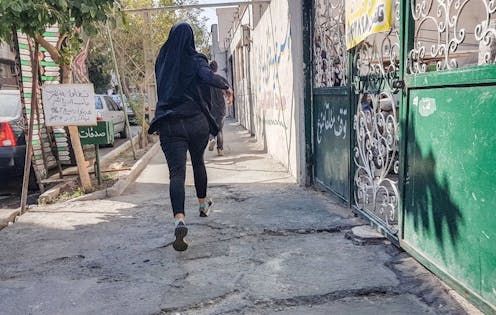
The “Women, Life, Freedom” movement that has taken hold in Iran in recent weeks is not new. Young Iranian women have been involved in small but consistent evolutionary actions during the entire 44 years of the Islamic Republic of Iran, particularly in the past two decades.
The initial movement goes back to the Iranian Revolution of 1979, the year radical Islamic groups took power. Street protests, the so-called “evolution toward revolution[1]”, have accelerated since 2017.
In all these movements, women have been courageous and bold. Key demonstrations include:
- student protest on the closure of a reformist newspaper[2] (1999)
- protest[3] about the irregularities in the presidential election (2009)
- protest against the government’s economic policies (2017-2018)
- Bloody November (2019)/Bloody Aban (2020) protests[4], caused by the significant increase in fuel prices.
Young Iranian women position themselves as agents of social change. They are not, as they are often represented outside Iran, powerless victims. They have always been at the forefront of breaking down social boundaries and taboos.
They have been fighting[5] to enhance their social status through education and career development.
They believe in evolution (small yet strong and consistent change), rather than sudden revolution (temporary and unsustainable change). The idea is that incremental change can lead to another unsuccessful revolution, such as in 1979.
In our research[6], we spoke to 391 women aged 18-35 from Shiraz, one of the biggest cities in Iran. We found that their evolutionary actions can be captured by key themes: they may seem ordinary, but they represent what young Iranian women are fighting for. They are not looking for something extraordinary. They only want to exercise some level of control over their basic rights.
1. Developing multiple identities. Young Iranian women must manage multiple identities due to the oppressive system. They feel their values, behaviour and actions are not aligned – and not truly free – because of the contradictory expectations their society places on them. They feel they are not always free to be their true selves.
They have used the creation of multiple identities as a coping strategy to be accepted by their society in different stages of their lives, from childhood to university, marriage and working life. As one young woman in our research observed:
Iranian women always should jump from a barrier [to achieve the most obvious rights they have], the barrier of traditional families, the barrier of (morality) police, the barrier of culture.
Another participant said:
My fake identity has been the dominant identity and I have not had a chance to be the real me.
2. Building digital freedom. Iranian women use social media to engage in national and international online social protest groups, exchange information and generate ideas on how to tackle social challenges in their society. Despite the government’s active crackdown on international social media platforms, young Iranians still find innovative ways of accessing them.
Social media have increased social, cultural and political awareness among the young generation, and this appears to be increasing the gap between younger and older generations of the country. One woman told us:
Although satellite TV and some of the social networks [such as Facebook] are banned in Iran, young generations try to have access, using different anti-filters.
3. Creating a unique style of dressing. Research has found[7] that most young Iranians are against mandatory hijab. It is not a cultural issue in Iran, but rather a very restrictive and radical Islamic law, which is one of the key foundations of the Islamic Republic of Iran.
The regime assumes that if the rules around mandatory hijab break down, other pillars of the Islamic Republic will be in danger. So protests against hijab – as we are seeing in Iran – challenge the legitimacy of the regime.
Read more: Iran: 'hijab' protests challenge legitimacy of Islamic Republic[8]
Young Iranian women have a high level of education and awareness, respecting different cultures, beliefs, religions and dress codes. They only want to have freedom of choice. As one woman told us: “Islamic leaders want us to hide our beauty.”
A recent study[9] found the majority of Iranians (58%) did not believe in the practice of wearing hijab. Only 23% agreed with the compulsory hijab, which is respected by the rest of the population: people do not want hijab abolished, they just want freedom of choice.
Read more: Iran protests: majority of people reject compulsory hijab and an Islamic regime, surveys find[10]
4. Creating hidden leisure opportunities. Young Iranian women try to create more opportunities to express the enjoyable yet hidden parts of their life. As one woman said:
We prefer to stay at home and have our gatherings and parties in private places, as we find indoor activities more interesting because we don’t have the limitations of dressing, drinking, female-male interactions.
5. Changing social and sexual relationships. Our research found Iranian women believe the limitations on social and sexual relationships can result in psychological and social health issues. In addition, they believe limitations on relationships before marriage can result in unsuccessful marriages.
Young Iranian women use different strategies to keep their relationships. One specific example is the creation of “white marriage[11]” – where a man and a woman live together without passing the Islamic process of marriage in Iran.
In many of these movements, Iranian women also find support from men (despite the general perception), particularly in the young generations, who equate a push for gender equality and women’s rights with a more democratic society.
They know that fighting for gender equality is everyone’s job, to enhance awareness and bring about change. There can be no democracy without first respecting women’s rights and restoring their dignity and freedom.
References
- ^ evolution toward revolution (jia.sipa.columbia.edu)
- ^ closure of a reformist newspaper (www.rferl.org)
- ^ protest (www.nytimes.com)
- ^ protests (guitinews.fr)
- ^ been fighting (www.sciencedirect.com)
- ^ our research (www.sciencedirect.com)
- ^ has found (theconversation.com)
- ^ Iran: 'hijab' protests challenge legitimacy of Islamic Republic (theconversation.com)
- ^ recent study (theconversation.com)
- ^ Iran protests: majority of people reject compulsory hijab and an Islamic regime, surveys find (theconversation.com)
- ^ white marriage (www.berghahnjournals.com)










