quiet hour shopping makes us wonder why our cities have to be so noisy
- Written by: Eduardo de la Fuente, Adjunct Senior Lecturer, Justice and Society, UniSA, University of South Australia
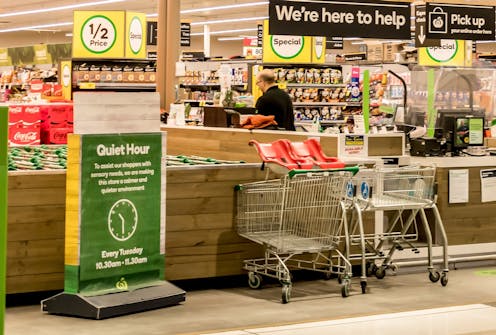
The idea behind “quiet hour” shopping is to set aside a time each week for a retail experience that minimises noise and other sources of sensory overload. It is aimed at people who are neurodivergent[1] – an umbrella term for people with autism, ADHD and other sensory-processing conditions.
What began as a boutique or specialist retail strategy has become more mainstream. Major supermarket[2] chains[3] and shopping centres[4] in Australia and overseas have introduced it in recent years.
In newly published research[5] we explored quiet hour as an aspect of the impacts of sound on how people experience city life. As expected, we found it did benefit people who are neurodivergent. But other people also welcomed the relief from sensory overload once they’d overcome the feeling of having wandered into an eerily quiet “post-apocalyptic scene”.
Our work has made us question the acceptance of urban noise and light as being part and parcel of a vibrant city.
Read more: Contested spaces: you can't stop the music – the sounds that divide shoppers[6]
What does quiet hour involve?
Quiet hour is intended to make retail spaces more inclusive or sensory-friendly. Its features include retailers or mall managers agreeing to:
switch automatic doors to open
pause collection of trolleys
turn off the PA and music
fix flickering lights and turn off as much lighting as practicable
remove scented reeds and pause automatic scent dispensers
switch off hand dryers
turn down the volume on checkout scanners.
One of the tools we used for mapping quiet hour was a thematic analysis[7] of reports about it in Australian print media from 2017 to 2019. We found the following themes:
an emphasis on the kinds of discomforts associated with retail environments
the importance of providing a “low-sensory environment” as a form of inclusion
while lighting was often mentioned, the main recurring theme was the reduction of sound.
Why does reducing sound matter?
Sound and sensory hypersensitivity are important themes in neurodivergent people’s accounts of how they struggle with everyday experiences others take for granted.
Leading autism researcher and advocate Sandra Thom-Jones writes[8] that neurodivergents’ sensitivity to sound is complex. It’s affected by “what the sound actually is, how loud it is, whether I am expecting it, and whether I can control it”.
People might assume everyone has the ability to frame which sounds are important[9] and which are “irrelevant to what we are listening to or doing”. However, the ability to single out sound sources and block out background noise is a major point of differentiation between neurotypicals and neurodivergents.
Thom-Jones, who received her autism diagnosis at age 52, reports[10] that when she is “in an environment with multiple sounds” she tends to “hear all of them”.
Thus, when she is catching up with a friend in a café, she may be “listening intently” to what her friend is saying but she will also be “hearing the piped music, the people talking at the next table, cars driving past, the coffee machine”.
Read more: Autistic people can hear more than most – which can be a strength and a challenge[11]
Others welcome quiet hour too
Given how neurodivergents process sound, quiet hour is likely to increase their sense of comfort in retail spaces.
However, quiet hour also suspends or – to use a term coined by Erving Goffman[13] – “rekeys” the sensory frames[14] of all shoppers. A quiet hour could benefit lots of people who may not have a specific condition but simply prefer a quieter retail environment.
Read more: Wired by sound: the long-term impacts of constant noise[15]
We found this is an under-researched area, but did find anecdotal accounts to suggest this. Take the case[16] of New Zealand actress and author Michelle Langstone.
She reports visiting stores across Auckland and Rotorua that offer quiet-hour shopping. She stumbled upon it by “sheer luck”. At first, she admits, it felt “a bit like a post-apocalyptic scene”.
Once she adjusted to the unfamiliar sensory environment, she felt herself succumbing to changed supermarket routines:
“I cruised every single [aisle], taking in the quiet for nearly 45 minutes, at the end of which I felt a kind of meditative peace come over me.”
Langstone also reports[17] avoiding impulse buying. That first time she left with “only [the] bread and eggs” she had gone to the shop for. She was able to focus on shopping rather than “multi-tasking”, and quiet hour left her with a “feeling of goodwill towards all shoppers”.
In other words, even if the strategy is about levelling the sensory playing field for neurodivergents, it seems to change the shopping experience[18] for other people too.
Why the bias towards the noisy city?
As researchers interested in sound and space, quiet hour made us reflect on how we think about these issues and our attitudes to noise. It made us question, for example, why one of the most cited texts in our field is entitled Noise: The Political Economy of Music[19]?
Read more: Let cities speak: what sounds define us now?[20]
Studies of silence or quietude are rare in urban or spatial studies. One has to turn to fields such as the study of meditation practices[21] or the silence associated with nature or sacred spaces[22] to find positive accounts of reduced noise.
This needs correcting. Sound intensity matters if cities, buildings or public spaces are to foster hospitality and “support people in their activities by facilitating their stay[23]”.
What quiet hour teaches us is that an inclusive or welcoming city is a city that “resonates[24]” with different kinds of minds, bodies and styles of sensory processing.
Quiet hour might therefore be both an inclusion strategy and an experiment that forces us to think more deeply about our cities and how they sound.
References
- ^ neurodivergent (www.weforum.org)
- ^ supermarket (www.coles.com.au)
- ^ chains (www.woolworthsgroup.com.au)
- ^ shopping centres (insideretail.com.au)
- ^ research (journals.sagepub.com)
- ^ Contested spaces: you can't stop the music – the sounds that divide shoppers (theconversation.com)
- ^ thematic analysis (journals.sagepub.com)
- ^ writes (www.mup.com.au)
- ^ frame which sounds are important (www.taylorfrancis.com)
- ^ reports (www.mup.com.au)
- ^ Autistic people can hear more than most – which can be a strength and a challenge (theconversation.com)
- ^ Lisa Fotios/Pexels (www.pexels.com)
- ^ Erving Goffman (www.google.com.au)
- ^ sensory frames (onlinelibrary.wiley.com)
- ^ Wired by sound: the long-term impacts of constant noise (theconversation.com)
- ^ case (thespinoff.co.nz)
- ^ reports (thespinoff.co.nz)
- ^ change the shopping experience (onlinelibrary.wiley.com)
- ^ Noise: The Political Economy of Music (www.upress.umn.edu)
- ^ Let cities speak: what sounds define us now? (theconversation.com)
- ^ meditation practices (journals.sagepub.com)
- ^ nature or sacred spaces (www.wiley.com)
- ^ support people in their activities by facilitating their stay (www.metrolab.brussels)
- ^ resonates (www.wiley.com)