New electric cars for under $45,000? They're finally coming to Australia – but the battle isn't over
- Written by: Hussein Dia, Professor of Future Urban Mobility, Swinburne University of Technology
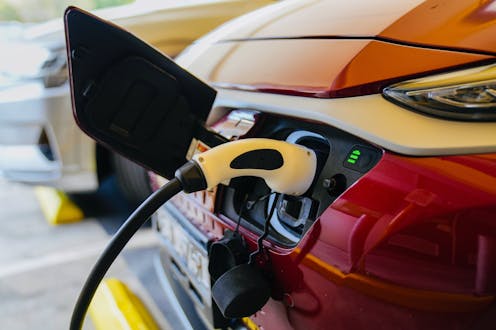
If you’re shopping for an electric vehicle in Australia at the moment, your options are limited. Of more than 300[1] electric vehicle models on sale globally, only about 30[2] are available here.
What’s more, waiting lists[3] for vehicles are long and the purchase cost is still higher than many consumers are willing to pay.
Australia might now have a federal government with stronger climate ambition than the last. But major new policies are still needed to accelerate the road transport transition.
There’s good news, however: Australian motorists have been promised more choice soon. So let’s take a look at the cars we might be driving in the next few years.
Why make the switch?
Transport is Australia’s third-largest[4] – and fastest growing – source of greenhouse gas emissions. Cars are responsible for the greatest share of these emissions.
Most of Australia’s vehicle fleet uses polluting fossil fuels. A switch to electric vehicles, coupled with a transition to renewable energy, is vital if Australia is to meet its commitments[5] to tackle climate change.
Electric vehicles are also cheaper to run than their traditional counterparts, and don’t rely on expensive imported fuel.
Despite all the benefits, electric vehicle uptake in Australia is still low. They accounted for just 3.39%[6] of new vehicle sales (or 26,356 cars in total) to September this year, according to the Electric Vehicle Council of Australia.
It’s an increase on last year, but still well below other nations. In the UK, for example, 19% of new cars sold are electric.
The ACT buys the most electric vehicles (9.5% of new vehicles) followed by New South Wales (3.7%), Victoria (3.4%), Queensland (3.3%), Tasmania (3.3%), Western Australia (2.8%), South Australia (2.3%) and the Northern Territory (0.8%).
Read more: A rapid shift to electric vehicles can save 24,000 lives and leave us $148bn better off over the next 2 decades[7]
Which electric vehicles are we buying?
Almost 40% of new battery electric vehicle sales this year were Tesla Model 3[8] (8,647 sales) and 25% were Tesla Model Y[9] (5,376 sales). Other top-selling models include the Hyundai Kona[10] (897 sales), MG ZS EV[11] (858 sales) and Polestar 2[12] (779 sales).
Less than 20% of vehicles sold had a purchase price below $65,000.
The Porsche Taycan, one of the most expensive electric vehicles on the market, was in 11th place with 401 sales. Its price ranges from[13] $156,000 to more than $350,000, depending on the model grade.
Some buyers are yet to receive the cars they purchased. Supply shortages mean consumers can wait 11 months[14] for their vehicle.
But despite the frequent delays, consumers keep placing orders. Hyundai recently offered[15] 200 of its Ioniq 5 electric SUVs for sale online; they were snapped up within 15 minutes.
Price is a sticking point
Clearly, some Australians are willing to buy an electric vehicle despite the price tag. But the purchase cost remains a big concern for others.
In a recent survey[16], more than half of Australian respondents preferred electric vehicles over fossil fuel cars – but 67% said price was the main barrier preventing them from making the switch.
Only 13% were willing to spend between $45,000 and $54,999 on an electric car.
In another survey of around 1,000 Australians[17], about 72% said they would budget less than $40,000 for their next car purchase.
But few battery electric vehicles cost less than $55,000, and many cost more than twice this. Others are nearly 60% more expensive[18] than their petrol-powered counterparts.
Choice coming soon
Carmakers have promised a suite of new battery electric vehicles will soon be available in Australia.
Two are expected to be the among the cheapest[19] new battery electric vehicles available here: the Atto 3[20] by carmaker BYD and MG’s updated ZS compact SUV[21].
Both will be available for less than $50,000 including on-road costs. The MG model is the cheaper[22] of the two, at $44,990 for the Excite variant.
Other models expected to arrive[23] in the next two years[24] include the Aiways U5 SUV[25], Fiat 500e[26], Kia Soul[27], Peugeot e-2008[28], Skoda Enyaq[29], Toyota bZ4x[30] and Volkswagen ID series[31].
The Chinese LDV electric ute[32] is already on sale in New Zealand and may be on Australian roads by the end of this year. It remains to be seen, however, if electric utes and vans will be embraced[33] by Australia’s tradespeople.
What policy settings are needed?
Clearly, Australia needs more affordable[34] mid- and low-end electric vehicles. But one key policy setting is holding us back: the lack of mandatory fuel efficiency standards for road transport vehicles.
Australia is the only country[35] in the OECD without such a policy. The standards help drive demand for low-emissions vehicles – so electric vehicle manufacturers often prefer to sell into those markets[36].
Car importers also tend to promote top-end models[37] first because they have higher profit margins.
Meanwhile globally, competition between manufacturers of cheaper battery electric vehicles is expected to intensifying. Multinational automakers in China[38] have been gearing up. Their lineup of new models is already selling in international markets.
Heavy trucks[39] are also ripe for electrification, and progress[40] has been rapid in recent years. Broad deployment in Australian will accelerate emissions cuts and improve air quality.
The road ahead
Electric vehicles are not the total solution to cutting transport emissions. We also need strategies[41] to change our travel behaviour, reduce the number of cars on the roads and improve walkability and access to public transport.
But electric vehicles are a crucial piece of the puzzle. To improve their uptake in Australia, policymakers can draw from a range of effective electric vehicle policies[42] that can be adapted from other nations. They include investment in charging stations and providing financial incentives to buy and run electric vehicles.
Australians want to drive electric vehicles, and governments must respond. Without a variety of affordable electric vehicles, Australia’s dependence on fossil fuels will deepen, and reaching our emissions reduction goals will become harder.
Read more: Four ways our cities can cut transport emissions in a hurry: avoid, shift, share and improve[43]
References
- ^ more than 300 (theconversation.com)
- ^ about 30 (www.carexpert.com.au)
- ^ waiting lists (www.theguardian.com)
- ^ third-largest (www.pwc.com.au)
- ^ commitments (www.pm.gov.au)
- ^ just 3.39% (electricvehiclecouncil.com.au)
- ^ A rapid shift to electric vehicles can save 24,000 lives and leave us $148bn better off over the next 2 decades (theconversation.com)
- ^ Tesla Model 3 (zecar.com)
- ^ Tesla Model Y (zecar.com)
- ^ Hyundai Kona (zecar.com)
- ^ MG ZS EV (zecar.com)
- ^ Polestar 2 (zecar.com)
- ^ ranges from (www.carexpert.com.au)
- ^ 11 months (zecar.com)
- ^ recently offered (thedriven.io)
- ^ recent survey (www.comparethemarket.com.au)
- ^ 1,000 Australians (www.savvy.com.au)
- ^ 60% more expensive (www.drive.com.au)
- ^ cheapest (www.carexpert.com.au)
- ^ Atto 3 (zecar.com)
- ^ ZS compact SUV (mgmotor.com.au)
- ^ cheaper (mgmotor.com.au)
- ^ expected to arrive (www.whichcar.com.au)
- ^ next two years (www.drive.com.au)
- ^ Aiways U5 SUV (www.carsguide.com.au)
- ^ Fiat 500e (www.drive.com.au)
- ^ Kia Soul (www.carsguide.com.au)
- ^ Peugeot e-2008 (www.carsales.com.au)
- ^ Skoda Enyaq (www.drive.com.au)
- ^ Toyota bZ4x (www.carexpert.com.au)
- ^ Volkswagen ID series (thedriven.io)
- ^ LDV electric ute (www.drive.com.au)
- ^ will be embraced (www.abc.net.au)
- ^ more affordable (www.carsguide.com.au)
- ^ only country (theconversation.com)
- ^ those markets (www.reuters.com)
- ^ top-end models (thedriven.io)
- ^ Multinational automakers in China (www.transportenvironment.org)
- ^ Heavy trucks (thedriven.io)
- ^ progress (www.theguardian.com)
- ^ strategies (theconversation.com)
- ^ effective electric vehicle policies (www.iea.org)
- ^ Four ways our cities can cut transport emissions in a hurry: avoid, shift, share and improve (theconversation.com)