The Times Australia
Google AI
The Times World News

.

Exploring the mathematical universe – connections, contradictions, and kale

  • Written by Joan Licata, Associate Professor, Mathematics, Australian National University
Exploring the mathematical universe – connections, contradictions, and kale

Science and maths skills are widely celebrated as keys to economic and technological progress, but abstract mathematics may seem bafflingly far from industrial optimisation or medical imaging. Pure mathematics often yields unanticipated applications, but without a time machine to look into the future, how do mathematicians like me choose what to study?

Over Thai noodles, I asked some colleagues what makes a problem interesting, and they offered a slew of suggestions: surprises, contradictions, patterns, exceptions, special cases, connections. These answers might sound quite different, but they all support a view of the mathematical universe as a structure to explore.

In this view, mathematicians are like anatomists learning how a body works, or navigators charting new waters. The questions we ask take many forms, but the most interesting ones are those that help us see the big picture more clearly.

Making maps

Mathematical objects come in many forms. Some of them are probably quite familiar, like numbers and shapes. Others might seem more exotic, like equations, functions and symmetries.

Instead of just naming objects, a mathematicians might ask how some class of objects is organised. Take prime numbers: we know there are infinitely many of them, but we need a structural understanding to work out how frequently they occur or to identify them in an efficient way.
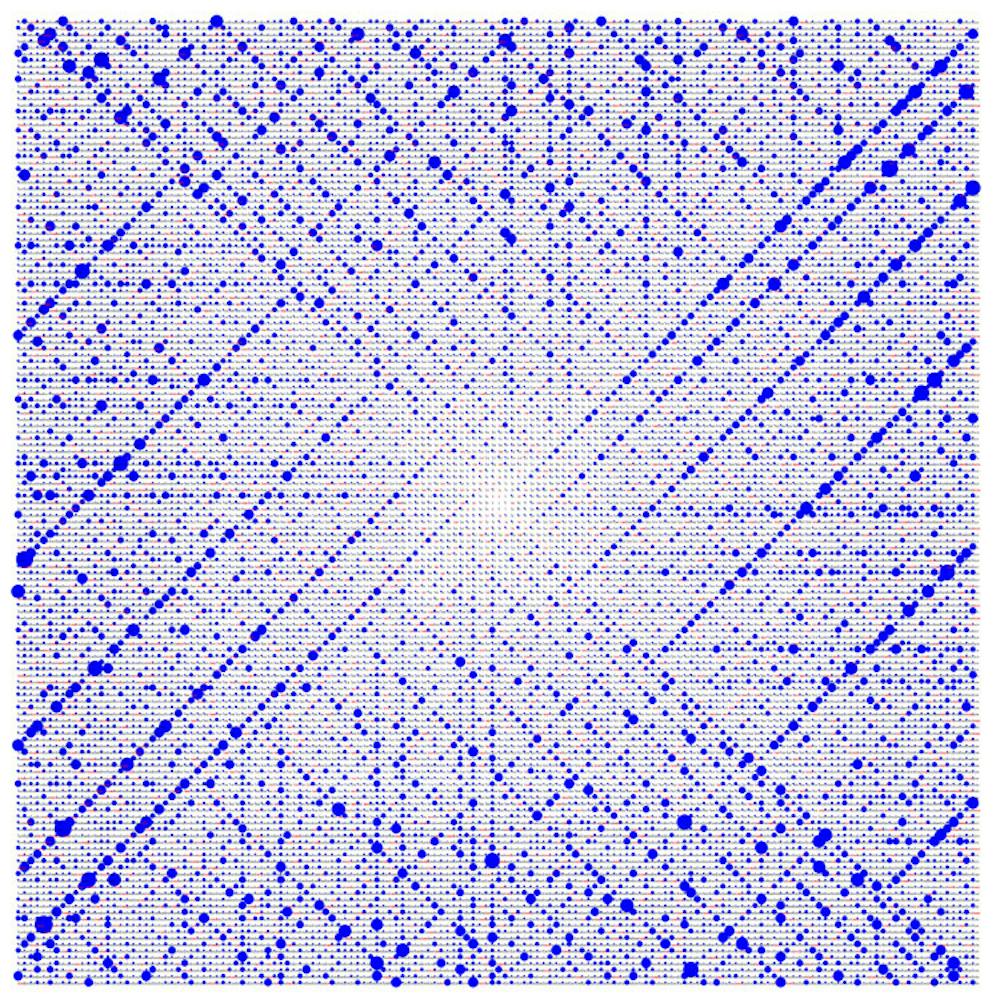
A grid of blue dots
The ‘Ulam spiral’ reveals some structure in the primes. If you arrange the counting numbers in squares spiralling outward, it becomes clear that many prime numbers fall on diagonal lines. Wikimedia Commons, CC BY-SA[1][2]

Other good questions explore relationships between apparently different objects. For example, shapes have symmetry, but so do the solutions to some equations.

Classifying objects and finding connections between them help us assemble a coherent map of the mathematical world. Along the way, we sometimes encounter surprising examples that defy the patterns we’ve inferred.

Such apparent contradictions reveal where our understanding is still lacking, and resolving them provides valuable insight.

Consider the triangle

The humble triangle provides a famous example of an apparent contradiction. Most people think of a triangle as the shape formed by three connecting line segments, and this works well for the geometry we can draw on a sheet of paper.

However, this notion of triangle is limited. On a surface with no straight lines, like a sphere or a curly kale leaf, we need a more flexible definition.

Read more: Pythagoras’ revenge: humans didn’t invent mathematics, it’s what the world is made of[3]

So, to extend geometry to surfaces that aren’t flat, an open-minded mathematician might propose a new definition of a triangle: pick three points and connect each pair by the shortest path between them.

This is a great generalisation because it matches the familiar definition in the familiar setting, but it also opens up new terrain. When mathematicians first studied these generalised triangles in the 19th century, they solved a millennia-old mystery and revolutionised mathematics.

The parallel postulate problem

Around 300 BC, the Greek mathematician Euclid wrote a treatise on planar geometry called The Elements. This work presented both fundamental principles and results that were logically derived from them.

One of his principles, called the parallel postulate, is equivalent to the statement that the sum of the angles in any triangle is 180°. This is exactly what you’ll measure in every flat triangle, but later mathematicians debated whether the parallel postulate should be a foundational principle or just a consequence of the other fundamental assumptions.

This puzzle persisted until the 1800s, when mathematicians realised why a proof had remained so elusive: the parallel postulate is false on some surfaces.


Image showing that a triangle on the surface of a sphere will have angles that add up to more than 180°, but on a hyperbolic surface will add up to less than 180°.
CC BY-ND[4] On a sphere, the sides of a triangle bend away from each other and the angles add up to more than 180°. On a rippled kale leaf, the sides bow in towards each other and the angle sum is less than 180°. Triangles where the angle sum breaks the apparent rule led to the revelation that there are kinds of geometry Euclid never imagined. This is a deep truth, with applications in physics, computer graphics, fast algorithms, and beyond. Salad days People sometimes debate whether mathematics is discovered or invented, but both points of view feel real to those of us who study mathematics for a living. Triangles on a piece of kale are skinny whether or not we notice them, but selecting which questions to study is a creative enterprise. Interesting questions arise from the friction between patterns we understand and the exceptions that challenge them. Progress comes when we reconcile apparent contradictions that pave the way to identify new ones. Today we understand the geometry of two-dimensional surfaces well, so we’re equipped to test ourselves against similar questions about higher-dimensional objects. Read more: Corals, crochet and the cosmos: how hyperbolic geometry pervades the universe[5] In the past few decades we’ve learned that three-dimensional spaces also have their own innate geometries. The most interesting one is called hyperbolic geometry, and it turns out to act like a three-dimensional version of curly kale. We know this geometry exists, but it remains mysterious: in my own research field, there are lots of questions we can answer for any three-dimensional space … except the hyperbolic ones. In higher dimensions we still have more questions than answers, but it’s safe to say that study of four-dimensional geometry is entering its salad days. References^ Wikimedia Commons (en.wikipedia.org)^ CC BY-SA (creativecommons.org)^ Pythagoras’ revenge: humans didn’t invent mathematics, it’s what the world is made of (theconversation.com)^ CC BY-ND (creativecommons.org)^ Corals, crochet and the cosmos: how hyperbolic geometry pervades the universe (theconversation.com)

Read more https://theconversation.com/exploring-the-mathematical-universe-connections-contradictions-and-kale-196053

Times Magazine

AI is failing ‘Humanity’s Last Exam’. So what does that mean for machine intelligence?

How do you translate ancient Palmyrene script from a Roman tombstone? How many paired tendons ...

Does Cloud Accounting Provide Adequate Security for Australian Businesses?

Today, many Australian businesses rely on cloud accounting platforms to manage their finances. Bec...

Freak Weather Spikes ‘Allergic Disease’ and Eczema As Temperatures Dip

“Allergic disease” and eczema cases are spiking due to the current freak weather as the Bureau o...

IPECS Phone System in 2026: The Future of Smart Business Communication

By 2026, business communication is no longer just about making and receiving calls. It’s about speed...

With Nvidia’s second-best AI chips headed for China, the US shifts priorities from security to trade

This week, US President Donald Trump approved previously banned exports[1] of Nvidia’s powerful ...

Navman MiVue™ True 4K PRO Surround honest review

If you drive a car, you should have a dashcam. Need convincing? All I ask that you do is search fo...

The Times Features

What the RBA wants Australians to do next to fight inflation – or risk more rate hikes

When the Reserve Bank of Australia (RBA) board voted unanimously[1] to lift the cash rate to 3.8...

Do You Need a Building & Pest Inspection for New Homes in Melbourne?

Many buyers assume that a brand-new home does not need an inspection. After all, everything is new...

A Step-by-Step Guide to Planning Your Office Move in Perth

Planning an office relocation can be a complex task, especially when business operations need to con...

What’s behind the surge in the price of gold and silver?

Gold and silver don’t usually move like meme stocks. They grind. They trend. They react to inflati...

State of Play: Nationals vs Liberals

The State of Play with the National Party and How Things Stand with the Liberal Party Australia’s...

SMEs face growing payroll challenges one year in on wage theft reforms

A year after wage theft reforms came into effect, Australian SMEs are confronting a new reality. P...

Evil Ray declares war on the sun

Australians love the sun. The sun doesn't love them back. Melanoma takes over 1,300 Australian liv...

Resolutions for Renovations? What to do before renovating in 2026

Rolling into the New Year means many Aussies have fresh plans for their homes with renovat...

Designing an Eco Conscious Kitchen That Lasts

Sustainable kitchens are no longer a passing trend in Australia. They reflect a growing shift towa...