Our Solar System is filled with asteroids that are particularly hard to destroy, new study finds
- Written by: Fred Jourdan, Professor, Curtin University
A vast amount of rocks and other material are hurtling around our Solar System as asteroids and comets. If one of these came towards us, could we successfully prevent the collision between an asteroid and Earth?
Well, maybe. But there appears to be one type of asteroid that might be particularly hard to destroy.
Asteroids are chunks of rocky debris in space, remnants of a more violent past in our Solar System. Studying them can reveal their physical properties, clues about the ancient history of the Solar System, and threats these space rocks may pose by impacting with Earth.
In our new study published today in the Proceedings of the National Academy of Sciences[1], we discovered that rubble pile asteroids are an extremely resistant type of asteroid and hard to destroy by collision.
Read more: An asteroid just buzzed past Earth, and we barely noticed in time[2]
Two main types of asteroid
Mainly concentrated in the asteroid belt, asteroids can be classified into two main types.
Monoliths – made from one solid chunk of rock – are what people usually have in mind when they think about asteroids. Monolithic-type asteroids about a kilometre in diameter have been predicted to have a lifespan of only a few hundred millions of years in the asteroid belt[3]. This is not long at all given the age of our Solar System.
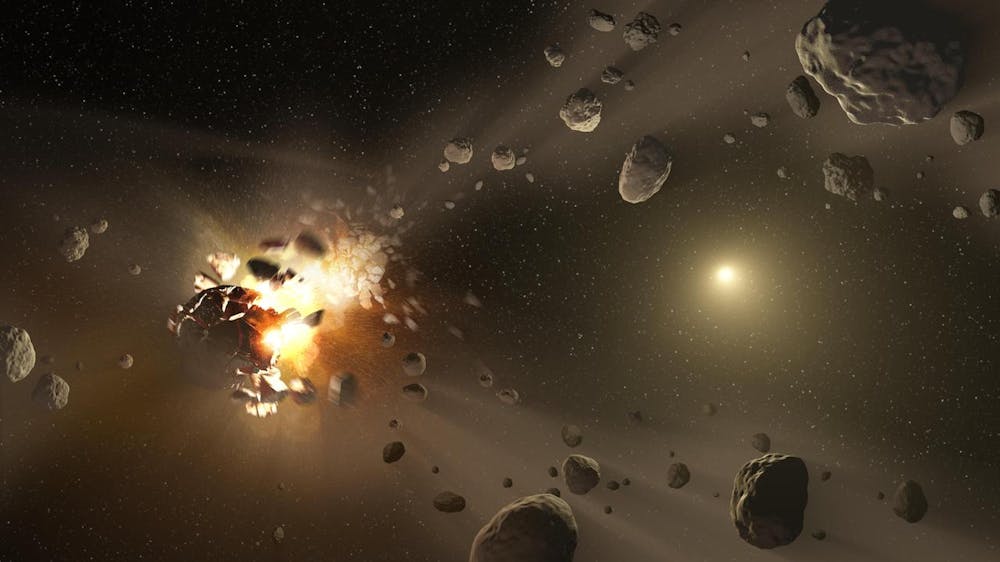
The other type are rubble pile asteroids[6]. These are entirely made up of lots of fragments ejected during the complete or partial destruction of pre-existing monolithic asteroids.
However, we don’t really know the durability, and therefore the potential lifespan, of rubble pile asteroids.
Sneaky and abundant rubble piles
In September 2022, NASA’s DART mission[7] (Double Asteroid Redirection Test) successfully impacted the asteroid Dimorphos[8]. The goal of this mission was to test if we could deflect an asteroid by impacting it with a small spacecraft, and it was a resounding success.
Read more: NASA's asteroid deflection mission was more successful than expected. An expert explains how[9]
Like other recent asteroid missions by the Japan Aerospace Exploration Agency[10] (JAXA) to visit asteroids Itokawa[11] and Ryugu[12], and by NASA to asteroid Bennu[13], close-up images have shown that Dimorphos is yet another rubble pile asteroid.
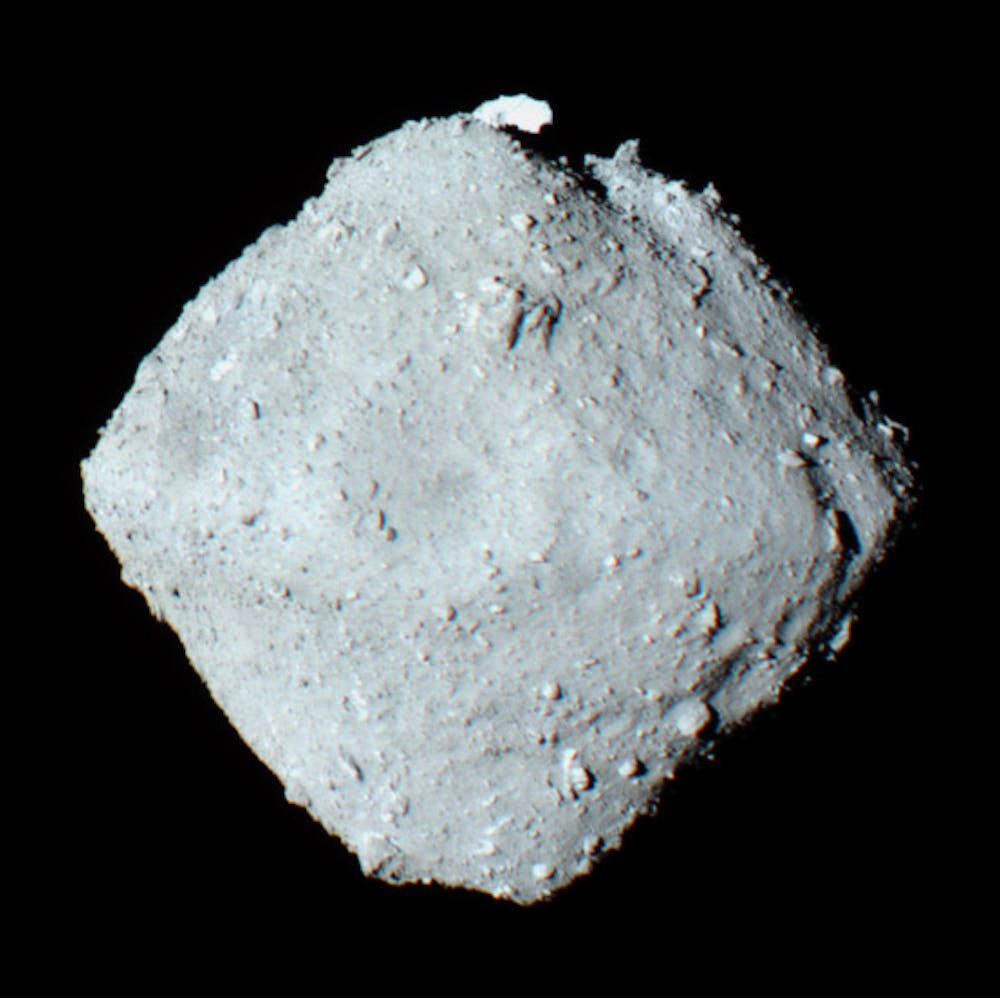 The much-studied Ryugu asteroid – classified as potentially hazardous – is also a rubble pile.
JAXA/Hayabusa2, CC BY[14]
The much-studied Ryugu asteroid – classified as potentially hazardous – is also a rubble pile.
JAXA/Hayabusa2, CC BY[14]
Those missions showed us that rubble pile asteroids have a low density because they are porous. Also, they are abundant. In fact, they are very abundant, and since they are the shattered bits of monolithic asteroids, they are relatively small, and thus hard to spot from Earth.
Hence, such asteroids represent a major threat for Earth and we really need to understand them better.
Learning from asteroid dust
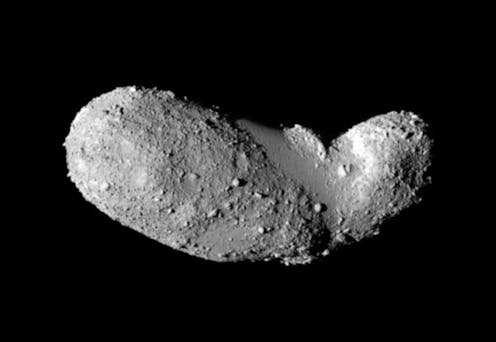
In 2010, the Hayabusa spacecraft designed by JAXA returned from the 535-metre long, peanut-shaped asteroid Itokawa[15]. The probe brought with it more than a thousand particles of rocks, each one smaller than a grain of sand. Those were the first-ever samples brought back from an asteroid!
As it then turned out, the pictures taken by the Hayabusa spacecraft while it was still orbiting Itokawa demonstrated the existence of rubble pile asteroids for the first time.
Early results by the team at JAXA who analysed the returned samples showed Itokawa formed after the complete destruction of a parent asteroid which was at least 20 kilometres large[16].
In our new study, we analysed several dust particles returned from asteroid Itokawa using two techniques: the first one fires an electron beam at the particle and detects electrons that get scattered back. It tells us if a rock has been shocked by any meteor impact.
The second one is called argon-argon dating[17] and uses a laser beam to measure how much radioactive decay happened in a crystal. It gives us the age of such a meteor impact.
Read more: Asteroid dust brought back to Earth may explain where our water came from with hydrogen clues[18]
Giant space cushions that last forever
Our results established that the huge impact that destroyed Itokawa’s parent asteroid and formed Itokawa happened more than 4.2 billion years ago, which is almost as old as the Solar System itself.
That result was totally unexpected. It also means Itokawa has survived almost an order of magnitude longer than its monolith counterparts.
Such an astonishingly long survival time for an asteroid is attributed to its shock-absorbent nature. Due to being a rubble pile, Itokawa is around 40% porous. In other words, almost half of it is made of voids, so constant collisions will simply crush the gaps between the rocks, instead of breaking apart the rocks themselves.
So, Itokawa is like a giant space cushion.
This result indicates rubble pile asteroids are much more abundant in the asteroid belt than we once thought. Once they form, they appear to be very hard to destroy.
This information is critical to prevent any potential asteroid collision with Earth. While the DART mission was successful in nudging the orbit of the asteroid it targeted, the transfer of kinetic energy between a small spacecraft and a rubble pile asteroid is very small. This means they are naturally resistant to falling apart if impacted.
Therefore, if there was an imminent and unforeseen threat to Earth in the shape of an incoming asteroid, we’d want a more aggressive approach. For example, we may need to use the shockwave of a nuclear blast in space, since large explosions would be able to transfer much more kinetic energy to a naturally cushioned rubble pile asteroid, and thus nudge it away.
Should we actually test a nuclear shock wave approach, then? That is an entirely different question.
Read more: How satellites, radar and drones are tracking meteorites and aiding Earth's asteroid defence[19]
References
- ^ in the Proceedings of the National Academy of Sciences (www.pnas.org)
- ^ An asteroid just buzzed past Earth, and we barely noticed in time (theconversation.com)
- ^ a few hundred millions of years in the asteroid belt (www.sciencedirect.com)
- ^ NASA/JPL-Caltech (images.nasa.gov)
- ^ CC BY (creativecommons.org)
- ^ rubble pile asteroids (en.wikipedia.org)
- ^ NASA’s DART mission (solarsystem.nasa.gov)
- ^ Dimorphos (en.wikipedia.org)
- ^ NASA's asteroid deflection mission was more successful than expected. An expert explains how (theconversation.com)
- ^ Japan Aerospace Exploration Agency (global.jaxa.jp)
- ^ Itokawa (global.jaxa.jp)
- ^ Ryugu (www.isas.jaxa.jp)
- ^ Bennu (solarsystem.nasa.gov)
- ^ CC BY (creativecommons.org)
- ^ asteroid Itokawa (pubmed.ncbi.nlm.nih.gov)
- ^ at least 20 kilometres large (www.science.org)
- ^ argon-argon dating (www.chemeurope.com)
- ^ Asteroid dust brought back to Earth may explain where our water came from with hydrogen clues (theconversation.com)
- ^ How satellites, radar and drones are tracking meteorites and aiding Earth's asteroid defence (theconversation.com)