Are your cats fighting or playing? Scientists analysed cat videos to figure out the difference
- Written by: Susan Hazel, Associate Professor, School of Animal and Veterinary Science, University of Adelaide
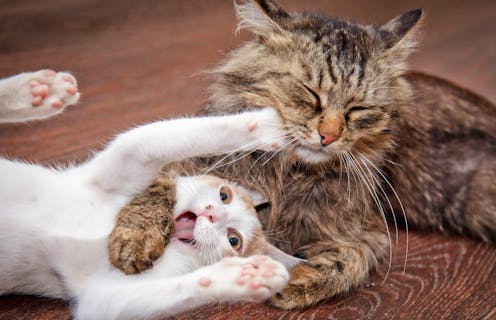
Have you ever worried if the play between your cats was getting too rough? A new study published in Scientific Reports[1] has investigated play and fighting in cats.
Their aim was to use simple behaviours anyone could observe to work out what was play and what might lead to fights. This is important because the consequences of fights include injuries to animals and humans[2]. At worst, you may even have to rehome one of your cats if they’re not getting along.
Categorising cat ‘fights’
The study, led by Noema Gajdoš-Kmecová[3] from University of Veterinary Medicine and Pharmacy in Slovakia and from the University of Lincoln, UK, analysed 105 videos of interactions between 210 cats.
The research team then developed an ethogram[4] – a list of specific behaviours used in the study of animal behaviour. These were put into six groups:
- Inactive: head and body motionless and in specific position, for example crouching
- Wrestling: cats in physical contact with wrestling movements
- Chasing: one cat runs in pursuit or another cat runs away
- Other interactive activities: for example grooming, approaching, raised fur on back
- Non-interactive: activity directed towards themselves or an inanimate object, for example drinking, self-licking
- Vocalisation: for example growl, hiss, meow
Each video was analysed to identify which of these behaviours were shown by each cat. Each interaction was then analysed statistically to work out which behaviours appeared together in clusters[5].
From this, the researchers separated the videos into three categories of interactions.
Playful: included 40% of cats from the videos and included wrestling and a lack of vocalising.
Agonistic: agonistic behaviours[6] are any social behaviours that include threatening, aggression and submission. Cats in this group vocalised and had recurring bouts of inactivity; 32% of cats from the sample landed in this group.
Intermediate: this group included 28% of cats and was more closely associated with the playful group than the agonistic group. Cats in this group interacted for prolonged periods with pauses in between.
As a crosscheck, these behavioural categories observed from the videos agreed fairly well with how the four authors, experts in cat behaviour, described each interaction.
What does this tell you about your cats’ play?
If your cats are wrestling, they are most likely playing. When there is friction between cats in a multi-cat household, they tend to avoid physical contact. Instead, they’ll use offensive or defensive manoeuvres that don’t involve extended direct contact, such as slapping.
If your cats are vocalising, and chasing between periods of inactivity (such as crouching) they are most likely fighting. Vocalisation is an especially important clue here to an aggressive, rather than playful interaction. Chasing is OK if it’s mutual, but if one cat is chasing or one cat is running away, that’s not so positive.
The intermediate group is the tricky one. It contains elements of both playful and agonistic behaviours, though was more closely related to the playful than the agonistic group. This suggests play could become agonistic, depending on what happens during the interaction.
In particular, the authors observed frequent breaks within the interaction, which may allow cats to reassess their partner’s interest in playing, and avoid escalation from play to aggression.
The big fights are easy to spot
This study is the first to apply a scientific approach to cat behaviours anybody can identify, describing three types of interactions to help identify between play and fighting in cats.
We all know when cats are really fighting, but the main strength is in working out intermediate examples – where it could be OK, but could also escalate.
The study focused on obvious behaviours anybody can observe, but cats can be quite subtle, too. They also use facial expression, ear and tail placement, and pheromones to communicate. These subtle signals may be just as important in differentiating between what is playing and what is fighting.
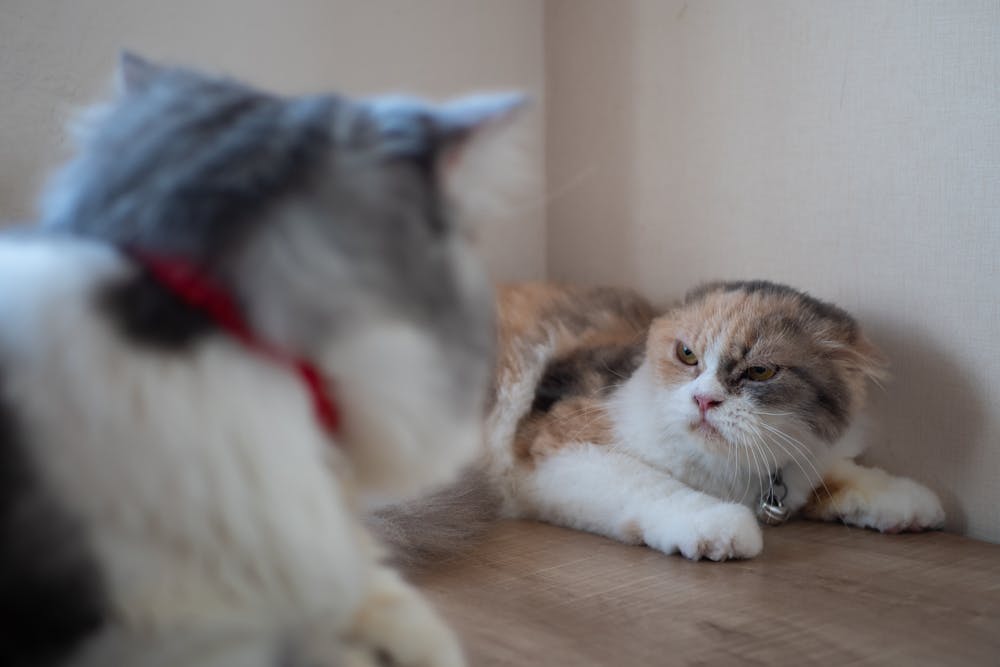 Not all cat communication is obvious to us humans – they tend to use their ears, faces, and even pheromones to signal to each other.
Gurkan Ergun/Shutterstock
Not all cat communication is obvious to us humans – they tend to use their ears, faces, and even pheromones to signal to each other.
Gurkan Ergun/Shutterstock
If your cats really are besties (sleep in close contact and share food and toys) the occasional bit of agonistic play is okay.
But if your cats don’t get on as well, you might need to watch for signs of agonistic behaviours. Tension between cats is not always obvious, but can affect their physical and mental health.
If you are unsure if your cats are really getting along, seeking help early from an expert in cat behaviour can prevent a cat-astrophe.
References
- ^ published in Scientific Reports (www.nature.com)
- ^ consequences of fights include injuries to animals and humans (www.vet.cornell.edu)
- ^ Noema Gajdoš-Kmecová (scholar.google.com.au)
- ^ developed an ethogram (primate.wisc.edu)
- ^ appeared together in clusters (en.wikipedia.org)
- ^ agonistic behaviours (link.springer.com)