Asteroid 2023 BU just passed a few thousand kilometres from Earth. Here's why that's exciting
- Written by: Steven Tingay, John Curtin Distinguished Professor (Radio Astronomy), Curtin University
There are hundreds of millions of asteroids[1] in our Solar System[2], which means new asteroids are discovered quite frequently. It also means close encounters between asteroids and Earth are fairly common.
Some of these close encounters end up with the asteroid impacting Earth, occasionally with severe consequences[3].
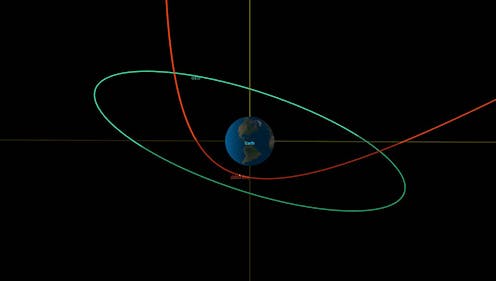
A recently discovered asteroid, named 2023 BU[4], has made the news[5] because today it passed very close to Earth. Discovered on Saturday January 21 by amateur astronomer Gennadiy Borisov[6] in Crimea, 2023 BU passed only about 3,600km from the surface of Earth (near the southern tip of South America) six days later on January 27.

That distance is just slightly farther than the distance between Perth and Sydney, and is only about 1% the distance between Earth and our Moon[9].
The asteroid also passed through the region of space that contains a significant proportion of the human-made satellites orbiting Earth.
All this makes 2023 BU the fourth-closest known asteroid encounter with Earth[10], ignoring those that have actually impacted the planet or our atmosphere.
Read more: NASA's asteroid deflection mission was more successful than expected. An expert explains how[11]
How does 2023 BU rate as an asteroid and a threat?
2023 BU is unremarkable, other than that it passed so close to Earth. The diameter of the asteroid is estimated to be just 4–8 metres[12], which is on the small end of the range of asteroid sizes.
There are likely hundreds of millions of such objects in our Solar System, and it is possible 2023 BU has come close to Earth many times before over the millennia. Until now, we have been oblivious to the fact.
In context, on average a 4-metre-diameter asteroid will impact Earth every year and an 8-metre-diameter asteroid every five years or so (see the infographic below).
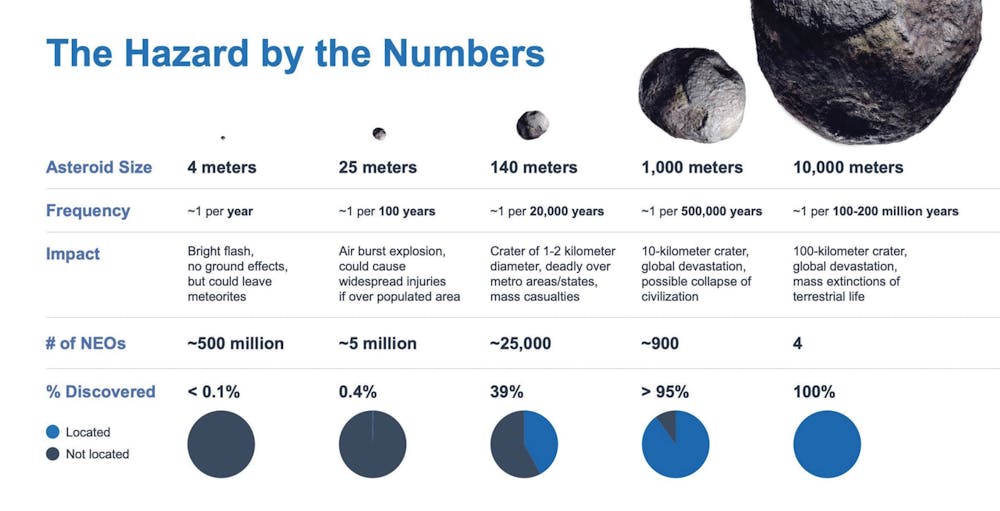 Statistically, larger asteroids have less of a chance impacting Earth than smaller ones do, because there are far fewer of them.
NASA[13]
Statistically, larger asteroids have less of a chance impacting Earth than smaller ones do, because there are far fewer of them.
NASA[13]
Asteroids of this size pose little risk to life on Earth when they hit, because they largely break up in the atmosphere. They produce spectacular fireballs, and some of the asteroid may make it to the ground as meteorites.
Now that 2023 BU has been discovered, its orbit around the Sun can be estimated and future visits to Earth predicted. It is estimated there is a 1 in 10,000 chance 2023 BU will impact Earth[14] sometime between 2077 and 2123.
So, we have little to fear from 2023 BU or any of the many millions of similar objects in the Solar System.
Asteroids need to be greater than 25 metres in diameter to pose any significant risk to life in a collision with Earth; to challenge the existence of civilisation, they’d need to be at least a kilometre in diameter.
It is estimated there are fewer than 1,000 such asteroids in the Solar System, and could impact Earth every 500,000 years. We know about more than 95% of these objects.
Read more: Astronomers have detected another 'planet killer' asteroid. Could we miss one coming our way?[15]
Will there be more close asteroid passes?
2023 BU was the fourth closest pass by an asteroid ever recorded. The three closer passes were by very small asteroids discovered in 2020 and 2021 (2021 UA[16], 2020 QG[17] and 2020 VT[18]).
Asteroid 2023 BU and countless other asteroids have passed very close to Earth during the nearly five billion years of the Solar System’s existence, and this situation will continue into the future.
What has changed in recent years is our ability to detect asteroids of this size, such that any threats can be characterised. That an object roughly five metres in size can be detected many thousands of kilometres away by a very dedicated amateur astronomer shows that the technology for making significant astronomical discoveries is within reach of the general public. This is very exciting.
Amateurs and professionals can together continue to discover and categorise objects, so threat analyses can be done. Another very exciting recent development came last year, by the Double Asteroid Redirection Test[19] (DART) mission, which successfully collided a spacecraft into an asteroid and changed its direction.
DART makes plausible the concept of redirecting an asteroid away from a collision course with Earth, if a threat analysis identifies a serious risk with enough warning.
References
- ^ asteroids (solarsystem.nasa.gov)
- ^ Solar System (solarsystem.nasa.gov)
- ^ occasionally with severe consequences (www.nationalgeographic.com)
- ^ 2023 BU (en.wikipedia.org)
- ^ made the news (www.bbc.com)
- ^ Gennadiy Borisov (en.wikipedia.org)
- ^ Phoenix7777/Wikimedia Commons (en.wikipedia.org)
- ^ CC BY-SA (creativecommons.org)
- ^ Moon (solarsystem.nasa.gov)
- ^ fourth-closest known asteroid encounter with Earth (en.wikipedia.org)
- ^ NASA's asteroid deflection mission was more successful than expected. An expert explains how (theconversation.com)
- ^ estimated to be just 4–8 metres (archive.md)
- ^ NASA (dart.jhuapl.edu)
- ^ 1 in 10,000 chance 2023 BU will impact Earth (cneos.jpl.nasa.gov)
- ^ Astronomers have detected another 'planet killer' asteroid. Could we miss one coming our way? (theconversation.com)
- ^ 2021 UA (en.wikipedia.org)
- ^ 2020 QG (en.wikipedia.org)
- ^ 2020 VT (en.wikipedia.org)
- ^ by the Double Asteroid Redirection Test (theconversation.com)