Toxic pollutants can build up inside our homes. Here are 8 ways to reduce the risks
- Written by: Mark Patrick Taylor, Victoria's Chief Environmental Scientist, EPA Victoria; Honorary Professor, School of Natural Sciences, Macquarie University
We know everything in our homes gathers dust. What you probably don’t know is whether there are toxic contaminants in your house dust, and where these might come from.
Our newly published research[1] found most of the dust inside homes came from outside and contains potentially toxic trace metals such as lead, arsenic and chromium.
Worryingly, we found some contaminants can accumulate at higher concentrations inside homes than outside. This happened in homes with certain characteristics: older properties, metal construction materials enriched in zinc, recent renovations and deteriorating paint.
Fortunately, you take some simple steps to reduce your exposure, which we explain later.
Read more: What is dust? And where does it all come from?[2]
What’s in house dust?
Our study explored the connected sources, pathways and potentially harmful exposures to trace metals at homes across Sydney. We collected and analysed 383 samples from nearby road dust (51 samples) and garden soil (166), as well as indoor dust (166).
We found the dust in homes comes from a range of sources including outdoor environments and soil, skin, cleaning products, pet hair and cooking particles.Nearly 60% of dust particles inside the homes originated from their immediate outdoor environment – it was dirt from outside[3]! Wind, your shoes or your pets can carry in soil[4] and dust[5]-related contaminants.
Read more: Wearing shoes in the house is just plain gross. The verdict from scientists who study indoor contaminants[6]
The remaining 40% of home dust came from indoor sources. These included fibres from clothes, carpets and furnishings[7], cleaning products, skin and hair.
Some dust sources can carry a cocktail of potentially harmful contaminants including:
The nature of the risk is related to how much of the contaminant you’re exposed to and for how long. The risks are greatest in children under the age of five. This is because they are small, closer to the floor and have frequent hand-mouth contact, which increases ingestion of contaminants.
Read more: Microplastics are common in homes across 29 countries. New research shows who's most at risk[8]
How do contaminants build up in homes?
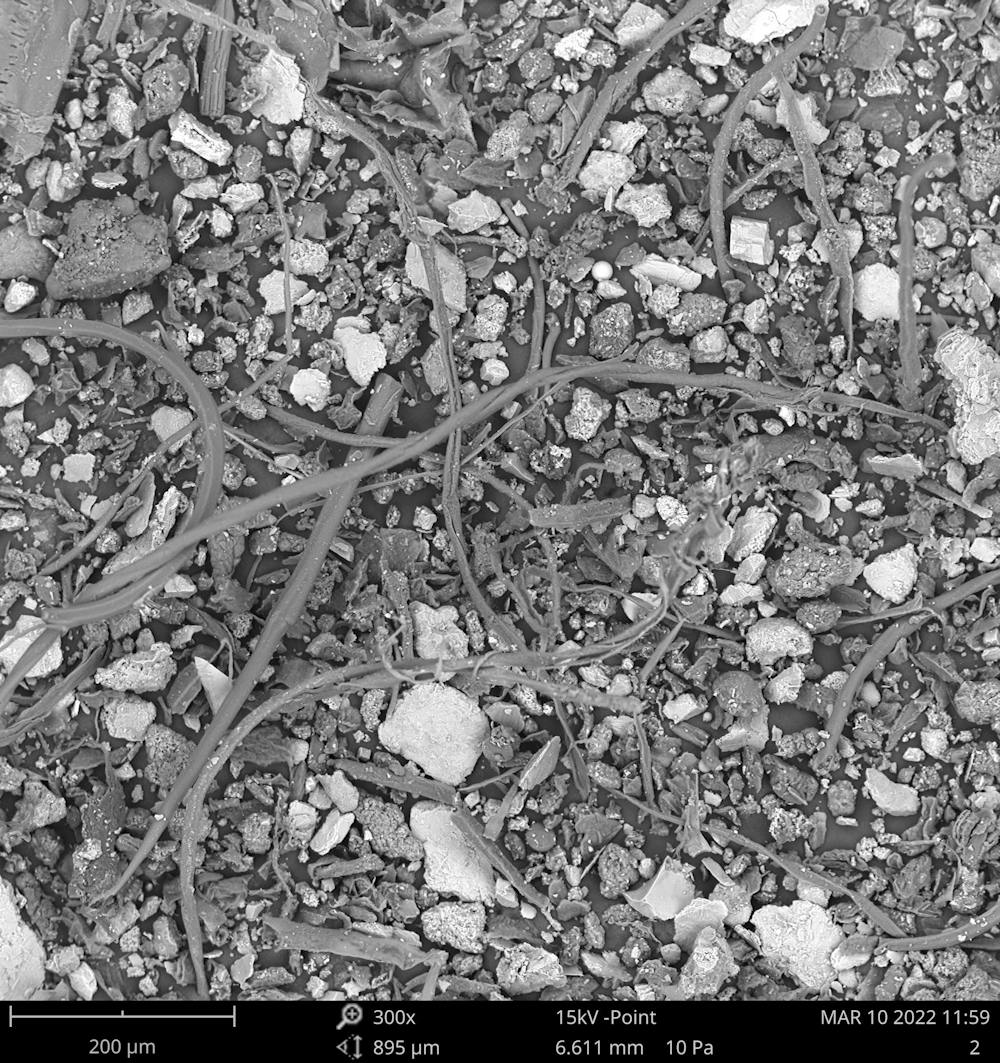
Industrial activity has left a marked legacy of contaminants in many city neighbourhoods. We analysed road dust, garden soil and vacuum dust samples from 166 homes in Sydney to see how this risk translated to inside homes. We used high-magnification microscopy and lead isotopic ratios[9] to understand trace metal composition in the samples.
On average, concentrations of trace metals arsenic, chromium, copper, manganese, lead and zinc were all higher inside homes than outside. This means homes are not only “accumulators” of trace metal contaminants but also important sources of a significant proportion of harmful contaminants that we can be exposed to.
The lead isotopic ratios, or the lead “fingerprints”, of each home and its garden soil matched. This confirms the soil is the main source of lead inside homes.
Most of this lead is the result of the pre-1970s use of high concentrations of lead in paints[10] and petrol[11], which contaminated many garden soils. Even low levels of lead exposure[12] can be harmful. Lead levels in some Sydney backyards[13] pose a risk for urban veggie growers[14] and backyard chickens and their eggs[15].
Read more: Backyard hens' eggs contain 40 times more lead on average than shop eggs, research finds[16]
High-magnification images of house dust showed mineral particles that have been blown in or tracked in on shoes. The rest of the dust was elongated fibres and hair from indoor sources.
Which homes are most at risk?
We also collected information about each house, relevant activities and renovations at the property. We found house age, proximity to the city centre and renovations had the greatest influence on levels of lead and other trace metals in the home.
All homes more than 50 years old had higher concentrations of arsenic, copper, lead and zinc in their garden soil and house dust. They are typically located closer to city centres[17], where early industrial activity has contaminated soils.
As older homes in former industrial areas are renovated, trace metal loads in these homes and gardens can increase. Walls and ceilings contain decades of dust. Old paint buried under more recent layers can also be released, causing lead exposure risks[18].
It is critical that home renovators take appropriate remediation steps or employ a qualified paint professional[19] so lead dust isn’t spread across the area.
8 ways to reduce your risk
We spend about 70% of our time at home[20], which the pandemic has increased. Understanding the environmental conditions and contaminants we encounter[21] and their effects on our health is more important than ever.
Armed with this knowledge, though, you can take some simple steps to reduce your exposure to contaminants in your home and garden:
regularly vacuum carpeted areas with a good vacuum cleaner fitted with a HEPA filter[22]
wet mop and wet dust hard surfaces
mulch areas of exposed soil in your garden
use a quality doormat and wash it regularly, which can roughly halve the amount of lead[23] in your home within three months
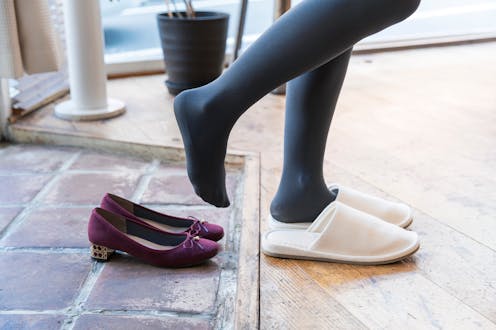
leave your shoes at the door as they can bring all sorts of nasties into the home[24]
wash your hands and your veggies thoroughly
close windows on windy days
when renovating, use dust-mitigation strategies and personal protective equipment (PPE).
You can dig a little deeper into what’s in your own home environment by sending your soil to VegeSafe Australia[25] or EPA Victoria’s GardenSafe[26] for analysis. If you live in the United States, Canada, United Kingdom or Australia you can also send your vacuum dust to DustSafe[27] for testing. You will receive a report outlining what was in your sample, with links and advice on what to do next where necessary.
Read more: House dust from 35 countries reveals our global toxic contaminant exposure and health risk[28]
References
- ^ newly published research (doi.org)
- ^ What is dust? And where does it all come from? (theconversation.com)
- ^ dirt from outside (theconversation.com)
- ^ soil (www.sciencedirect.com)
- ^ dust (pubs.acs.org)
- ^ Wearing shoes in the house is just plain gross. The verdict from scientists who study indoor contaminants (theconversation.com)
- ^ fibres from clothes, carpets and furnishings (theconversation.com)
- ^ Microplastics are common in homes across 29 countries. New research shows who's most at risk (theconversation.com)
- ^ lead isotopic ratios (www.climate-policy-watcher.org)
- ^ paints (www.dcceew.gov.au)
- ^ petrol (dx.doi.org)
- ^ low levels of lead exposure (theconversation.com)
- ^ Sydney backyards (theconversation.com)
- ^ urban veggie growers (doi.org)
- ^ backyard chickens and their eggs (theconversation.com)
- ^ Backyard hens' eggs contain 40 times more lead on average than shop eggs, research finds (theconversation.com)
- ^ located closer to city centres (iupui-earth-science.shinyapps.io)
- ^ lead exposure risks (www.abc.net.au)
- ^ employ a qualified paint professional (painters.edu.au)
- ^ 70% of our time at home (escholarship.org)
- ^ conditions and contaminants we encounter (www.cdc.gov)
- ^ HEPA filter (www2.education.vic.gov.au)
- ^ halve the amount of lead (nrl.northumbria.ac.uk)
- ^ bring all sorts of nasties into the home (theconversation.com)
- ^ VegeSafe Australia (www.360dustanalysis.com)
- ^ EPA Victoria’s GardenSafe (www.epa.vic.gov.au)
- ^ DustSafe (www.360dustanalysis.com)
- ^ House dust from 35 countries reveals our global toxic contaminant exposure and health risk (theconversation.com)