'Acts that defy humanity:' 3 essential reads on police brutality, race and the power of video evidence
- Written by: Howard Manly, Race + Equity Editor, The Conversation US
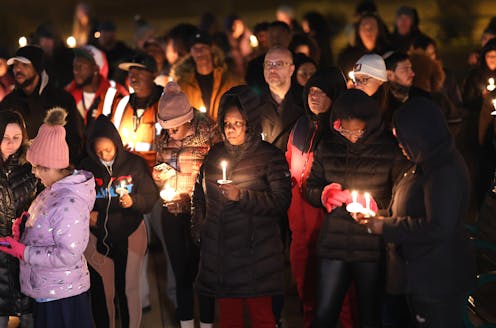
In the case of the five Black, former Memphis police officers accused of murder in the beating death of Tyre Nichols, justice has moved quickly.
In fewer than 30 days after Nichols’ Jan. 10, 2023 death, the former officers were charged[1] with second-degree murder, assault, kidnapping, official misconduct and official oppression.
The Memphis Police Department released video footage of the officers’ encounter with Nichols on Jan. 27, 2023. And some who’ve seen the video, which includes footage captured by body-worn cameras, cameras mounted on dashboards of police vehicles and security cameras on utility poles in the vicinity, have described it as “horrific.”[2]
Before the video was released Memphis Police Chief Cerelyn Davis told CNN[3]: “You are going to see acts that defy humanity.”
In recent years, as national outrage over the systemic racism within U.S. law enforcement has grown, The Conversation U.S. has published several articles on police brutality, race and the national outrage over systemic racism within the U.S. criminal justice system.
1. Different interpretations of video evidence
Media Studies Professor Sandra Ristovska[4] examines the use of video as evidence in state and federal courts in the U.S. and writes[5] about the Rodney King[6] and George Floyd[7] cases where jurors interpreted video evidence differently.
In the King case, the four Los Angeles police officers were acquitted of charges of assault and excessive use of force as the jury believed the video showed a justified response to King’s allegedly frightening actions.
Lead prosecutor Terry White ended his closing arguments by asking the jury: “Now who do you believe, the defendants or your own eyes?”
In the Floyd case, jurors believed their own eyes and convicted Derek Chauvin for the murder of Floyd.
As Ristovska explains, bystander, bodycam and dashcam videos of policing can be powerful forms of evidence.
“Yet judges, attorneys and jurors may see and treat video in varied ways that can lead to inconsistent renderings of justice,” she writes.
Read more: From Rodney King to George Floyd, how video evidence can be differently interpreted in courts[8]
2. The racist roots of policing
As historian Clare Corbould[9] explains, police violence that disproportionately targets African Americans long predates portable video cameras.
Where Black Africans were once enslaved to provide cheap labor, Corbould writes, they are now policed, charged, indicted and incarcerated at staggering rates.
“As many have noted since [George] Floyd’s murder, the origins of U.S. policing lie in the control of supposedly disorderly populations,” Corbould writes[10], “whether of enslaved people or, after the end of slavery, an impoverished class of laborers including Black people and immigrants.”
Read more: Relief at Derek Chauvin conviction a sign of long history of police brutality[11]
3. College requirements for police may reduce fatal encounters
In their peer-reviewed study of data on 235 U.S. city police departments from 2000 to 2016, Thaddeus L. Johnson[12] and Natasha N. Johnson[13] found that police forces requiring at least a two-year college degree for employment are less likely to employ officers who engage in actions that cause the deaths of Black and unarmed citizens.
As they explain[14], “Our results demonstrated that college minimums are associated with as much as three times lower rates of police-related fatalities involving Black people than police forces without a college degree requirement.”
Their findings further suggest that the impact of a more educated police force may emerge during only the most dangerous encounters that often precede the use of weapons.
More research needs to be done but they conclude that police agencies trying to reduce fatal confrontations should consider ways to recruit college-degreed applicants while at the same time support college attendance among current officers.
Read more: College requirements for police forces can save Black lives, but at what cost?[15]
Editor’s note: This story is a roundup of articles from The Conversation’s archives.
References
- ^ former officers were charged (www.reuters.com)
- ^ described it as “horrific.” (www.msn.com)
- ^ Memphis Police Chief Cerelyn Davis told CNN (www.cnn.com)
- ^ Sandra Ristovska (www.colorado.edu)
- ^ writes (theconversation.com)
- ^ Rodney King (www.youtube.com)
- ^ George Floyd (www.youtube.com)
- ^ From Rodney King to George Floyd, how video evidence can be differently interpreted in courts (theconversation.com)
- ^ Clare Corbould (www.deakin.edu.au)
- ^ Corbould writes (theconversation.com)
- ^ Relief at Derek Chauvin conviction a sign of long history of police brutality (theconversation.com)
- ^ Thaddeus L. Johnson (aysps.gsu.edu)
- ^ Natasha N. Johnson (aysps.gsu.edu)
- ^ they explain (theconversation.com)
- ^ College requirements for police forces can save Black lives, but at what cost? (theconversation.com)