Is my medicine making me feel hotter this summer? 5 reasons why
- Written by: Nial Wheate, Associate Professor of the Sydney Pharmacy School, University of Sydney
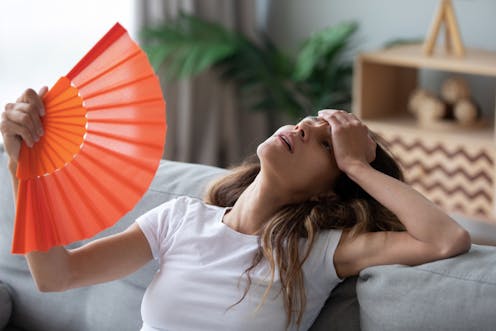
If you’re really feeling the heat this summer, it might be down to more than the temperature outside.
Some types of medicines can increase your core body temperature or make you feel hotter than you really are. Some can affect your body’s ability to cool down.
Here’s what you need to know about heat intolerance and medicines.
Read more: How to cope with extreme heat days without racking up the aircon bills[1]
What is heat intolerance?
Some people simply dislike the feeling of feeling hot, while others feel hot at temperatures most people find comfortable. Both are examples of heat intolerance[2].
Typical symptoms during warm weather include excessive sweating (or not sweating enough), exhaustion and fatigue, nausea, vomiting or dizziness, and changes in mood.
A number of factors can cause heat intolerance.
This includes the disorder dysautonomia[3], which affects people’s autonomic nervous system – the part of the body that regulates the automatic functions of the body, including our response to heat.
Conditions such as diabetes, alcohol misuse, Parkinson’s disease[4], the autoimmune disease Guillain-Barré syndrome[5] and mitochondrial disease[6] can cause dysautonomia. People in old age, those with some neurological conditions, or people less physically fit may also have it.
But importantly, medications can also contribute to heat intolerance.
Read more: 5 reasons to check on your elderly neighbour during a heatwave[7]
1. Your body temperature rises
Some medicines directly increase your body temperature, which then increases the risk of heat intolerance.
These include stimulant medications[8] to treat ADHD (attention deficit hyperactivity disorder), such as methylphenidate, dexamfetamine and lisdexamfetamine.
Antipsychotic medications[9] (such as clozapine, olanzapine and quetiapine) used to treat mental health conditions, such as schizophrenia and bipolar disorder, are other examples.
These ADHD and antipsychotic medicines raise your temperature by acting on the hypothalamus, the region of the brain essential for cooling.
The drug levothyroxine, used to treat an under-active thyroid, also increases your body temperature, this time by increasing your metabolism[10].

2. Your blood flow is affected
Other medicines constrict (tighten) blood vessels, decreasing blood flow to the skin, and so prevent heat from escaping this way. This means your body can’t regulate its temperature as well in the heat.
Examples include beta-blockers[12] (such as metoprolol, atenolol and propranolol). These medications are used to treat conditions such as high blood pressure, angina (a type of chest pain), tachycardia (fast heart rate), heart failure, and to prevent migraines.
Decongestants[13] for blocked noses (for example, pseudoephedrine and phenylephrine), triptans for migraines (such as sumatriptan and zolmitriptan) and the ADHD medications mentioned earlier can also act to decrease blood flow to the skin.
Read more: Forget nose spray, good sex clears a stuffy nose just as effectively — and is a lot more fun[14]
3. You can get dehydrated
Other medicines can cause dehydration, which then makes you more susceptible to heat intolerance. The best examples are diuretics[15] such as furosemide, hydrochlorothiazide, acetazolamide and aldosterone.
These are used to control high blood pressure and heart failure by forcing your kidneys to remove more fluid from your body.
Laxatives, such as senna extract and bisacodyl, also remove water from your body and so have a similar effect.
Read more: Health Check: how do I tell if I'm dehydrated?[16]
4. You can sweat less
Other medicines have a drying effect. This can be needed for medicines to do their job (for instance, to dry up a runny nose). For others, it is an unwanted side effect.
This drying reduces the amount you sweat, making it harder to lose heat and regulate your core temperature. A number of medicines have these effects, including:
- some antihistamines (such as promethazine, doxylamine and diphenhydramine)
- certain antidepressants (such as amitriptyline, clomipramine and dothiepin)
- medicines used to treat urinary incontinence[17] (for example, oxybutynin and solifenacin)
- nausea medicine (prochlorperazine)
- medicines for stomach cramps and spasms (for instance, hyoscine)
- the antipsychoptics chlorpromazine, olanzapine, quetiapine and clozapine.
Read more: Health Check: do men really sweat more than women?[18]
5. You don’t feel thirsty
Finally, some medicines, such as the antipsychotics haloperidol and droperidol, can aggravate heat intolerance by reducing your ability to feel thirsty.
If you don’t feel thirsty, you drink less and are therefore at risk of dehydration and feeling hot.
 People taking some medications just don’t feel thirsty.
Shutterstock[19]
People taking some medications just don’t feel thirsty.
Shutterstock[19]
Read more: Health Check: how can extreme heat lead to death?[20]
What can you do about it?
If you are feeling hot this summer and think your medicine may be contributing, it’s very important you keep taking your medicine.
Speak to your pharmacist or doctor about your symptoms. They will offer advice and discuss alternatives.
References
- ^ How to cope with extreme heat days without racking up the aircon bills (theconversation.com)
- ^ heat intolerance (www.medicalnewstoday.com)
- ^ dysautonomia (my.clevelandclinic.org)
- ^ Parkinson’s disease (theconversation.com)
- ^ Guillain-Barré syndrome (theconversation.com)
- ^ mitochondrial disease (theconversation.com)
- ^ 5 reasons to check on your elderly neighbour during a heatwave (theconversation.com)
- ^ stimulant medications (bpspubs.onlinelibrary.wiley.com)
- ^ Antipsychotic medications (www.healthdirect.gov.au)
- ^ increasing your metabolism (www.ncbi.nlm.nih.gov)
- ^ SciePro/Shutterstock (www.shutterstock.com)
- ^ beta-blockers (www.healthdirect.gov.au)
- ^ Decongestants (www.nhs.uk)
- ^ Forget nose spray, good sex clears a stuffy nose just as effectively — and is a lot more fun (theconversation.com)
- ^ diuretics (www.mayoclinic.org)
- ^ Health Check: how do I tell if I'm dehydrated? (theconversation.com)
- ^ urinary incontinence (www.healthdirect.gov.au)
- ^ Health Check: do men really sweat more than women? (theconversation.com)
- ^ Shutterstock (www.shutterstock.com)
- ^ Health Check: how can extreme heat lead to death? (theconversation.com)
Read more https://theconversation.com/is-my-medicine-making-me-feel-hotter-this-summer-5-reasons-why-199085