We planted pine in response to Cyclone Bola – with devastating consequences. It is now time to invest in natives
- Written by: David Norton, Emeritus professor, University of Canterbury
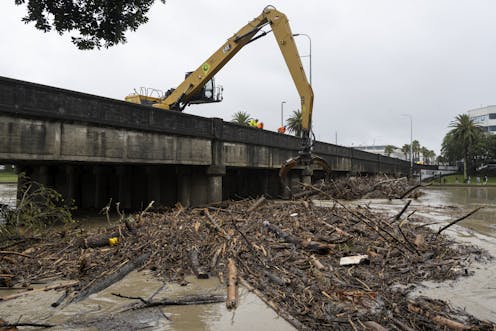
During Cyclones Hale and Gabrielle the poor management of exotic plantations – primarily pine – has again led to extensive damage in Tairāwhiti. Critical public infrastructure destroyed; highly productive agricultural and horticultural land washed away or buried; houses, fences and sheds knocked over; people’s lives and dreams upended; people dead.
The impacts on natural ecosystems are still unknown, but there will have been extensive damage in terrestrial, freshwater and marine environments. Similar damage occurred during storms in June 2018[1] and July 2020[2].
While heavy rainfall and flooded rivers are a major factor, it is sediment and slash from plantation harvesting that has been the cause of most of the damage.
Slash[3] is the woody material (including large logs) left after clear-fell harvesting of commercial forests.
Landslides in harvested sites pick up the material and carry it downstream, causing significant damage. All the evidence from Cyclone Gabrielle shows that much of the damage was caused by radiata pine slash[4].
The legacy of poor land management
Sediment and slash from exotic tree harvesting sites were established as major factors in the damage[5] that occurred during the June 2018 Tolaga Bay storm in recent court cases taken by Gisborne District Council.
Read more: Cyclone Gabrielle triggered more destructive forestry 'slash' – NZ must change how it grows trees on fragile land[6]
Five plantation companies were found guilty and fined for breaching resource consent conditions relating to their management practices.
Multiple groups have called for an inquiry into the way plantation harvest sites are being managed in Tairāwhiti and elsewhere.
But given the severity and ongoing nature of these impacts, is it not time we move beyond focusing on management practices and address the broader underlying issues that have triggered this situation?
These ultimate causes are complex but primarily revolve around historic poor land management decision-making and human-induced climate change.
Among the key drivers of the current problems in Tairāwhiti are the large areas of exotic tree plantations that were established with government support[7] after the devastation of Cyclone Bola.
But this devastation also reflects earlier poor land management decisions to clear native forest off steep, erodible hill country in the late 19th and early 20th centuries, which was also encouraged by the government of the day.
Looming climate change
The other underlying driver of the disaster is human-induced climate change. Atmospheric CO2 levels are now 150% above pre-industrial levels and climates are changing rapidly with new and unprecedented events becoming the norm.
While increasing global temperatures are the most obvious feature of human-induced climate change, it is the increasing frequency and intensity of extreme weather events that are having the biggest impacts on people and the environment.
Read more: Global supply chains are devouring what's left of Earth's unspoilt forests[8]
It is essential that we hold the forestry sector accountable in Tairāwhiti and elsewhere. But we also need to urgently address the underlying causes because no matter how strict harvesting rules are, storm events are going to occur with increasing frequency and intensity[9].
Time for urgent action
With more than 40 years experience researching forest ecology and sustainable land management in Aotearoa, I believe there are four key areas where we need to urgently act to address these issues.
As a country we need to rapidly reduce greenhouse gas emissions and rapidly increase the draw-down of CO2 out of the atmosphere. These are national issues and not confined to Tairāwhiti but as a nation we seem to be sleepwalking in our response to the climate emergency.
We need a comprehensive catchment-by-catchment assessment across all of Tairāwhiti (and likely other areas of Aotearoa) to identify those plantations that are located in the wrong place in terms of potential harvesting impacts. There should be no further harvesting in Tairāwhiti plantations until this exercise has been completed. We also need to identify those areas that currently lack plantations but should never be planted in exotic tree crops (for any purpose).
The government then needs to buy out the current owners of these plantations and embark on a programme of careful conversion to native forest. This will come at a cost, but it needs to be done. We already have models for this in Tairāwhiti where the Gisborne District Council has started converting pine forests in its water supply catchment to native forests.
Finally, we need to establish substantially more native forests throughout all Tairāwhiti, and Aotearoa more generally, to help build resilience in our landscapes.
The consequences of short-term thinking
For too long we have been fixated in Aotearoa with maximising short-term returns from exotic tree crops without thinking about long-term consequences. The legacies of this fixation are now really starting to impact us as the climate emergency exposes the risks that poorly sited and managed exotic tree crops pose.
And we are now making the same mistakes with exotic carbon tree crops, again leaving unacceptable legacies for future generations to deal with because of a focus on short-term financial gains.
Exotic tree plantations have dominated forest policy in Aotearoa and we urgently need to shift this to a focus on diverse native forests.
Our native rainforests provide so many benefits that exotic tree crops can never provide. They are critical for the conservation of our native biodiversity, providing habitat for a myriad of plant, animal, fungal and microbial species. They also regulate local climates, enhance water quality and reduce erosion. This helps sustain healthy freshwater and marine environments.
Native replanting initiatives championed by charities like Pure Advantage[11] need to be the primary focus of forest policy in Aotearoa now and in the future.
References
- ^ June 2018 (floodlist.com)
- ^ July 2020 (www.1news.co.nz)
- ^ Slash (thespinoff.co.nz)
- ^ radiata pine slash (theconversation.com)
- ^ established as major factors in the damage (www.gdc.govt.nz)
- ^ Cyclone Gabrielle triggered more destructive forestry 'slash' – NZ must change how it grows trees on fragile land (theconversation.com)
- ^ established with government support (www.stuff.co.nz)
- ^ Global supply chains are devouring what's left of Earth's unspoilt forests (theconversation.com)
- ^ increasing frequency and intensity (www.theguardian.com)
- ^ Amy Toensing/Getty Images (www.gettyimages.com.au)
- ^ Pure Advantage (pureadvantage.org)