Peace in Ukraine doesn't ultimately depend on Putin or Zelensky – it's the Ukrainian people who must decide
- Written by: William Partlett, Associate Professor, The University of Melbourne
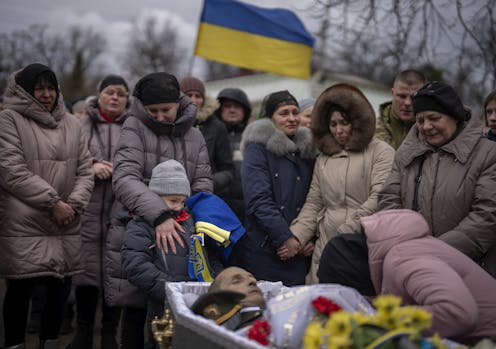
Russia’s invasion of Ukraine has now lasted for one year. As overwhelming victory for either side looks unlikely, many are now calling for a negotiated settlement to the war. For instance, China is promising[1] details of a peace plan imminently.
A critical question underlying any negotiated settlement is: how can the demands on both sides be balanced to achieve a stable, durable peace?
The answer to this question often ignores an indispensable player, the Ukrainian people. For both legal and political reasons, Ukraine’s constitutional democracy[2] requires any peace deal to be ratified by its people. If they are ignored, a stable peace deal is far less likely.
Negotiations hinging on Russia’s annexations
As we enter the second year of the war, bilateral negotiations are hopelessly deadlocked over the control of territory that lies within Ukraine’s internationally recognised borders.
On September 30, 2022, Russia illegally annexed[3] four occupied territories in eastern and southern Ukraine.
Read more: Should the West negotiate with Russia? The pros and cons of high-level talks[4]
In December, Ukrainian President Volodomyr Zelensky proposed[5] a 10-point peace plan that called for Russia to restore Ukraine’s territorial integrity and withdraw all of its armed forces from the country. Zelensky said this was “not up to negotiations”.
Russian President Vladimir Putin suggested[6] he might be willing to negotiate, but the Kremlin later added Ukraine must recognise its annexation of the four Ukrainian regions.
In response, an increasing chorus of both “realist[7]” and anti-war[8] voices have argued that US President Joe Biden or the west more broadly must seek to broker a deal between Ukraine and Russia and stop the violence. This includes encouraging Ukraine to be “flexible[9]” in its negotiations.
China is also putting forward[10] a peace plan to encourage negotiations and end the war. It will reportedly focus on the need to uphold the principles of sovereignty and territorial integrity, but take into account Russia’s security concerns.
This has led many into a moral debate[11] about whether Ukraine should be pushed to negotiate over the status of its sovereign territory.
The forgotten role of the Ukrainian people
The discussion so far misses a critical reality. A stable peace deal cannot just be a diplomatic pact between Ukraine, Russia, China and the west. It also requires the support of the Ukrainian people for both legal and political reasons.
Legally, Ukraine is a constitutional democracy. This means any formal cession of Ukraine’s sovereign territory (including Crimea) would require constitutional change and, therefore, a referendum. In fact, article 156 of Ukraine’s Constitution[12] requires such fundamental changes to be put to an all-Ukrainian referendum.
Read more: How can Russia's invasion of Ukraine end? Here's how peace negotiations have worked in past wars[13]
Politically, any stable peace deal must have broad public support or it will be abandoned by a future leader.
Zelensky knows this. In March 2022, he was willing to promise Russia that Ukraine would never join NATO in return for other security guarantees from the US and Europe. But he said ultimately this decision was not his to make – it had to be ratified[14] by the people.
This makes political sense: an unpopular set of concessions in a peace deal with Russia would end Zelensky’s political career and would likely be overturned by a future president.
The legal and political role of the Ukrainian people should come as no surprise. They were largely ignored in the Minsk agreements[15] drawn up by diplomats in Ukraine, Russia and Europe to try to resolve the conflict that broke out after Russia’s annexation of Crimea and the Russian-backed insurgency in Ukraine’s eastern Donbas region.
Most notably, article 11 of the Minsk II agreement required[16] amendments to Ukraine’s Constitution decentralising control over the two regions in Donbas.
This agreement failed, in part, because of a lack of support from the Ukrainian people. The decentralisation reforms were highly controversial[17], triggering violent protests that ended any chance of reform.
Furthermore, in a 2019 referendum, the Ukrainian people inserted[18] a commitment to “full-fledged membership” in NATO into Ukraine’s Constitution. This further undermined the implementation of the Minsk agreements.
Read more: Russia says peace in Ukraine will be ‘on our terms’ – but what can the West accept and at what cost?[19]
Vast majority of Ukrainians reject giving land to Russia
Those wanting a peace deal, therefore, must accept the reality that a peace deal cannot simply be the result of clever diplomatic bargaining and negotiation. It must also take into account the realities of Ukrainian democracy and the important role the people play in Ukrainian politics.
Ignoring the role of the people would be a significant mistake. In fact, there is strong evidence[20] showing the war is deepening hostility to Russia among the Ukrainian people. Consequently, it is increasingly unlikely that Ukrainians would endorse any Russian annexation of Ukraine’s sovereign territory (even Russia’s 2014 absorption of Crimea).
In fact, polling shows as many as 84% of Ukrainians now reject[21] any territorial concessions to Russia.
Ukrainian popular opinion can certainly change over time, particularly if a peace deal is crafted in a way that will garner support from the Ukrainian people. But the need for popular support will undoubtedly constrain the number of concessions that Ukraine can make and shape the details of any peace deal.
However, if these popular constraints are ignored, it is hard to avoid an even more sobering conclusion: short of major change in the war – such as overwhelming victory for either side or new leadership in Russia – it will be increasingly difficult to get a stable peace deal at all.
References
- ^ promising (www.theguardian.com)
- ^ constitutional democracy (www.constituteproject.org)
- ^ illegally annexed (www.theguardian.com)
- ^ Should the West negotiate with Russia? The pros and cons of high-level talks (theconversation.com)
- ^ proposed (www.aljazeera.com)
- ^ suggested (www.newsweek.com)
- ^ realist (www.washingtonpost.com)
- ^ anti-war (www.peaceinukraine.org)
- ^ flexible (www.foreignaffairs.com)
- ^ putting forward (www.theguardian.com)
- ^ moral debate (www.brookings.edu)
- ^ article 156 of Ukraine’s Constitution (www.refworld.org)
- ^ How can Russia's invasion of Ukraine end? Here's how peace negotiations have worked in past wars (theconversation.com)
- ^ ratified (www.bbc.com)
- ^ Minsk agreements (www.aljazeera.com)
- ^ required (www.chathamhouse.org)
- ^ highly controversial (www.washingtonpost.com)
- ^ inserted (www.voanews.com)
- ^ Russia says peace in Ukraine will be ‘on our terms’ – but what can the West accept and at what cost? (theconversation.com)
- ^ strong evidence (www.brookings.edu)
- ^ reject (www.rferl.org)