

When should we worry about bird flu making us sick? When we see human-to-human transmission – and there's no evidence of that yet
- Written by Ash Porter, Research officer, The Peter Doherty Institute for Infection and Immunity
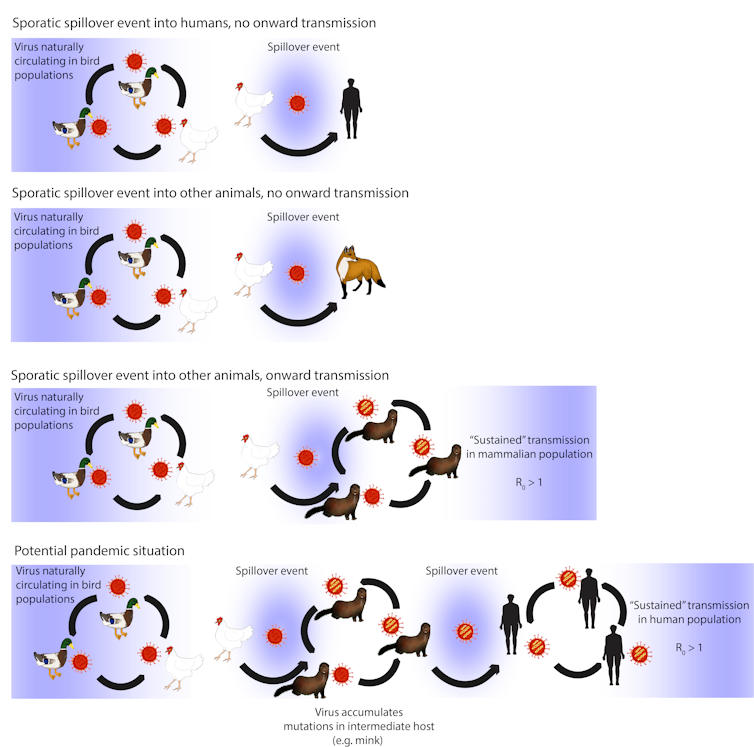
Bird flu has been causing growing concern in recent months, with hundreds of millions of birds dying of the virus since October 2021. This is the largest[1] global outbreak.
Last week[2], an 11-year-old child in Cambodia died from bird flu, prompting concern about spillover from wild birds and poultry to humans. But the cases we’ve seen in Cambodia are a different bird flu strain to that causing the massive bird deaths around the world.
While a small proportion of people have become ill while in contact with infected birds, there is no evidence either strain has spread from human to human.
Read more: What is spillover? Bird flu outbreak underscores need for early detection to prevent the next big pandemic[3]
What is bird flu?
Many types of bird flu naturally circulate in wild birds. These are generally low pathogenic avian influenza viruses (LPAI), which typically cause few or no signs of disease.
However, some viruses are classified as highly pathogenic avian influenza (HPAI) and this is the case for the virus causing the global bird flu outbreak.
Avian influenza viruses are also categorised by subtype (creating the H and N number combination, here H5N1) and specific clades within the H5 subtype (equivalent to SARS-CoV-2 variants). The one we’re currently concerned about is H5N1 clade 2.3.4.4b.
The current strain of bird flu emerged in 2020/21, and spread rapidly causing outbreaks in Europe and Asia. The virus spread to North America in December 2021[4], causing substantial outbreaks[5] in wild birds and poultry since.
The virus entered South America in December 2022, with catastrophic outbreaks in wild birds[7] and marine mammals[8].
Only Australia[9] and the Antarctic remain free.
How does it get to humans?
The virus which causes bird flu is the same species that causes seasonal human influenza, swine influenza, equine influenza, and canine influenza, although different subtypes and strains are involved.
However, viruses are able to jump the species barrier. This is called “spillover”. We see strains of human influenza in Australian pigs[10], for example, and some strains of canine influenza originated in horses[11]. There is also evidence[12] that human flu strains emerged from birds.
Scientists are concerned about the large numbers of spillover events with this strain of bird flu. Cases have been detected[13] in marine mammals[14] in Peru and New England, wild foxes, skunks, otters, bobcats, bears and raccoons in North America and other countries, and in farmed mink[15] in Spain.
What’s happening in Cambodia?
Last week, a child with H5N1 died in the Prey Veng province of Cambodia. Of 12 contacts[16] identified, only one tested positive: the child’s parent, who is currently asymptomatic.
Both infections appear to be due to exposure to infected birds, which were found on the family’s property. Human-to-human transmission is unlikely.
Rapid genetic sequencing of the virus[17] determined it was a lineage commonly found in Cambodia (2.3.2.1c), and distinct from the clade 2.3.4.4b lineage causing concerns globally.
This is not the first report of spillover into humans. Recently a child in Ecuador was infected with 2.3.4.4b, most likely originating[18] from sick poultry. Human cases[19] due to 2.3.4.4 have occured[20] in Russia, China, the United Kingdom, the United States, Spain, Vietnam. So far, all human cases have occurred in people exposed to infected birds.
Spillover events like these occur when people are in contact with sick birds. Thankfully, spillover events do not often lead to human-to-human transmission of the virus.
However, if the virus develops the capability to spread in a new host, then outbreaks (and even pandemics) can occur. Scientists are closely monitoring for any evidence of bird flu adapting and spreading between mammals including humans.
Read more: Bird flu continues to spread in mammals – what this means for humans and wildlife[21]
Why (and how) do viruses switch hosts?
As part of their natural evolution, some viruses are particularly good at “jumping” to new hosts. For example, mpox (which used to be called monkeypox) and SARS-CoV-2 are both zoonotic viruses.
It is thought that mpox naturally infects rodents[22]. Mpox spills over into humans every few years, including a spillover last year that has continued into a widespread, ongoing outbreak[23].
We expect[24] the ancestral lineage of SARS-CoV-2 was circulating in bat populations before it spilled over into humans. SARS-CoV-2 might have infected an intermediate host[25] before jumping into the human population, picking up some advantageous mutations that allowed it to spread rapidly in humans. Several animals have been suggested as potential intermediate hosts, including mink and pangolins.
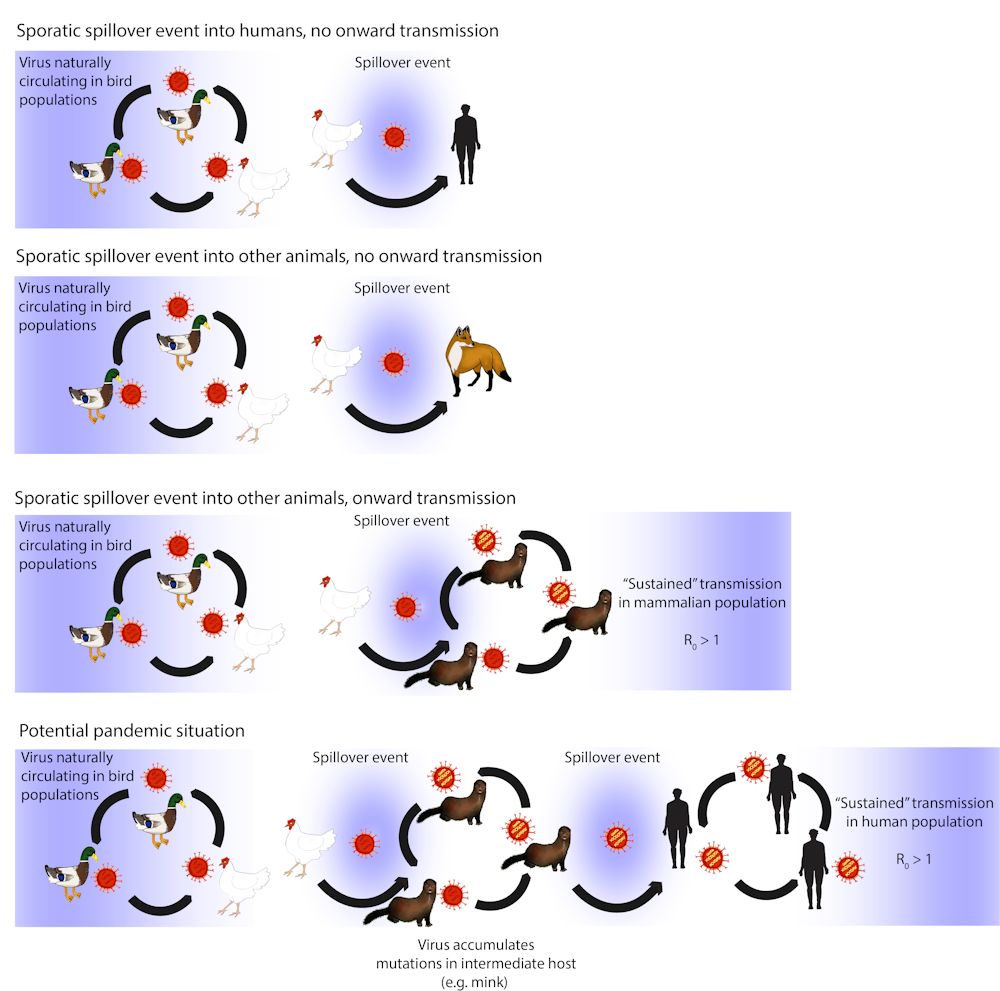
Based on genomic surveillance, cases of bird flu in mammals almost always contain the same mutation. There is concern that further mutations may arise when circulating in an intermediate host which may allow the virus to better transmit between mammals, such as the spillover in mink farms, where mink-to-mink transmission was suspected[26] to have occurred.
To date, the risk of human-to-human transmission of bird flu remains low[27]. But as ferrets (which are related to minks) are a model animal for influenza infection in humans, if mink-to-mink transmission occurred on the farm in Spain, human-to-human transmission is plausible.
What might happen next?
Climate change and urbanisation are pushing humans and wildlife closer together, meaning there is more opportunity to interact with infected animals.
Our history of influenza pandemics caused by viruses with combinations of swine, avian and human influenza A virus genes shows we need consistent and ongoing surveillance of influenza A viruses, particularly in farms[28] along with wild-living and captive animal populations.
Government agencies and researchers across the globe are actively working on detection, response and genomic surveillance of bird flu outbreaks in birds and mammals. Genomic sequencing and surveillance can help inform us about where viruses are spreading, and how viruses is adapting to new hosts.
The World Organization for Animal Health recommends[29] avoiding direct contact with sick or dead wild birds, poultry and wild animals and reporting outbreaks to local authorities.
Read more: Bird flu: domestic chicken keepers could be putting themselves – and others – at risk[30]
References
- ^ largest (wahis.woah.org)
- ^ Last week (www.who.int)
- ^ What is spillover? Bird flu outbreak underscores need for early detection to prevent the next big pandemic (theconversation.com)
- ^ North America in December 2021 (doi.org)
- ^ outbreaks (www.aphis.usda.gov)
- ^ EPA/Keith Serey (photos.aap.com.au)
- ^ wild birds (www.science.org)
- ^ marine mammals (doi.org)
- ^ Australia (doi.org)
- ^ Australian pigs (doi.org)
- ^ originated in horses (doi.org)
- ^ evidence (www.nature.com)
- ^ detected (www.aphis.usda.gov)
- ^ marine mammals (www.biorxiv.org)
- ^ farmed mink (www.eurosurveillance.org)
- ^ 12 contacts (www.who.int)
- ^ genetic sequencing of the virus (www.who.int)
- ^ originating (www.who.int)
- ^ Human cases (cdn.who.int)
- ^ occured (www.science.org)
- ^ Bird flu continues to spread in mammals – what this means for humans and wildlife (theconversation.com)
- ^ naturally infects rodents (www.who.int)
- ^ outbreak (www.who.int)
- ^ expect (academic.oup.com)
- ^ intermediate host (www.science.org)
- ^ was suspected (www.eurosurveillance.org)
- ^ low (www.who.int)
- ^ farms (royalsocietypublishing.org)
- ^ recommends (www.woah.org)
- ^ Bird flu: domestic chicken keepers could be putting themselves – and others – at risk (theconversation.com)