why NZ should be wary of buying into the AUKUS security pact
- Written by: Alexander Gillespie, Professor of Law, University of Waikato
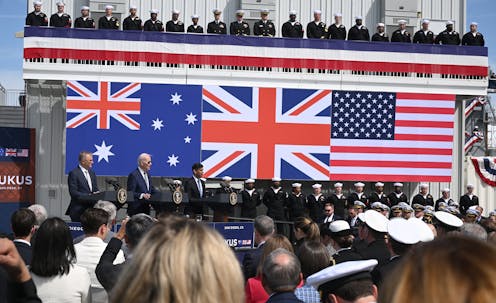
As the strategic rivalry between the United States and China intensifies, the invitation to discuss[1] participation in the AUKUS security agreement presents New Zealand with a potentially momentous decision: how best to secure its own strategic interests and values in the Indo-Pacific region.
AUKUS is the 2021 agreement[2] between Australia, the UK and the US for the “exchange of naval nuclear propulsion information”. It has been presented as the foundation for an enhanced security partnership linked to a “free and open Indo-Pacific” and a rules-based international order.
While it does not explicitly say so, the pact is a response to the perceived threat of China’s increasing assertiveness in the region. The Chinese government has condemned AUKUS as reflecting a “Cold War mentality”, involving a “path of error and danger[3]”; it is a threat to both “regional peace” and the “international nuclear nonproliferation regime”.
As a first major initiative, Australia will buy at least three US Virginia-class nuclear-powered submarines by the early 2030s. By the mid-2050s, it will receive five or more new SSN-AUKUS submarines that combine US technology and a UK design. The cost of Australia’s nuclear submarine programme will be more than A$268 billion over the next 30 years.
AUKUS also envisages the sharing of information in cutting-edge defence technologies, including artificial intelligence, quantum capabilities and cybersecurity. This is where New Zealand has expressed some interest at a so-called “pillar two” non-nuclear level.
Rational political decision-making involves choosing the best option among available alternatives, about which a certain degree of uncertainty exists. So, the question is: what is the most rational decision for New Zealand?
The argument for AUKUS
The claim that a new Cold War between China and the US is under way is shaped by the conviction that a rising great power is almost inevitably trying to displace the US as the dominant global power.
This is happening at a time when significant parts of international law are in free fall, globalisation is at risk of stalling, and the UN Security Council is increasingly unable to resolve critical problems.
Read more: As Australia signs up for nuclear subs, NZ faces hard decisions over the AUKUS alliance[4]
A growing arms race and points of extreme geopolitical tension, from North Korea to Taiwan, highlight the need for an arrangement like AUKUS to provide a counterweight of like-minded partners to ensure greater stability.
In this climate, the argument goes, New Zealand’s preferred option of “hedging” between the superpowers has been squeezed. As a relatively small nation, it must now choose which side to support.
Given New Zealand’s history, liberal democratic values and existing security ties with the AUKUS partners, it makes sense for Wellington to align with the agreement’s long-term strategy to deter and contain China’s expanding military power.
Failure to do so risks New Zealand not having access to emerging state-of-the-art defence technologies.
The argument against AUKUS
The counterargument is that the Cold War analogy is inaccurate. The increasingly interconnected post-Cold-War era is fundamentally different from the period between 1947 and 1989, with its rival global economic systems and competing but comparable alliance systems.
The binary assumption that the fate of the Indo-Pacific will be largely shaped by the outcome of US-China rivalry – and by the capacity of the US and its closest allies to counterbalance Chinese ambitions in the vast Indo-Pacific region – is questionable.
Regional states such as Malaysia, Indonesia and Vietnam, and EU states like France and Germany, remain concerned about China’s assertive diplomacy in the Indo-Pacific. But they seem to have little confidence that AUKUS, a security arrangement involving three English-speaking states, is capable of a serious response in a region inhabited by billions of people.
Read more: Paul Keating lashes Albanese government over AUKUS, calling it Labor's biggest failure since WW1[5]
Furthermore, while China’s global ambitions are real, they should not be over-hyped. The country’s impressive rise to superpower status has been built on full participation in the world capitalist economy and an outstanding trade performance. This has created a high level of economic interdependence for China and its trade partners.
Besides, AUKUS will not be able to do much in the short term to counter China’s designs on Taiwan. Despite the defence minister’s assurances, New Zealand’s participation would create real uncertainty about its independent foreign policy and its commitment to non-nuclear security in a region where many states have criticised AUKUS for fuelling nuclear proliferation.
Finally, the assumption that AUKUS is the only pathway to new military technologies overlooks Wellington’s already excellent bilateral ties with Australia and the US, its involvement in the Five Eyes partnership, and deepening links with NATO (including the prime minister’s planned visit[6] to this year’s NATO summit).
Read more: Finland, NATO and the evolving new world order – what small nations know[7]
The case for caution
On balance, we believe the evidence points to New Zealand’s interests and values being best safeguarded by maintaining a cautious approach to AUKUS.
We accept New Zealand shares a great deal with Australia, the UK and the US, and should not be “neutral” in the face of authoritarian pressures from China. We also agree New Zealand’s military should be fit for purpose.
However, it must be recognised New Zealand holds a distinctive worldview, one committed to defending an international rules-based order and to deepening it (through measures like UN Security Council reform) to enhance the security of all nations.
While it is correct in principle to explore talks about AUKUS, New Zealand should have no illusions about the huge implications such involvement would have for its vision of a fairer, more secure and nuclear-free world.
References
- ^ invitation to discuss (www.theguardian.com)
- ^ 2021 agreement (www.documentcloud.org)
- ^ path of error and danger (www.theguardian.com)
- ^ As Australia signs up for nuclear subs, NZ faces hard decisions over the AUKUS alliance (theconversation.com)
- ^ Paul Keating lashes Albanese government over AUKUS, calling it Labor's biggest failure since WW1 (theconversation.com)
- ^ planned visit (www.stuff.co.nz)
- ^ Finland, NATO and the evolving new world order – what small nations know (theconversation.com)