What does a king actually do?
- Written by: Jess Carniel, Senior Lecturer in Humanities, University of Southern Queensland
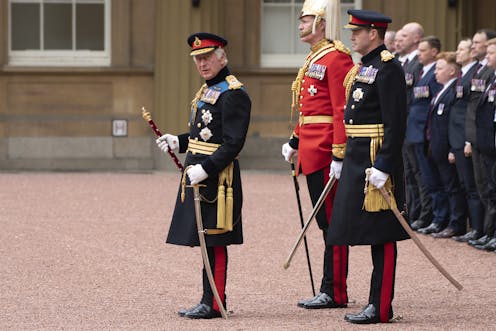
This weekend’s coronation ceremony formally invests the monarch with their regnal powers – but King Charles III has been doing the job since he was proclaimed king in September 2022. So what does a monarch actually do?
Historically, the role of the monarch was to maintain the peace of the realm, oversee the administration of justice, and to uphold the rule of law in the land. While the king still represented the nation symbolically, it was a far more hands-on, practical role than monarchs of today.
Roles and responsibilities
The monarch’s position description, so to speak, includes the roles of head of state, head of nation, head of the Church of England, head of the Armed Forces, and head of the Commonwealth. These are largely ceremonial and symbolic roles – the king does not intervene in the day-to-day running of these institutions.
As head of state, the king performs certain constitutional duties. These include appointing a prime minister and inviting them to form a government, forming and dissolving parliament, opening and closing parliament each year, and signing legislation.
Upon election, the prime minister meets with the king, who formally invites them to form a government. While monarchs are expected to remain non-partisan and apolitical, they are kept informed on state matters daily and meet with the prime minister each week. These meetings are private and no record is kept of what is discussed – so, yes, those scenes in The Crown are complete fiction[1]. The king can consult and advise, but the prime minister is under no obligation to follow any advice he provides.
The king’s parliamentary roles are largely ceremonial, with one exception. The king can dissolve parliament. The last king to do this was William IV in 1831 during the Reform Crisis.
Throughout the Commonwealth, such as Australia, the king is represented by governors-general. They perform for these nations the same constitutional duties performed by the king for the UK. Governor-General Sir John Kerr famously dismissed Prime Minister Gough Whitlam and dissolved Australian parliament in 1975. After decades of speculation about the role of the Queen in the dismissal, the so-called Palace Papers[2] revealed that while the Palace was interested in the matter, Kerr had acted independently.
Read more: Australian politics explainer: Gough Whitlam's dismissal as prime minister[3]
In international affairs, the king can act as a representative of the United Kingdom, such as meeting political leaders and hosting state functions, but cannot act politically on its behalf.
As head of nation, the king is a “focus for national identity[4]”, symbolising its unity and continuity. In this role, the king recognises citizen achievements, attends events, and broadcasts special messages to the nation. This may include annual messages, such as the Christmas message, or special broadcasts, such as the Queen’s address at the height of the pandemic.
The king is also the head of the Church of England and Defender of the Faith[5]. However, prior to his ascension to the throne, Charles expressed a more inclusive desire to be the defender of faiths, reflecting the multicultural and multi-faith reality of the UK and the Commonwealth.
Although the king served in all three arms of the British forces and still maintains several ceremonial rankings, the role of Head of Armed Forces is also symbolic. Should the UK go to war, the king won’t determine its defence strategy, but he will officially declare both when the country is at war and when it is over.
During the second world war, the royal family played an important role in fostering national and military morale. Then-Princess Elizabeth famously joined the Auxiliary Territorial Service[6] when she turned 18, and trained as a mechanic.
In addition to these roles, the king also holds various royal patronages[7]. This involves providing support to his chosen organisations by attending events and bringing publicity to the causes.
As the Prince of Wales, Charles held over 420 patronages[8]. He inherited a further 600 following the death of Queen Elizabeth II. Some patronages were associated with the rank of Prince of Wales, so have been passed on to Prince William. Others may be redistributed amongst the senior royals in order to ensure a manageable royal workload.
Read more: King Charles will redistribute hundreds of charity patronages – here's why they are such an important part of royal life[9]
Senior royals and Counsellors of State
Although there is only one monarch (it’s in the name, after all), the king does not work alone. He is often assisted in his representational duties by a group of family members referred to as the “senior” or “working royals”. These are members of the royal family who carries out duties on behalf of the Crown. Traditionally, the senior royals[10] comprise the monarch’s consort, the heir and the heir’s spouse and children, and other children and their spouses. However, the current list of senior royals includes the king’s brother, Prince Edward, and his wife, Countess Sophie, and the king’s sister, Princess Anne.
The Duke and Duchess of Sussex (aka Harry and Meghan) famously resigned from their role as senior royals in early 2020. Prince Andrew has been removed from public duties due to allegations of sexual abuse[11] and his association with the convicted sex trafficker, Jeffrey Epstein.
However, both Prince Harry and Prince Andrew remain among the Counsellors of State[12]. Counsellors are determined by law – the Regency Act[13] – and are authorised to carry out minor official constitutional duties of the king if he is overseas or unwell, such as attending Privy Council meetings and signing routine documents. But they can’t perform major duties such as appointing prime ministers or dissolving parliament.
Counsellors of State are appointed from the four adults next in succession who have reached the age of 21. The monarch’s spouse is also eligible for appointment, even though they are not in line to the throne. This meant that following the ascension of King Charles, the Counsellors of State were Queen Camilla, Prince William, Prince Harry, Prince Andrew, and Princess Beatrice.
However, as Prince Harry and Prince Andrew are not actively carrying out royal duties, and Prince Harry is no longer resident in the UK, there was some concern about the appropriateness and the sheer logistics[14] of the current list of counsellors. To address this, the Counsellors of State Act 2022[15] expanded the Regency Act to specifically include Prince Edward and Princess Anne, providing the king with two more local, active, and experienced counsellors to call on.
Read more: Why Prince Andrew and Prince Harry can fill in for the King, and how the law might change[16]
Questioning the monarchy today
King Charles’ ascension to the throne in September 2022 prompted various national conversations around the Commonwealth of Nations[17] about the prospect of becoming republics.
The monarch’s various duties may be largely symbolic, but symbols are powerful articulations of particular values, relationships, and histories[18]. It is important for the various nations of the Commonwealth to reflect on their symbols and institutions as they look toward their futures.
References
- ^ those scenes in The Crown are complete fiction (www.theguardian.com)
- ^ Palace Papers (www.abc.net.au)
- ^ Australian politics explainer: Gough Whitlam's dismissal as prime minister (theconversation.com)
- ^ focus for national identity (www.royal.uk)
- ^ Defender of the Faith (theconversation.com)
- ^ Princess Elizabeth famously joined the Auxiliary Territorial Service (www.nationalww2museum.org)
- ^ royal patronages (www.royal.uk)
- ^ Charles held over 420 patronages (theconversation.com)
- ^ King Charles will redistribute hundreds of charity patronages – here's why they are such an important part of royal life (theconversation.com)
- ^ senior royals (www.harpersbazaar.com)
- ^ allegations of sexual abuse (theconversation.com)
- ^ Counsellors of State (www.royal.uk)
- ^ Regency Act (www.legislation.gov.uk)
- ^ concern about the appropriateness and the sheer logistics (theconversation.com)
- ^ Counsellors of State Act 2022 (www.legislation.gov.uk)
- ^ Why Prince Andrew and Prince Harry can fill in for the King, and how the law might change (theconversation.com)
- ^ conversations around the Commonwealth of Nations (www.theguardian.com)
- ^ histories (theconversation.com)
Read more https://theconversation.com/what-does-a-king-actually-do-203842