As Timor-Leste heads to the polls, here's how Australia can support its democracy
- Written by: Melissa Conley Tyler, Honorary Fellow, Asia Institute, The University of Melbourne
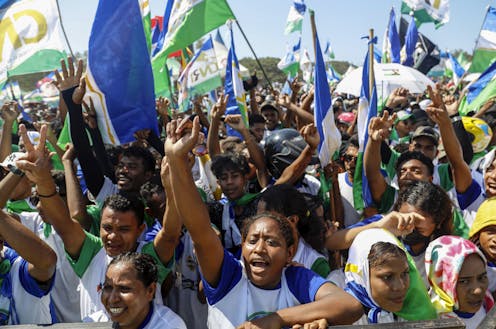
Sunday May 21 is election day in Timor-Leste, when voters decide on 65 members of parliament to represent them. Each election[1] is a reminder[2] of the successful regional and international cooperation that led to Timor-Leste’s independence. It’s also a reminder of the importance of Timor-Leste as an exemplar[3] of democracy, peace and human rights as foundational values.
It is in Australia’s interest that this be nurtured.
As a small state facing many challenges, maintaining these values has regional and global resonance. Timor-Leste is an important voice[4] both in the Pacific and Southeast Asia. It is a successful state that, despite difficulties, has been able to be peace-loving[5] and sustain relations with Indonesia.
By contrast, democratic regression, or the worst-case scenario of a failed state, would be an enormous setback for the entire region.
What role should Australia play in keeping this democracy strong?
The history of the Australia-Timor-Leste bilateral relationship is complicated. It includes the vital Timorese assistance during the second world war and Australia’s tacit approval of Indonesia’s 1975 annexation. It also includes Australia leading the United Nations International Force East Timor (INTERFET), which in turn led to Timor-Leste’s transition to independence following a referendum in 1999.
The two nations have been complexly intertwined through Timor-Leste’s journey to independence and democratic development.
There have been instances of unease[6] between the two countries. The most notable was the allegation of Australian spying during negotiations on the Greater Sunrise oil fields. This remains an ongoing issue with the potential to derail ties again.
Read more: After a border dispute and spying scandal, can Australia and Timor-Leste be good neighbours?[7]
But there have also been positive steps, such as Operation Astute, an Australian-led military and police deployment. This operation helped stabilise the country during the 2006-2008 political turmoil that culminated in the attempted assassination of President Jose Ramos-Horta and his medical evacuation.
In 2018, Australia and Timor-Leste concluded a treaty[8] establishing their maritime boundaries following a United Nations conciliation process.
The complexity of the relationship means Australia needs to be respectful in relations, but it should not stop Australia from being a partner to support Timor-Leste’s democratic processes and institutions.
A recent report[9] outlines how Australia can support Timor-Leste’s governance in ways that ensure effective, capable and legitimate institutions that are responsive to people.
Australia has a track record of such programs. The eight-year, $72 million Governance for Development[10] Program supported Timor-Leste agencies to develop good policy and improve systems as well as helping civil society engage with government decision-making. The program worked in areas including public financial management, economic policy, enabling business, public service administration, law reform and financial services.
The Partnership for Inclusive Prosperity[11] (PROVISU) will continue to support good governance and economic policy by providing support to Timor-Leste’s central government agencies and economic ministries. Through programs like this, Australia can offer meaningful support to Timor-Leste.
Good governance that responds to citizens’ needs is a perennial problem. Timor-Leste’s nascent bureaucracy makes this a priority issue. Australia should continue to develop partnerships that strengthen institutions so they are able to deal with problems.
An example of this is PARTISIPA[12], a ten-year $80 million program to improve access to quality basic infrastructure and services. It works in partnership with national and subnational governments to improve the delivery of decentralised services and village-level infrastructure, such as rural water. It continues Australia’s long-term support for the national village development program and its community-driven processes.
Another area where Australia can contribute is in media.
Timor-Leste has a vibrant media landscape[13] that is among the freest in the region. Australian can support Timor-Leste to ensure its media are strong and robust as well as free, with public interest is at its core. It can also work with local media to strengthen their ability to educate the general public on governance issues, to hold power to account and to promote the rule of law.
An example of this is a recent memorandum of understanding between the ABC and Timor-Leste’s public broadcaster RTTL[14], which includes media development programs. The agreement recognises the vital role both organisations play in informing audiences and contributing to democracy. The ABC will work with RTTL to establish a new English-language news service, helping staff enhance their journalism and content-making skills.
Another priority Australia can engage with is the justice system.
Consultations with Timorese civil society organisations, conducted by The Asia Foundation for the Asia-Pacific Development, Diplomacy & Defence Dialogue (AP4D) report[15], revealed a particular concern about rebuilding trust in the judicial system. It’s an area with which Australia has not been greatly involved compared to Portugal.
Australia should also engage with Timorese political parties, recognising the important structural role they play in governance. This can complement continued engagement with formal government institutions and the national parliament. Australia should continue to invest in the protection and promotion of human rights.
Read more: ASEAN leaders give 'in-principle' support for Timor-Leste's membership. What does this actually mean?[16]
Finally, Australia should be a partner for youth civic and political engagement, given the reality of a future political transition[17] from independence leaders to younger generations.
Timor-Leste today lives with a legacy of conflict, which has far-reaching implications. There is significant pressure on government to meet the needs and expectations of the Timorese people. Australia can be a partner to support these goals.
By helping to build a stronger, resilient and prosperous Timor-Leste, Australia is investing in a more secure and stable immediate neighbourhood, which will reap mutual benefits.
References
- ^ Each election (www.newmandala.org)
- ^ reminder (theconversation.com)
- ^ exemplar (www.cfr.org)
- ^ important voice (www.lowyinstitute.org)
- ^ peace-loving (www.visionofhumanity.org)
- ^ unease (theconversation.com)
- ^ After a border dispute and spying scandal, can Australia and Timor-Leste be good neighbours? (theconversation.com)
- ^ concluded a treaty (theconversation.com)
- ^ recent report (asiapacific4d.com)
- ^ Governance for Development (www.dfat.gov.au)
- ^ Partnership for Inclusive Prosperity (www.tenders.gov.au)
- ^ PARTISIPA (www.dfat.gov.au)
- ^ vibrant media landscape (rsf.org)
- ^ ABC and Timor-Leste’s public broadcaster RTTL (about.abc.net.au)
- ^ Asia-Pacific Development, Diplomacy & Defence Dialogue (AP4D) report (asiapacific4d.com)
- ^ ASEAN leaders give 'in-principle' support for Timor-Leste's membership. What does this actually mean? (theconversation.com)
- ^ future political transition (www.lowyinstitute.org)