Quad without hoopla still worked, while China visit will require delicate diplomacy
- Written by: Michelle Grattan, Professorial Fellow, University of Canberra
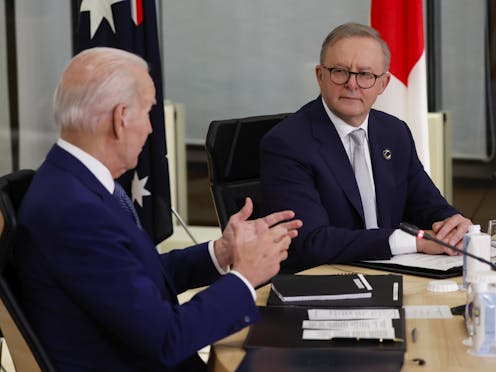
Anthony Albanese now has a firm promise of a state visit to the United States this year, and an invitation to go to China.
If he manages that double-header in coming months, it will be another coup for his foreign policy, underlining both the strength of the Australian-American alliance and the continuing improvement in the relationship with Beijing.
The US visit will be a piece of cake, although no doubt it will lead to a further gritting of teeth from the left of Labor’s base.
The challenges of a trip to China would be more complicated, partly depending on when it occurred and how much further that country had gone in relaxing trade restrictions on Australian products. Last week saw more progress with China bringing Australian timber in from the cold.
Opposition spokesman Simon Birmingham says Albanese should not go before there is “absolute clarity that these trade sanctions are going to be lifted”. That might seem too inflexible, but Albanese would be only too aware of the care he would have to take in such a visit.
China sees the thaw in relations as an opportunity to try to extract concessions – notably on Chinese investment in Australia, and on winning support for its entry to the Comprehensive and Progressive Agreement for Trans-Pacific Partnership (CPTPP).
The Albanese government wants to normalise things, without taking any action that would compromise our national interests. So far, it has (rightly) stepped cautiously, and will need to continue to do so.
When they met for a bilateral during the weekend G7 summit, US President Joe Biden was full of public apologies to Albanese for cancelling this week’s trip to Sydney and Canberra, due to his crisis at home over the debt ceiling.
Albanese (who in an earlier Labor government had been in a few crisis meetings himself) was full of understanding. He’d have done “exactly the same thing”, he said, observing that “all politics is local”. The two signed an agreement for more collaboration on clean energy and climate change.
In the end, while the cancellation of the Australian leg of Biden’s trip swept away the hoopla around having the Quad at the Opera House, and the presidential address to federal parliament, it didn’t matter a great deal.
The leaders of the Quad – which comprises the US, India, Japan and Australia – got together, albeit briefly. (Albanese suggested the fact everyone was happy to delay the G7 dinner to facilitate the Quad meeting showed general recognition of the Quad’s importance.) And various agreements came out of that meeting, the same ones that would have emerged from the aborted Sydney gathering.
In a statement later, Albanese said the Quad leaders discussed regional challenges (for which, read China) and noted they released “a shared vision for the Quad and the Indo-Pacific region”. In practical terms, there were agreements relating to access to clean energy in the Indo-Pacific, and health security and connectivity infrastructure in the region.
Read more: Grattan on Friday: Albanese governs on softly-softly catchee monkey formula. Would Plibersek or Chalmers have been bolder?[1]
Meanwhile, despite the enormous pressures from high inflation and rising interest rates, the government is using the anniversary of its May 21, 2022, election victory to talk up its achievements on the economy, notably job creation.
Treasurer Jim Chalmers on Sunday issued a Treasury analysis of ABS employment data showing the government has had the “strongest start for jobs growth” of any Australian government at their first anniversary.
According to these figures, between May 2022 and April 2023, 333,000 more Australians were employed. The next-highest first year number was 198,600 under the Rudd government.
Female employment is at “record highs”, with female unemployment down to 3.3%, the lowest since August 1973.
The government says Australia has posted stronger employment growth than any of the major advanced economies. The Treasury analysis shows wages are growing faster and more people are receiving pay rises since the government won the election. The higher wages growth has left average full-time annual earnings about A$1,000 higher than they would have been under the previous rate of growth, the government says.
We can expect to hear a good deal about these figures from Chalmers in the media and when parliament resumes on Monday. His release brings to mind the practice of his old boss, former Treasurer Wayne Swan, who frequently put out treasury analyses (some of which were contested).
Albanese returns overnight from Japan to a gritty fortnight of parliament, with the House of Representatives debating the legislation for the Voice referendum (the House vote is expected next week) and Senate estimates taking some deep dives into various decisions.
The referendum is still many months away in the final quarter of the year (the government has given no date yet), but the campaigning is stepping up and becoming more fraught.
Read more: Politics with Michelle Grattan: Labor MP Marion Scrymgour on the Voice and the need for a new NT jobs program[2]
There has been a softening of the “yes” vote in some polling, and last week a nasty stoush broke out between two Indigenous leaders on the “yes” side.
Mick Gooda, a former social justice commissioner, said he feared the defeat of the referendum and proposed removing the reference to the Voice making representatives to “executive government” to boost its chances.
This prompted Noel Pearson, one of the leaders of the Voice campaign, to accuse “little Micky Gooda” of “wetting the bed”.
The government has no intention of changing the wording of the proposed constitutional amendment.
But it will hope its “information program” on the Voice, launched at the weekend and going into a wide range of media, will remove the doubts of some voters who are presently uncertain.
Minister for Indigenous Australians Linda Burney said that in parallel with the media campaign, the Museum of Australian Democracy and Constitution Education Fund Australia were set to deliver a grassroots civics program with general information about the constitution and referendum processes.