Victoria's rapid exit from native forest logging is welcome – and long overdue
- Written by: David Lindenmayer, Professor, The Fenner School of Environment and Society, Australian National University
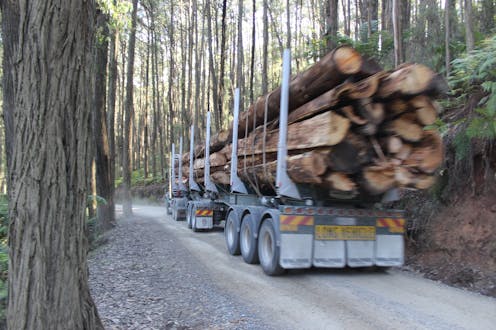
By the end of the year, Victoria’s trouble-plagued native forest industry will end – six years ahead of schedule. The state’s iconic mountain ash forests and endangered wildlife will at last be safe from chainsaws. And there will be no shortage of wood – there’s more than enough plantation timber to fill the gap.
Today’s announcement[1] by Premier Daniel Andrews is excellent news for forests, the state’s economy, and its threatened species. We congratulate the Victorian government for this decision.
Ending native forest logging is long overdue. For decades, we’ve known of how much damage it does to biodiversity. Logging vast areas of Victoria’s native forests over the past several decades has pushed many once-common animals, such as the greater glider[2], to become endangered.
Even now, the last remaining logging areas proposed under the state’s Timber Release Plan[3] overlap directly with the areas of highest conservation value[4] for biodiversity.
Our research has catalogued the damage done to produce low-value products such as woodchips and paper pulp. The industry never made economic sense. The state-owned logging company, VicForests, has been running at a loss for many years. The industry can switch to our abundant plantations of eucalyptus and pine.

What damage did native forest logging do?
The vast majority of areas slated for logging provide habitat for more than 50 threatened and rare species. We know that the more forests are logged, the less likely[5] we are to find species such as the critically endangered Leadbeater’s Possum. Logging pushes species into decline. Common species become threatened and threatened species move closer to extinction.
The lead author of this article has been part of a team conducting ecological monitoring and research in Victoria’s forests for almost 40 years.
We have seen the damage first-hand. We’ve watched old forests of high conservation value be clearfelled when they should not have been. We’ve watched essential habitat such as large old trees, with their all-important nesting hollows, become rarer and rarer.
We have seen extraordinary animals such as the Southern Greater Glider go from the most common species identified in night surveys to so scarce they’re now endangered.
We have seen once intact landscapes become dominated[6] by highly flammable young forest at risk of extremely severe wildfires.
And we watched in dismay as logging fragmented landscape. Now up to 70%[7] of Victoria’s critically endangered mountain ash forests are either severely disturbed by wildfire and logging or within 200 metres of such areas.
 The greater sooty owl depends on large old hollow-bearing trees to rear young and will benefit from the cessation of native forest logging.
Darren Bellerby / Flickr
The greater sooty owl depends on large old hollow-bearing trees to rear young and will benefit from the cessation of native forest logging.
Darren Bellerby / Flickr
Native forest logging never made sense
Almost all (86%) of felled native forests in Victoria are turned into low-value products such as woodchips, paper pulp and boxliners.
In 2018, we estimated sawn timber equates to just 14% of the volume of logs[8] cut from native forests.
By contrast, more than 80% of all sawn timber in Victoria comes from plantations[9]. Native forest timber does not help build houses.
Read more: Logged native forests mostly end up in landfill, not in buildings and furniture[10]
Bringing forward the end of native forest logging from 2030 will be a major boost for climate action – equal to[11] removing 730,000 petrol or diesel cars from our roads every year. This single decision gives Victoria – and Australia – a far greater chance[12] of meeting their emissions reductions targets.
In its last annual report[13], VicForests announced a loss of A$54 million and a loan of $80 million. It’s now propped up only by the Victorian Treasury.
Even before these losses, the Victorian Parliamentary Budget Office showed the state would be $190 million better off[14] without it.
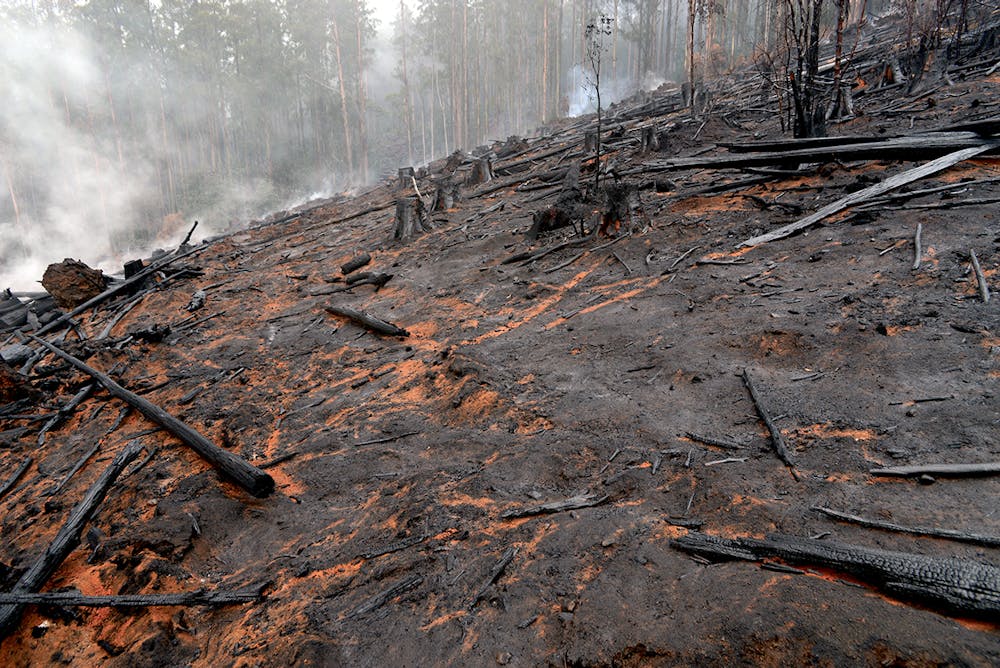 Logging practices left little behind to support native plants and animals, and could contribute a lot of ash and sediment to streams if it rained.
David Blair
Logging practices left little behind to support native plants and animals, and could contribute a lot of ash and sediment to streams if it rained.
David Blair
How can we help forests recover?
Ending logging will take pressure off our forests. But we can’t simply walk away from heavily damaged areas. Many areas have never properly regenerated after logging or repeated fire.
In north-eastern Victoria, years of logging have warped the composition of tree species in the forest; many areas are dominated by trees that are largely unsuitable[15] as food sources for koalas and greater gliders.
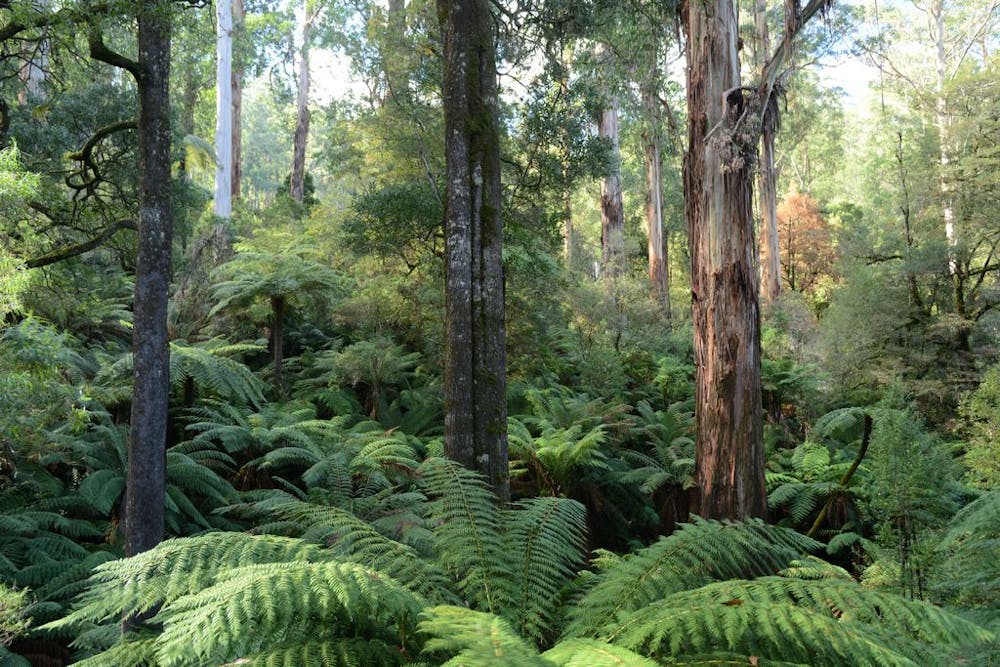 A mixed age forest in Melbourne’s O'Shannassy water catchment. Mature forests produce higher quality water for Melbourne and more of it than logged areas.
David Blair / The Australian National University
A mixed age forest in Melbourne’s O'Shannassy water catchment. Mature forests produce higher quality water for Melbourne and more of it than logged areas.
David Blair / The Australian National University
The urgent task is to restore forests across Victoria while managing fire and invasive species such as deer.
That’s not all. We will still need wood and paper. Ending native forest logging requires getting things right in Australia’s plantations.
At present, we export up to 95% of all plantation eucalypt logs we grow for processing overseas. That’s a missed opportunity for local jobs.
Even now, the plantation sector is crying out for more workers in haulage and processing. This sector offers comparable jobs for workers leaving the native forest sector. But there will be other jobs: forest restoration, firefighting, feral animal control, carbon stock management and more. Getting the transition right is important.
The exit from native forest logging must now be coupled with the declaration of a Great Forest National Park in the Central Highlands region. The region has been a hotspot for native forest logging in recent decades.
It’s almost ten years since the state’s then-environment minister Lisa Neville promised this park would be declared[16]. Once established, the new park should be co-managed with First Nations peoples to ensure Aboriginal self-determination, as well as good opportunities to work on Country.
Today is a day for celebrating. At last, Victoria’s government has acted for the future. Preserving our native forests is worth much more in carbon storage, water production and tourism than they ever were as woodchips.
Victoria’s move is a clarion call for other Australian states still doggedly logging their precious forests.
Read more: When is a nature reserve not a nature reserve? When it's already been burned and logged[17]
References
- ^ announcement (www.premier.vic.gov.au)
- ^ greater glider (www.environment.vic.gov.au)
- ^ Timber Release Plan (www.vicforests.com.au)
- ^ highest conservation value (doi.org)
- ^ less likely (doi.org)
- ^ become dominated (doi.org)
- ^ up to 70% (doi.org)
- ^ volume of logs (theconversation.com)
- ^ comes from plantations (www.agriculture.gov.au)
- ^ Logged native forests mostly end up in landfill, not in buildings and furniture (theconversation.com)
- ^ equal to (www.premier.vic.gov.au)
- ^ far greater chance (www.canberratimes.com.au)
- ^ annual report (www.vicforests.com.au)
- ^ better off (sway.office.com)
- ^ largely unsuitable (www.sciencedirect.com)
- ^ would be declared (www.theage.com.au)
- ^ When is a nature reserve not a nature reserve? When it's already been burned and logged (theconversation.com)