Using electric water heaters to store renewable energy could do the work of 2 million home batteries – and save us billions
- Written by: David Roche, Research Director - Strategic Energy Collaborations, University of Technology Sydney
Australia’s energy transition is well under way. Some 3 million households have rooftop solar[1] and sales of medium-sized electric cars[2] are surging. But as we work towards fully electric households powered by renewable energy, have we overlooked a key enabling technology, the humble electric water heater?
About half of Australian households[3] use electric water heaters, while the rest use gas. So what’s so great about electric water heaters?
Electric water heaters offer a cheap way to store large amounts of energy, in the form of hot water. A heater with a 300-litre tank can store about as much energy as a second-generation Tesla Powerwall – at a fraction of the cost.
Our research[4] at the UTS Institute for Sustainable Futures has found Australians could use household electric water heaters to store as much energy as over 2 million home batteries of that kind. This could eventually save over A$6 billion a year on our energy bills while getting us closer to net-zero carbon emissions.
Our report[5], published today and funded by the Australian Renewable Energy Agency (ARENA), recommends that, to halve emissions by 2030 and reach net zero by 2050, we urgently need policies to rapidly replace gas water heaters with “smart” electric water heaters. Smart heaters can be switched on and off in response to changes in electricity supply and demand across the grid.
This means these heaters can soak up excess “off-peak” renewable energy, particularly from solar, and so help us solve two key problems at once. They can help reduce and eventually eliminate greenhouse gas emissions. And they can make our electricity grid more stable by providing flexible demand that helps balance out the fluctuating supply from renewable sources.
Cutting emissions
There are three main types of electric water heater. A conventional “resistance” heater uses electricity to heat water directly. Solar water heaters use sunlight and electricity, but have become less popular as newer “heat pump” units emerged. These collect heat from the air and “pump” it into water. A heat pump uses three to four times less electricity than a resistance heater.
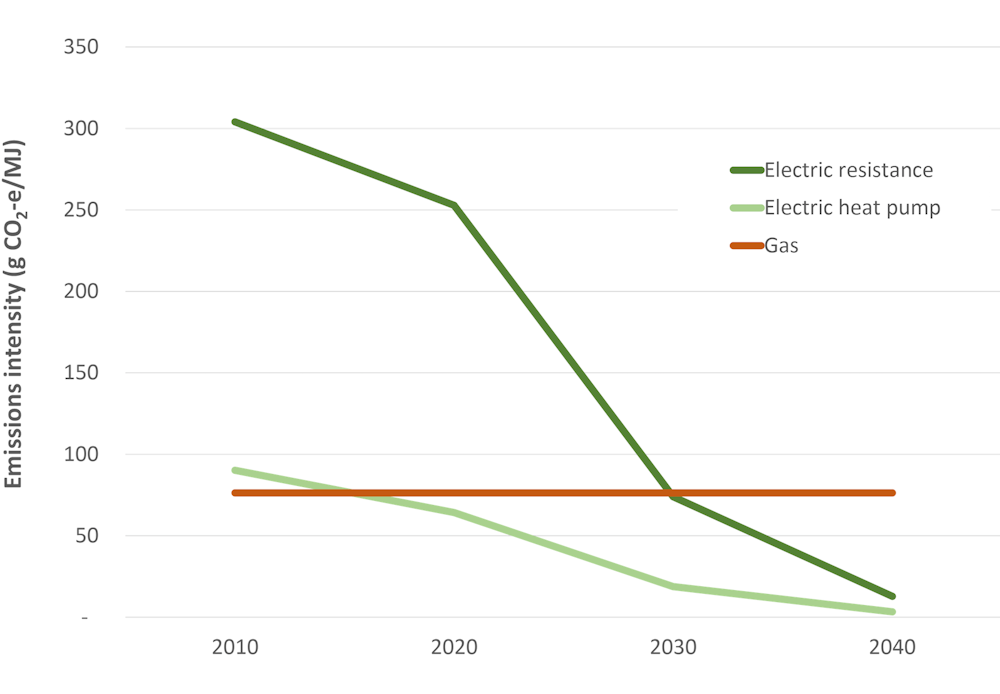
Back in 2010, a resistance electric water heater typically produced around four times more emissions than its gas equivalent. Heat pump emissions were about the same as for gas. That’s because electric water heaters use a lot of electricity[6], and most of it came from burning coal.
As we generate more electricity from renewables, this picture is changing dramatically. Australia’s energy market operator, AEMO, publishes regularly updated pathways to a clean-energy future. In the most likely outcome, the “step-change scenario[7]”, gas will become the most greenhouse-intensive water-heating option by 2030.
By 2040, once the transition to a renewable electricity system is largely complete, emissions from resistance and heat pump water heaters will be much lower than for their gas counterparts.
Water heaters can last 15 years or more. So the stock of heaters in our homes for the next two decades depends on what we install today. Replacing gas heaters with electric heaters should therefore be an immediate priority in our energy transition.
Our work[8] explored a range of scenarios, each with a different mix of water-heating technologies. One was a business-as-usual baseline where gas water heaters remain prevalent. In alternative scenarios gas is phased out over the next 10–20 years.
We found that replacing gas with electric water heating would not only help us get to net-zero emissions sooner, it would save us money.
Gas is expensive and unlikely to get much cheaper. Abundant renewables offer an excess of cheap electricity that water heaters can help soak up. Embracing this opportunity could save over $6 billion a year on our energy bills by 2040.
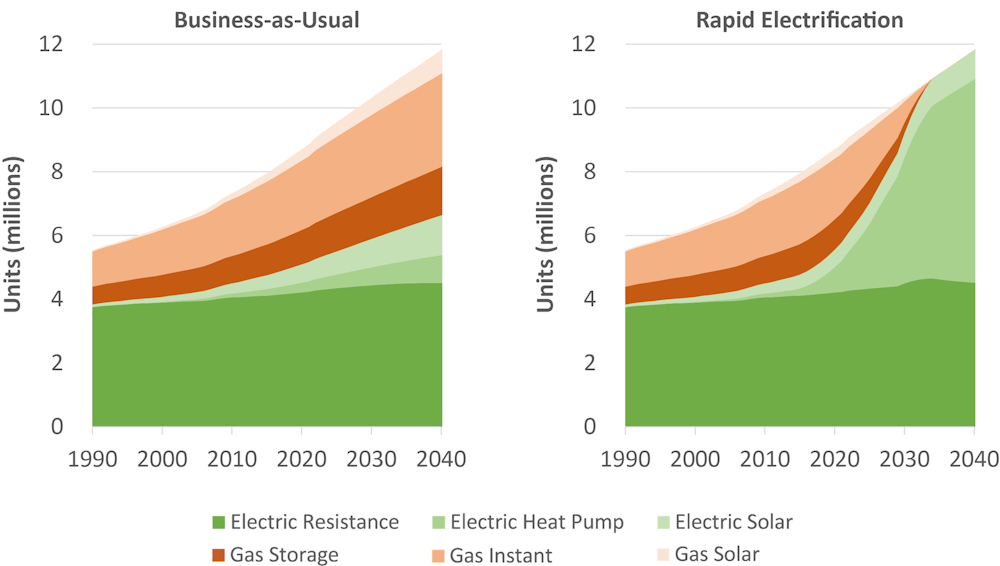 In our modelling of the National Electricity Market, business-as-usual policy (left) locks in costly and high-emissions gas units for decades to come. In our rapid electrification scenario (right), electric water heaters rapidly replace gas units.
Author provided
In our modelling of the National Electricity Market, business-as-usual policy (left) locks in costly and high-emissions gas units for decades to come. In our rapid electrification scenario (right), electric water heaters rapidly replace gas units.
Author provided
Boosting grid stability
Solar and wind are now the cheapest technologies we’ve ever had for generating electricity[9]. But to maintain a stable electricity system, we need to match demand with the fluctuating supply from renewable sources. Batteries offer a partial solution, but are still relatively costly.
Electric water heaters offer a much cheaper way to store large amounts of energy and provide the demand flexibility the grid needs.
Our research[10] found that, compared to the business-as-usual baseline, a scenario that emphasises demand flexibility using smart electric water heaters could provide an extra 30GWh of daily flexible demand capacity. That’s the equivalent of over 2 million home batteries across the National Electricity Market, which supplies electricity to eastern and southern Australia.
Back to the future for water heating
Since the 1950s, “off-peak hot water” has seen Australian electricity providers turning household water heaters off during the day and on at night to better match demand and supply. In return, customers received heavily discounted prices.
In recent decades we’ve moved away from off-peak electric hot water, as incentives dwindled and more homes connected to natural gas[11].
As we electrify our hot water, which technology should we embrace: resistance or heat pump? The answer is both.
Our research[12] explored the trade-off between highly flexible resistance water heaters versus highly efficient but less flexible heat pumps.
Heat pumps use less electricity and cost less to run. Where electricity prices are high or power flow is limited, using heat pumps makes sense. However, they have a higher upfront cost and are not suited to all homes. Many apartments, for example, lack access to suitable outdoor space.
And because they use less electricity, heat pumps offer less flexible demand. As renewables, particularly solar, increasingly power our grid, the ability of resistance electric heaters to soak up excess “off-peak” renewable energy is a big advantage.
With the right policies and market reforms, we will all benefit from a system that once again rewards customers with cheap off-peak electricity in exchange for network operators being able to switch our water heaters off and on as needed.
References
- ^ 3 million households have rooftop solar (iea-pvps.org)
- ^ sales of medium-sized electric cars (www.theage.com.au)
- ^ half of Australian households (www.energynetworks.com.au)
- ^ Our research (www.uts.edu.au)
- ^ Our report (www.uts.edu.au)
- ^ use a lot of electricity (www.energy.gov.au)
- ^ step-change scenario (aemo.com.au)
- ^ Our work (www.uts.edu.au)
- ^ cheapest technologies we’ve ever had for generating electricity (www.un.org)
- ^ Our research (www.uts.edu.au)
- ^ connected to natural gas (www.energynetworks.com.au)
- ^ Our research (www.uts.edu.au)