Where was the Sun? Here's why astronomers are more useful in court cases than you'd think
- Written by: Brad E Tucker, Astrophysicist, Australian National University
Over the past eight years, I have been asked to submit astronomical evidence for court cases all over Australia.
Normally when we think of evidence in court, we think of eyewitnesses, DNA[1] or police reports. Often, this evidence requires an expert to explain it – to be able to communicate the findings and data to the members of the court to make an informed decision. These experts are typically in medicine, engineering, psychology, or other fields.
Expert astronomers usually are not what one pictures in court, but that is exactly what I do.
The first time I was asked by police to do it came as a bit of a surprise. I had never thought about applying astronomy to the courtroom. Once the first group knew I can do it, more and more requests came in, from colleagues in the same police force or division, or investigators having seen my evidence elsewhere.
Now, I’m asked to submit evidence for roughly 1–2 cases per week. Usually this requires submitting a statement of evidence[2] to the court. But sometimes I am asked to attend court and explain what the evidence means.
When I’m needed as an expert in court, it tends to be for matters of consequence. My evidence is either critical to a part of the case, or the case itself is fairly major and all the details are being checked and verified.
But what exactly am I providing evidence for?
Tracking the Sun and the Moon
Most court evidence from an astronomer involves calculating the positions and lighting from an astronomical body – the Sun or Moon. Luckily, the tools we use[3] to calculate the positions of celestial bodies are very accurate, and can be calculated hundreds to thousands of years into the past or future.
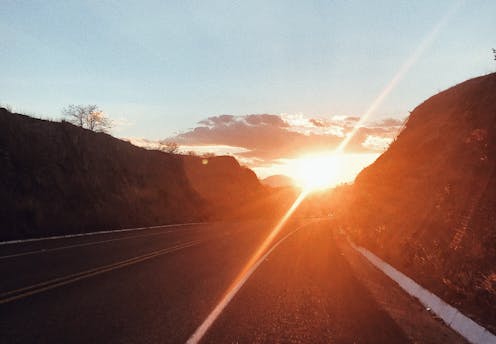
An obvious example is when someone claims the Sun was in their eyes, causing a glare, and they get into a car accident. Someone needs to say where the Sun was, its position, and how it aligned with the street and direction of travel. At certain times and in certain directions, the Sun may indeed hinder someone’s vision.
There is also the situation where someone sees something, but it happened around sunrise or sunset. An expert is needed to say what the lighting level was – as there are very clear definitions based on the Sun’s position below the horizon, and how much you can see. For instance, what if the event occurred five minutes after sunset? The light level depends on the time of year, the location and other factors. It is not a clear-cut case of daytime versus nighttime.
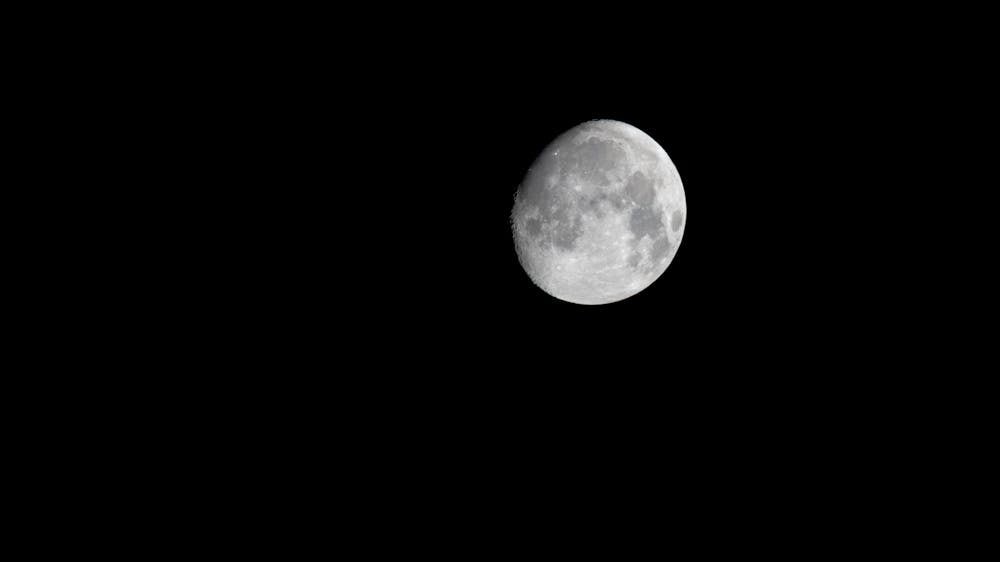
The Moon can feature in court evidence as well. Especially in dark locations away from city lights, an astronomer can provide evidence on how much light the Moon provided on a given night.
There are also historical cases or times when people note the view or phase of the Moon as a way of defining when something happened. The full Moon has a precise definition, but the day before or after may appear to look like a full Moon, despite it not technically being full.
The limitations of expertise
Of course, like any part of science, there are limits to what I can say. If someone was looking through a window – how refractive was the window? Were there clouds blocking the Moon or Sun? It is up to other experts, and other parts of the legal system to sort out these factors.
Just like many fields, space technology is changing, and so too is its impact on law and crime. Satellites are being used more and more in cases to help track things as they happen. For example, the space technology company Maxar[5] operates some of the highest-resolution commercial satellites to image Earth. For a small cost, people can task these satellites to look at certain areas and/or times.
Lately, we have seen the impact of satellites on Russia’s war in Ukraine, and how they have been instrumental in looking at troop movements, and even evidence of some of the alleged war crimes.
Read more: Ukraine war: offensive use of satellite tech a sign of how conflict is increasingly moving into space[6]
Satellite images have been used for a range of criminal investigations, such as people smuggling[7] or illegal mines[8].
They are also being used in Australia for criminal matters. This is yet another situation where an expert is needed to explain the satellite imagery and what it may mean, or even help access it altogether.
Experts are vital
Working as an expert witness has given me hope, because I see the extent to which the justice system will sometimes go to get all the details right – like taking into account the phase of the Moon or the position of the Sun. It is also the perfect example of the importance of experts in our society.
In science, we are actively encouraging people to go to sources of accurate and trustworthy information, especially in an era of rife misinformation.
Through experts, fields like space and astronomy can impact people’s lives directly – even in the court room.
Read more: Servant or partner? The role of expertise and knowledge in democracy[9]
References
- ^ DNA (theconversation.com)
- ^ statement of evidence (www.cornwalls.com.au)
- ^ tools we use (gml.noaa.gov)
- ^ Patrick Ilao/Unsplash (unsplash.com)
- ^ the space technology company Maxar (www.maxar.com)
- ^ Ukraine war: offensive use of satellite tech a sign of how conflict is increasingly moving into space (theconversation.com)
- ^ people smuggling (blog.maxar.com)
- ^ illegal mines (blog.maxar.com)
- ^ Servant or partner? The role of expertise and knowledge in democracy (theconversation.com)