Green hydrogen could be a game changer by displacing fossil fuels – we just need the price to come down
- Written by: Ralph Cooney, Professor Emeritus in Advanced Materials, University of Auckland
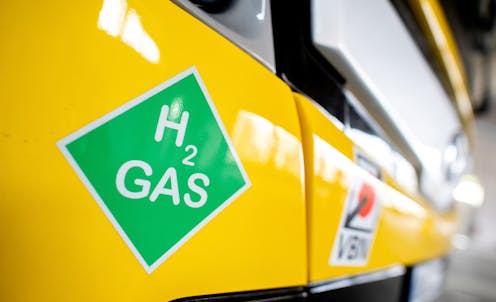
As the global economy moves away from fossil fuels, green hydrogen could be critical to achieving a zero-carbon world by 2050[1].
Green hydrogen offers a solution to decarbonising “hard-to-abate” industries such as steel and fertiliser production, heavy-duty transport and shipping. Recent announcements by high-emitting countries suggest the switch to green hydrogen might be greater and come sooner than expected.
Indian Prime Minister Narendra Modi announced[2] a US$2.3 billion green hydrogen mission, expected to increase 400% by 2050. India’s steel industry and heavy-duty transport will consume about half of this production[3].
According to its latest government plan, China would produce[4] 100,000-200,000 tons of renewable-based hydrogen annually and have a fleet of 50,000 hydrogen-fuelled vehicles by 2025.
The Biden administration announced an investment of US$750 million[5] in green hydrogen. It’s expected to generate 700,000 new jobs and leverage further investment[6] of US$140 billion.
New Zealand’s national grid is far more renewable than the Australian grid, which is still dependent on coal. Nevertheless, both countries are investing in green hydrogen as a future fuel.
The Australian government has allocated A$2 billion in its 2023 budget to accelerate large-scale green hydrogen projects[7]. In New Zealand, the proposed Southern Green Hydrogen project has moved to the development stage. Final investment decisions are expected later this year.
Read more: Green hydrogen is coming - and these Australian regions are well placed to build our new export industry[8]
Green hydrogen transition
Green hydrogen is produced by using renewable energy sources to split water into hydrogen and oxygen, either through electrolysis or photolysis. The former technology is more advanced at this stage.
At present, 98% of all hydrogen is produced using fossil fuels (“grey hydrogen” or “blue hydrogen” if carbon is scrubbed). To meet Paris Agreement targets, hydrogen production needs to be decarbonised. Installed production capacity for green hydrogen will need to increase 75 times before 2030.
The good news is that the cost of green hydrogen is projected[9] to fall to US$2-3 per kilogram by 2030 due to improved production methods and economies of scale. The falling cost of renewables, the increasing demand for energy and the climate change emergency have created unprecedented momentum for clean hydrogen.
Grey and blue hydrogen have their existing industrial uses but will be transition fuels. They’ll eventually be replaced by green hydrogen, which will also meet a rapidly growing range of new uses, such as green steel[10].
Some hydrogen applications are well under way. Airbus is involved in the development of electric planes[11] that use a combination of hydrogen combustion for take-off power and hydrogen fuel cells for mid-flight power.
While most electric vehicles will continue to be powered by batteries, some car makers have had successful hydrogen-fuelled cars in commercial production[12].
High cost of production is the main factor behind the low uptake of green hydrogen. But a price of US$2/kg is considered a potential tipping point to make green hydrogen competitive against other fuel sources. Once this tipping point has passed, projected for 2030[13], green hydrogen is expected to progressively displace fossil fuels across most sectors.
The cost of electrolysers[14] has roughly halved over the past five years. This trend is expected to continue. The recent development[15] of solid-oxide electrolysers that can deliver 100% efficiency at an elevated temperature range promises further growth.
Potential for developing countries
The immediate challenges for green hydrogen are that it will need to gain global acceptance and expand infrastructure urgently.
Future international hydrogen partnerships are expected to benefit both developing and developed economies. An example is Africa, which is well positioned to develop green hydrogen projects given its renewable energy potential[16]. Africa also has rich platinum resources, which are needed for water-splitting catalysis.
Read more: Green hydrogen sounds like a win for developing countries. But cost and transport are problems[17]
North Africa’s great potential to produce green hydrogen[18] is linked to its exceptional solar radiation levels and large wind resource. The World Bank estimates the total wind resource of Algeria[19] is comparable to Europe’s.
Global installations of electrolysers are set to expand by a factor of 120 from 2GW today to 242GW by 2030, according to analysis by BloombergNEF[20]. Major manufacturers include EvolOH, which plans to produce up to 3.75GW per year of electrolysers by 2025, and Plug Power gigafactory, which sources its power from hydroelectricity from the Niagara Falls.
Barriers to uptake
This new revolution in green hydrogen energy has some important residual barriers to resolve.
The first is that the water to be used in electrolysers needs to be free of contaminants. However, the increasing shortage of clean freshwater is a looming global problem.
To obviate this challenge, a research collaboration involving Australian and Chinese universities has demonstrated that seawater can be split[21] using a commercial electrolyser. This approach uses a non-precious catalyst with nearly 100% efficiency. This technology needs further refinement, but it does seem to offer a viable solution.
Read more: For Australia to lead the way on green hydrogen, first we must find enough water[22]
A second problem is that hydrogen in the atmosphere behaves as an indirect greenhouse gas[23]. Hydrogen reacts with OH radicals that would otherwise decompose the potent greenhouse gas methane.
The net effect is that methane persists longer in warming the atmosphere than if hydrogen were not present. The quantification of hydrogen’s indirect greenhouse gas effect hinges on the extent of leakage. This urgently needs more detailed evaluation.
The remaining related problem is pipeline leakiness, estimated[24] at between 2.9% and 5.6%. In an important pipeline test, China’s Sinopec plans to build the first green hydrogen pipeline from Inner Mongolia to Beijing to test hydrogen leakiness[25] under practical conditions.
In parallel developments, the conversion of green hydrogen to green ammonia via a Haber-Bosch type process is the key to using green ammonia as a more easily transported fuel for high-power transportation, as well as a green fertiliser.
In 2100 a person reviewing the emergence of hydrogen may see a link between the coal and steam revolution of the previous centuries that created the climate crisis and the hydrogen revolution that helped resolve it.
References
- ^ zero-carbon world by 2050 (www.economist.com)
- ^ announced (www.upi.com)
- ^ production (www.hellenicshippingnews.com)
- ^ China would produce (www.csis.org)
- ^ investment of US$750 million (www.energy.gov)
- ^ leverage further investment (www.forbes.com)
- ^ accelerate large-scale green hydrogen projects (oilprice.com)
- ^ Green hydrogen is coming - and these Australian regions are well placed to build our new export industry (theconversation.com)
- ^ projected (blogs.worldbank.org)
- ^ green steel (www.theguardian.com)
- ^ development of electric planes (www.airbus.com)
- ^ commercial production (www.toyota.co.nz)
- ^ projected for 2030 (www.rechargenews.com)
- ^ cost of electrolysers (reneweconomy.com.au)
- ^ development (reneweconomy.com.au)
- ^ renewable energy potential (www.eib.org)
- ^ Green hydrogen sounds like a win for developing countries. But cost and transport are problems (theconversation.com)
- ^ great potential to produce green hydrogen (e360.yale.edu)
- ^ total wind resource of Algeria (documents1.worldbank.org)
- ^ analysis by BloombergNEF (www.hydrogeninsight.com)
- ^ seawater can be split (www.adelaide.edu.au)
- ^ For Australia to lead the way on green hydrogen, first we must find enough water (theconversation.com)
- ^ behaves as an indirect greenhouse gas (www.hydrogeninsight.com)
- ^ estimated (www.energypolicy.columbia.edu)
- ^ test hydrogen leakiness (www.offshore-technology.com)