Who benefits most from the protection of free speech – the haves or the have-nots?
- Written by: Arthur Grimes, Professor of Wellbeing and Public Policy, Te Herenga Waka — Victoria University of Wellington
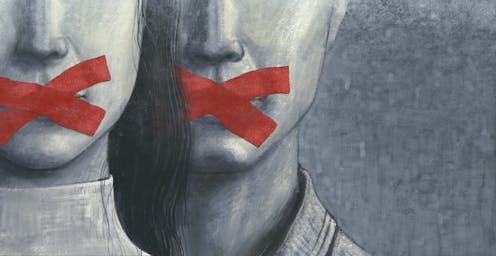
Whether it be repression of free speech under authoritarian regimes or instances of “cancel culture[1]” in various countries, the importance of freedom of expression is as hotly contested as ever[2]. But does freedom of speech benefit all groups equally?
In recently published research[3], we tackled the question of who actually benefits the most from having freedom of speech. Is it people with the most resources – either income or education – who benefit more, or is it people with few resources?
The idea that those with resources benefit most falls in line with the “hierarchy of needs[4]” developed by American psychologist Abraham Maslow. He argued that people would seek to meet their most pressing needs – such as food and shelter – before looking to achieve “luxuries” such as freedom of speech.
But the view that freedom of speech most benefits those with few resources is consistent with the idea that marginalised people have less scope to influence decisions in society through their spending or networks. They require freedom of speech to influence societal decisions.
The right to say anything
The principle of free speech was perhaps best illustrated in 1906 by the writer Evelyn Beatrice Hall, paraphrasing French philosopher Voltaire. She wrote:
I disapprove of what you say, but I will defend to the death your right to say it.
Free speech was entrenched as a right by the United Nations in Article 19 of its 1948 Universal Declaration of Human Rights[5]:
Everyone has the right to freedom of opinion and expression; this right includes freedom to hold opinions without interference and to seek, receive and impart information and ideas through any media and regardless of frontiers.
But it is recognised that even in countries with a high degree of free speech there may be restrictions against hate speech, terrorism and treason[6]. Following the Christchurch massacre, for example, the terrorist’s manifesto and video were classified as objectionable and banned from distribution in New Zealand[7].
And, while the right to freedom of expression is enshrined in most constitutions, people in many countries face restrictions on their speech. During the recent coronation of King Charles, for example, 52 protesters in the United Kingdom were arrested[8] before their protest even started. This was criticised as an assault on their free speech.
Free speech and wellbeing
Our research tested whether changes in countries’ restrictions on free speech were associated with rises or falls in the wellbeing of well-resourced people relative to poorly-resourced people in those countries.
The analysis included 300,000 individuals from more than 90 countries over a 40-year period. It used wellbeing and other individual data from the World Values Survey[9] and the Latino Barometer[10] survey. Wellbeing was measured by how people rate the overall quality of their life.
We supplemented the individual wellbeing data with measures of country-level free speech and human rights, sourced from two independently compiled databases (CIRIGHTS[11] and VDEM[12]). Many countries in the surveys had marked changes in their free speech levels over the study period.
The research produced two key findings.
First, people with more resources place greater stated priority on freedom of speech (when asked to rank its importance).
Read more: Oath Keepers convictions shed light on the limits of free speech – and the threat posed by militias[13]
Second, it was actually the people with fewer resources who benefited most from free speech. The results indicated that free speech empowered those with fewer resources, providing a greater lift to the wellbeing of more marginalised people.
The two results are not incompatible: people with fewer resources may need to prioritise basic needs more than “luxuries” such as free speech but, being in marginalised populations, they may still benefit most from having freedom of expression.
We also found that people who said they valued free speech benefited from living in countries with free speech. And, preferences towards free speech varied according to certain characteristics within the population (in addition to income and education).
Groups more likely to prioritise free speech included the young, students, non-religious people and those on the left of the political spectrum. Preferences also reflected country circumstances, with people in the West being more supportive of free speech than people in other regions of the world.
In defence of the marketplace of ideas
In a world in which freedom of speech is increasingly being placed at risk, it may become important to protect the “marketplace for ideas[14]”. As 19th century thinker John Stuart Mill argued, ideas should “compete” in an open marketplace and be tested by the public to determine which ideas will prevail.
Read more: There are differences between free speech, hate speech and academic freedom – and they matter[15]
Notwithstanding current risks with social media “echo-chambers[16]”, this basic insight still has much to recommend it. People must be able to express their views and receive the views of others openly.
The UN Declaration of Human Rights emphasises this two-way aspect of freedom of expression – that is, people have “the right to seek, receive and impart information and ideas”.
Countries’ laws should reflect Hall’s insistence about freedom of expression – at a national level we should defend people’s right to say what they want. At a personal level, we should also respect the importance of being a good listener, even when, to paraphrase Hall, we disapprove of what is being said.
References
- ^ cancel culture (www.pewresearch.org)
- ^ is as hotly contested as ever (www.article19.org)
- ^ recently published research (www.sciencedirect.com)
- ^ hierarchy of needs (www.simplypsychology.org)
- ^ Universal Declaration of Human Rights (www.un.org)
- ^ hate speech, terrorism and treason (lawecommons.luc.edu)
- ^ banned from distribution in New Zealand (www.dia.govt.nz)
- ^ 52 protesters in the United Kingdom were arrested (newrepublic.com)
- ^ World Values Survey (www.worldvaluessurvey.org)
- ^ Latino Barometer (www.latinobarometro.org)
- ^ CIRIGHTS (cirights.com)
- ^ VDEM (v-dem.net)
- ^ Oath Keepers convictions shed light on the limits of free speech – and the threat posed by militias (theconversation.com)
- ^ marketplace for ideas (rdi.org)
- ^ There are differences between free speech, hate speech and academic freedom – and they matter (theconversation.com)
- ^ echo-chambers (www.pnas.org)