I can't imagine anybody would come out of On The Beach and not hold their loved ones just that little bit closer
- Written by: Huw Griffiths, Associate Professor of English Literature, University of Sydney
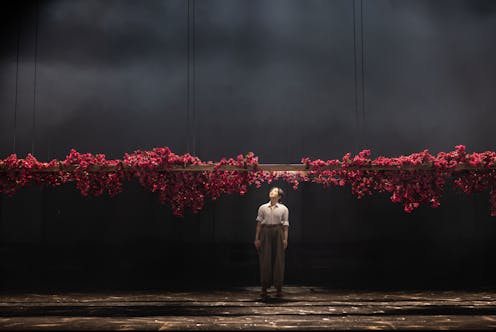
Review: On The Beach, directed by Kip Williams.
When Nevil Shute wrote his 1957 novel On the Beach[1], the world was emerging from the devastation of the second world war to confront new fears.
Shute imagines a not-too-distant future in which a short nuclear war has destroyed life on much of the planet. It has left Australia briefly isolated, with the radioactive cloud slowly advancing towards its beaches. The characters in the novel are waiting out their inevitable deaths.
To adapt this novel in 2023 is to consider our own lives in parallel, as we walk bleary-eyed from the pandemic into a future of escalating global conflict and climate crisis.
Shute’s novel chillingly emphasises the persistence of a kind of stoic duty as an affirmation of the human in the face of overwhelming death. But playwright Tommy Murphy and director Kip Williams have produced something both more poignant and more life-affirming from the dry bones of the original.
Read more: 'This is the way the world ends': Nevil Shute's On the Beach warned us of nuclear annihilation. It's still a hot-button issue[2]
Passion for life
In the first half of this new play for the Sydney Theatre Company, Murphy is able to excavate genuine wit and humour from Shute’s turgid prose, allowing us to care that these people make the right choices for themselves. The dialogue is warm and human. And our connection to the characters in the first half provides a platform for the devastating pathos of the second half.
I can’t have been the only person hopelessly failing to hold back tears as the Max Richter soundtrack[3] played behind some astonishingly affecting tableaux in the closing moments of the play.
Shute famously thought of writing as a “pansy occupation[4]”, only deigning to write if the writing had utility. The novel comes as a conservative warning against complacency.
Australia’s sense of its isolation from global conflict is seen as a delusion against which readers are encouraged to reevaluate their commitment to a collective future. His sights are set as much on his country of birth, the United Kingdom, and what he saw as its disastrous turn towards socialism in the post-war period as they are on the naive utopianism he found in Australia, his adopted country.
In this 2023 adaptation, however, the story is invested with a sensual passion for life that moves well beyond Shute’s stern warnings and instead provides a celebration of sex, love, desire and embodied, animal life.
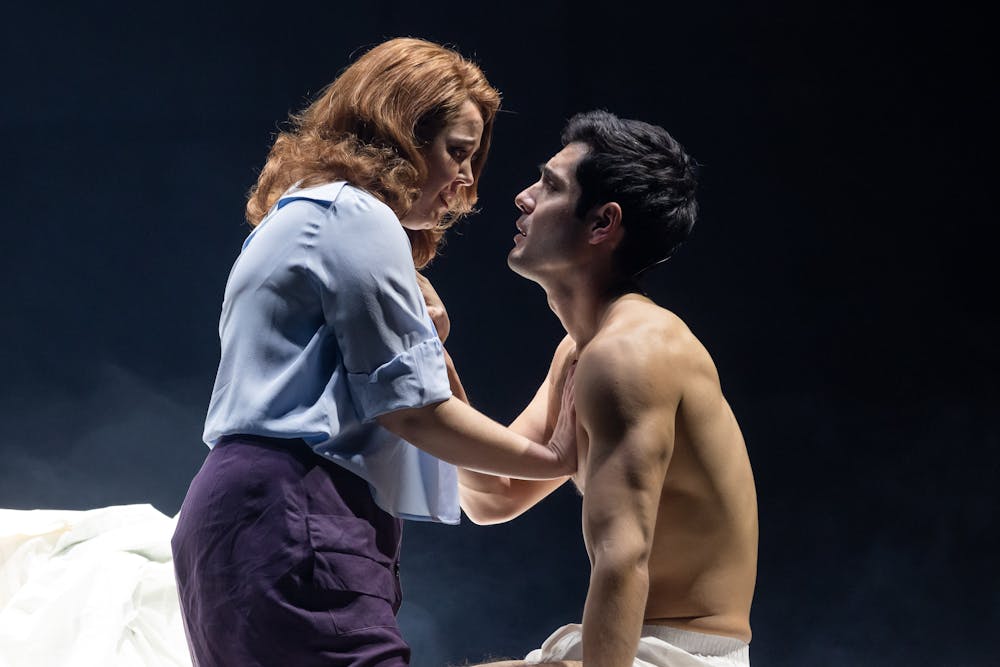 The play is a celebration of sex, love, desire and embodied, animal life.
Daniel Boud/Sydney Theatre Company
The play is a celebration of sex, love, desire and embodied, animal life.
Daniel Boud/Sydney Theatre Company
Where Shute’s characters stoically refrain from sex, this production loves the human body and its capabilities. Regrets here are not for lives lived wrongly but for lost futures that both we and the characters can see reaching out in front of us, unattainable. The beauty of men’s bodies is, in particular, constantly held up by the production as a reminder to both characters and audience of life-affirming humanity.
Read more: 6 books about the climate crisis that offer hope[5]
Fragile lives
Williams’ direction brilliantly brings out the possibilities of Murphy’s script, and the two local theatre makers are on absolutely top form.
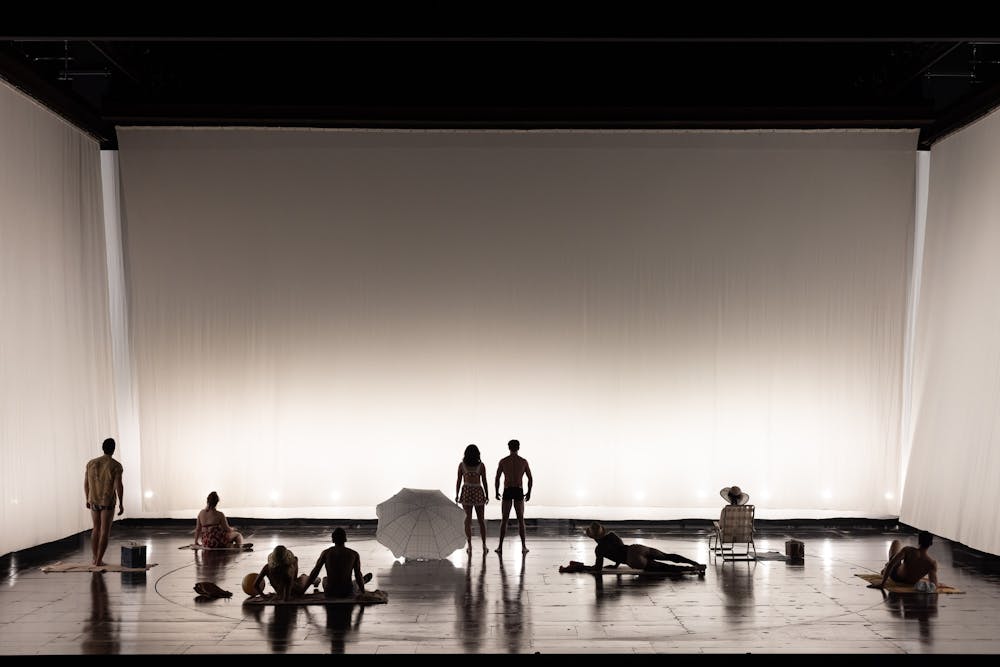
The staging does not contain the complex screen-work of Williams’ recent novelistic adaptations Dorian Gray[6] and Jekyll and Hyde[7], but it is still disarmingly gorgeous. Lighting from Damien Cooper and set design from Michael Hankin contribute to a cinematic experience that underscores the beauty the production draws out of our fragile lives.
Contessa Treffone gives a stand out performance as Moira, carrying much of the emotional weight of the play. The humour of the first half mostly comes from her warm and empathetic rendition of a young woman determined to drain the last drops from the champagne flute of life.
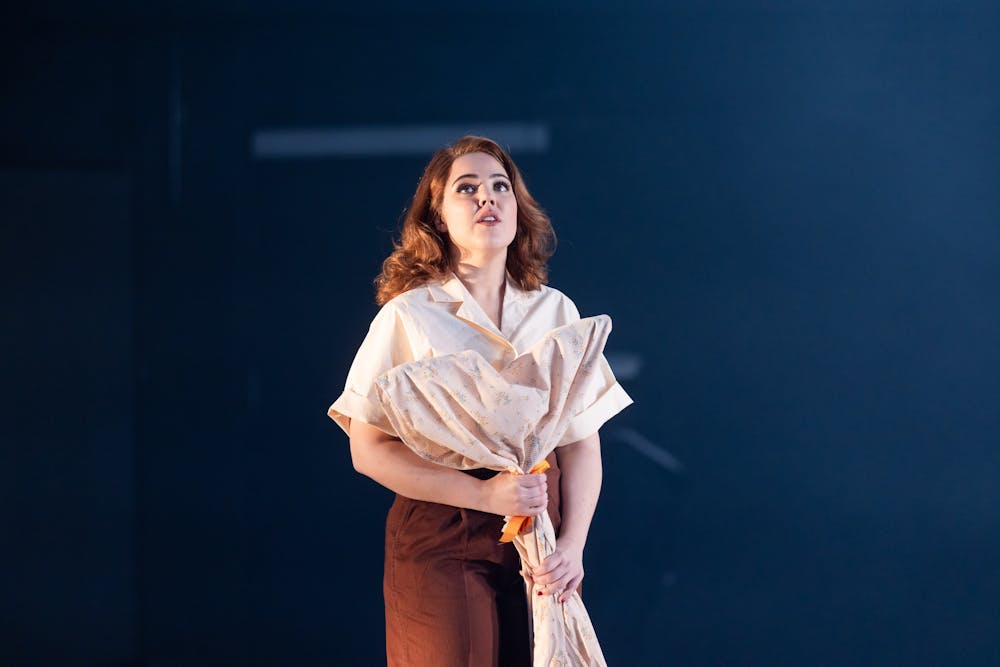 Contessa Treffone carries much of the emotional weight of the play.
Daniel Boud/Sydney Theatre Company
Contessa Treffone carries much of the emotional weight of the play.
Daniel Boud/Sydney Theatre Company
Michelle Lim Davidson as Mary, a mother uncertain what to do with her baby daughter in the face of death, also provides a performance that moves from nimble wit to affecting anguish. Matthew Backer’s scientist, Dr John Osborne, provides some much-needed glue to the scenes set in the submarine that sets out from Melbourne, only to discover a world of lost hopes.
On The Beach is clear-eyed in its pessimistic outlook for our lives. But with rare and important generosity, a sense of inevitable doom is turned into an affirmation of life, love and into a re-commitment to the future.
I can’t imagine anybody would come out of the theatre and not hold their loved ones just that little bit closer. And perhaps they might also take a look around themselves to see all of this beauty we still, perhaps, have time to save.
On the Beach is at the Sydney Theatre Company until August 12.
References
- ^ On the Beach (theconversation.com)
- ^ 'This is the way the world ends': Nevil Shute's On the Beach warned us of nuclear annihilation. It's still a hot-button issue (theconversation.com)
- ^ Max Richter soundtrack (www.youtube.com)
- ^ pansy occupation (www.themonthly.com.au)
- ^ 6 books about the climate crisis that offer hope (theconversation.com)
- ^ Dorian Gray (theconversation.com)
- ^ Jekyll and Hyde (theconversation.com)