New study highlights the brain trauma risks for young athletes
- Written by: Stephen Townsend, Lecturer, School of Human Movement and Nutrition Sciences, The University of Queensland
The Boston University CTE Center[1] today reported the results of the largest-ever study of chronic traumatic encephalopathy (CTE) in young athletes.
The study[2], examining autopsied tissue, found signs of CTE in 63 out of 152 young athlete brains. The subjects of the study competed in youth, high school and college competitions, and all died before the age of 30.
This case series includes the first American woman athlete diagnosed with the disease, just months after the Australian Sports Brain Bank reported the world’s first[3] case of CTE in a female athlete.
The results of this study have major implications for sporting leagues around the globe. Like other dementias, CTE is often assumed to be a disease that develops later in life, but as neuropathologist and Boston University CTE Centre Professor Ann McKee says, “this study clearly shows that the pathology of CTE starts early”.
These latest findings come as Australia’s Senate is due to report[4] the findings of its inquiry into concussions and repeated head trauma in contact sport.
This should push sporting organisations to do more to protect the brains of all athletes, especially in junior and recreational competitions.
CTE and young athletes
CTE[5] is a devastating and currently incurable form of dementia which causes neurodegeneration of the brain[6]. The disease has long[7] been[8] associated with contact sport participation.
Dementias like CTE are often thought of as diseases of the elderly. However, some high-profile cases of CTE have been identified among younger athletes.
In Australia, much-loved NRL player and coach Paul Green[9] was 49 when he died and was later found to have CTE. Former AFL star Shane Tuck[10] was 38 when he died with the disease. Former AFLW player Heather Anderson[11] was only 28. A recent study[12] in the United States also found CTE in the brain of an 18-year-old athlete.
The disease is known[13] to cause mood disorders and behaviour changes. People with CTE may be at higher risk of suicide.
These cases and the latest Boston University study indicate the risk of developing CTE is not restricted to those in their middle or older years. Although there is some evidence developing brains are more vulnerable to trauma[14] – it creates a chronic inflammatory response affecting brain development – the pathology of CTE is still being studied.
The risk factors for young athletes[15] are complex and multifaceted but it is likely that playing junior contact sport heightens an athlete’s risk of developing neurodegenerative diseases as an adult.
The strongest predictor[16] for developing CTE is cumulative exposure to repeated brain trauma, rather than the number of diagnosable concussions. Prolonged exposure to repeated low-level impacts appears to produce a greater lifetime volume of brain trauma when compared with athletes who sustain a small number of more forceful injuries.
Again, the reasons for this dynamic require further study. One potential explanation is that low-level impacts, which often do not reach the clinical threshold[17] for a concussion diagnosis, are easier to ignore and play through.
For the athletes in the Boston University study to develop CTE before the age of 30, it is likely they were exposed to repeated brain trauma from an early age through youth sport.
Read more: Australian researchers confirm world’s first case of dementia linked to repetitive brain trauma in a female athlete[18]
Are contact sports safe for kids?
Public health advocates in North America[19], Australia[20], New Zealand Aotearoa[21] and the United Kingdom[22] have long expressed concerns about the risks of contact sport for children.
Improved oversight would go some way toward reducing the serious health risks of mild traumatic brain injury (concussion). These include post-concussion syndrome[23] (where symptoms do not resolve within the expected time period of about one month) and second impact syndrome[24] (where a young athlete who has previously been concussed receives a second impact either on the same day or up to a week later, resulting in catastrophic outcomes).
Although professional athletes are increasingly subject to monitoring for brain injuries, these practices are not consistently in place for participants in semi-professional, club or junior competitions[25]. It is essential that sports bodies implement the same reporting, monitoring and exclusion protocols all the way through their competitions, especially in junior sport.
First steps
Existing concussion guidelines are not designed to account for the types of sub-concussive injuries (where an impact does not result in observable symptoms) most strongly associated with CTE. To protect them from the disease, contact sporting bodies must reduce young athletes’ lifetime exposure to brain trauma. One way to do this would be to restrict contact in training and games for juniors.
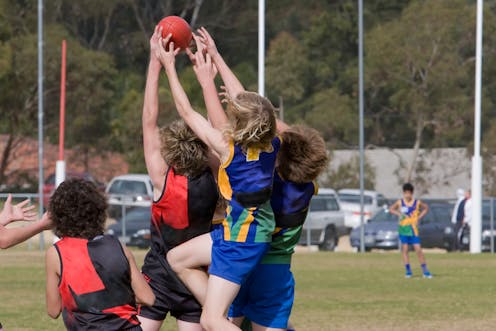
Some sporting bodies have already taken the initial steps. Australian Rules football players[27] are restricted to modified tackling until the age of 12. The National Rugby League[28] will soon implement a ban on tackling until midway through under-7s competitions.
The US Soccer Federation prohibits[29] children under 11 from heading the ball. The UK Football Association will trial a ban on deliberate heading[30] before age 12 – a clear acknowledgement of the dangers of repetitive low-grade brain trauma.
The prevalence of CTE in this study from the US, where athletes routinely wear helmets to play football and ice hockey, is further evidence helmets do not protect young players from concussions or the risk of CTE.
Read more: Do women soccer players have more concussions? This world cup and beyond, here's how to keep our players safe[31]
Changes to tackling rules were met with resistance by those who fear[32] they would “soften” the games. Further measures to protect athletes will require courage from contact sports administrators.
This new study shows CTE can develop in young brains and builds off previous research suggesting the origins of this pathology may lie in junior contact sport. To protect players from neurodegenerative diseases like CTE, sports must reduce cumulative exposure to brain trauma[33] for all athletes, beginning with the junior leagues. In Australia, where children have at least four football codes to choose from, this message must be received with particular urgency.
If this article has raised issues for you, or if you’re concerned about someone you know, call Lifeline[34] on 13 11 14. The National Dementia Helpline number is 1800 100 500.
References
- ^ Boston University CTE Center (www.bu.edu)
- ^ study (jamanetwork.com)
- ^ world’s first (theconversation.com)
- ^ report (www.aph.gov.au)
- ^ CTE (www.mayoclinic.org)
- ^ neurodegeneration of the brain (www.frontiersin.org)
- ^ long (www.frontiersin.org)
- ^ been (www.ncbi.nlm.nih.gov)
- ^ Paul Green (www.abc.net.au)
- ^ Shane Tuck (www.theguardian.com)
- ^ Heather Anderson (www.abc.net.au)
- ^ recent study (www.bu.edu)
- ^ known (www.mayoclinic.org)
- ^ developing brains are more vulnerable to trauma (pubmed.ncbi.nlm.nih.gov)
- ^ risk factors for young athletes (www.nejm.org)
- ^ predictor (www.nature.com)
- ^ clinical threshold (www.concussioninsport.gov.au)
- ^ Australian researchers confirm world’s first case of dementia linked to repetitive brain trauma in a female athlete (theconversation.com)
- ^ North America (www.cambridge.org)
- ^ Australia (www.frontiersin.org)
- ^ New Zealand Aotearoa (www.stuff.co.nz)
- ^ United Kingdom (pubmed.ncbi.nlm.nih.gov)
- ^ post-concussion syndrome (concussionfoundation.org)
- ^ second impact syndrome (www.ncbi.nlm.nih.gov)
- ^ semi-professional, club or junior competitions (theconversation.com)
- ^ Shutterstock (www.shutterstock.com)
- ^ Australian Rules football players (www.play.afl)
- ^ National Rugby League (www.playrugbyleague.com)
- ^ prohibits (www.nytimes.com)
- ^ a ban on deliberate heading (www.thefa.com)
- ^ Do women soccer players have more concussions? This world cup and beyond, here's how to keep our players safe (theconversation.com)
- ^ fear (www.dailymail.co.uk)
- ^ reduce cumulative exposure to brain trauma (concussionfoundation.org)
- ^ Lifeline (www.lifeline.org.au)
Read more https://theconversation.com/new-study-highlights-the-brain-trauma-risks-for-young-athletes-212369