New path for early human migrations through a once-lush Arabia contradicts a single ‘out of Africa’ origin
- Written by: Michael Petraglia, Director, Australian Research Centre for Human Evolution, Griffith University
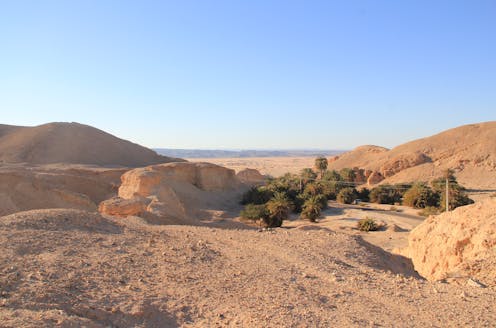
Our species, Homo sapiens, migrated out of Africa multiple times – reaching the Levant and Arabia between 130,000 and 70,000 years ago, as exemplified by human fossils and archaeological sites found at various locations.
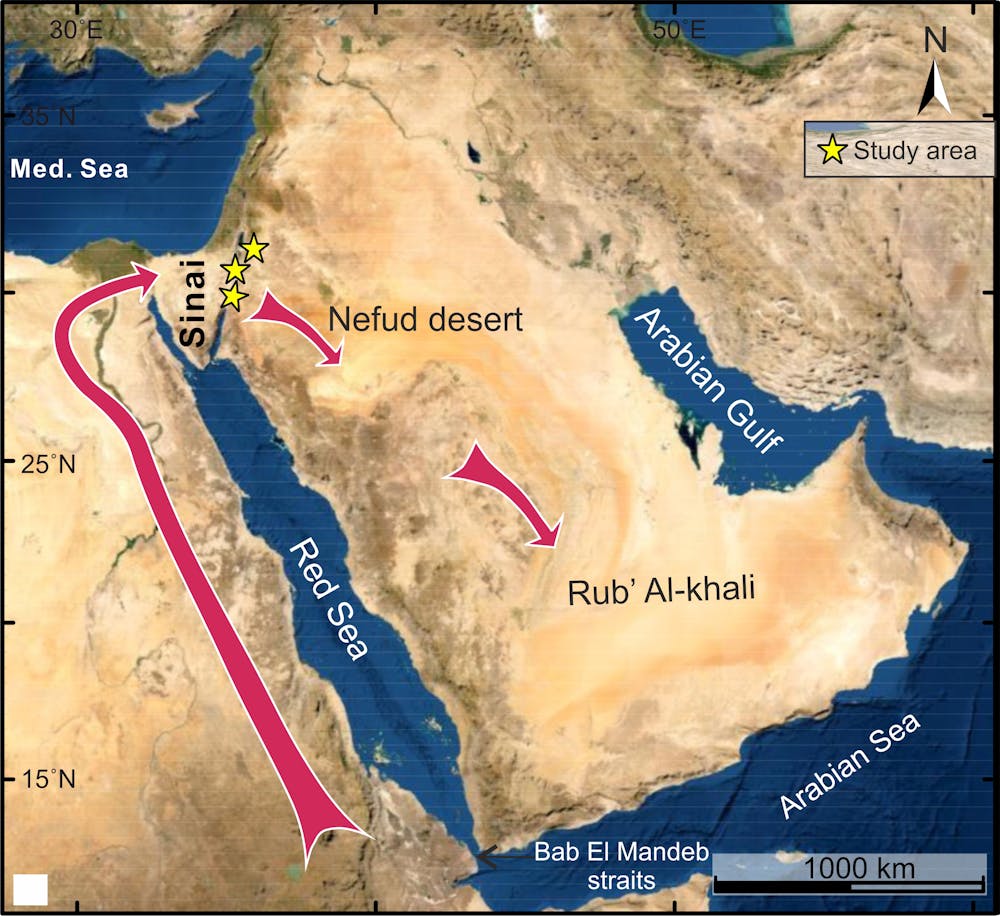
Little is known, however, about the pathways of these migrations. In a study[1] published today in Science Advances, we find the now inhospitable and hyper-arid zone of the southern Jordan Rift Valley was frequently lush and well-watered in the past.
Our evidence suggests this valley had a riverine and wetland zone that would have provided ideal passage for hunter-gatherers as they moved out of Africa and deep into the Levant and Arabia.
Wandering out of Africa
Researchers hypothesise humans migrating out of Africa[2] would have used platforms in the eastern Sahara, the Nile River Valley, or the margins of the western Red Sea.
From there, these small bands of hunter-gatherers would have passed into the Sinai – a land bridge connecting Africa with the rest of Asia – following migrating animals and hunting a variety of them for sustenance.
For many of these hunter-gatherers, the next stop on the journey would have been the southern portion of the Jordan Rift Valley. This valley is situated in a strategic zone, with the Dead Sea to the north and the Gulf of Aqaba in the south.
Our field work was concentrated on three sites. The first two were Wadi Gharandal[3] and an area near the village of Gregra – both in the valley itself. The third site, Wadi Hasa[4], is located in the more elevated areas of the Jordan plateau.
“Wadi” is an Arabic word describing a temporary riverbed that only contains water during heavy rains.
When Arabia was a verdant land
Our goal was to reconstruct the region’s past environmental settings by accurately dating various sections of sediment. We used a technique called luminescence dating to estimate how long sediment grains had been shielded from sunlight, thereby allowing us to calculate how old they were.
Our findings from sedimentary sections ranging 5 to 12 metres in thickness showed ecosystem fluctuations over time, including cycles of dry and humid environments. We also found evidence for the presence of ancient rivers and wetlands.
Luminescence dating showed the sedimentary environments formed between 125,000 and 43,000 years ago, suggesting there had been multiple wet intervals.
At Wadi Gharandal, our team recovered three stone tools associated with a wetland environment. Two of these were made using the Levallois method[5] – a characteristic manufacturing technique known to have been used by both Neanderthals and Homo sapiens. We dated the tools to 84,000 years ago.
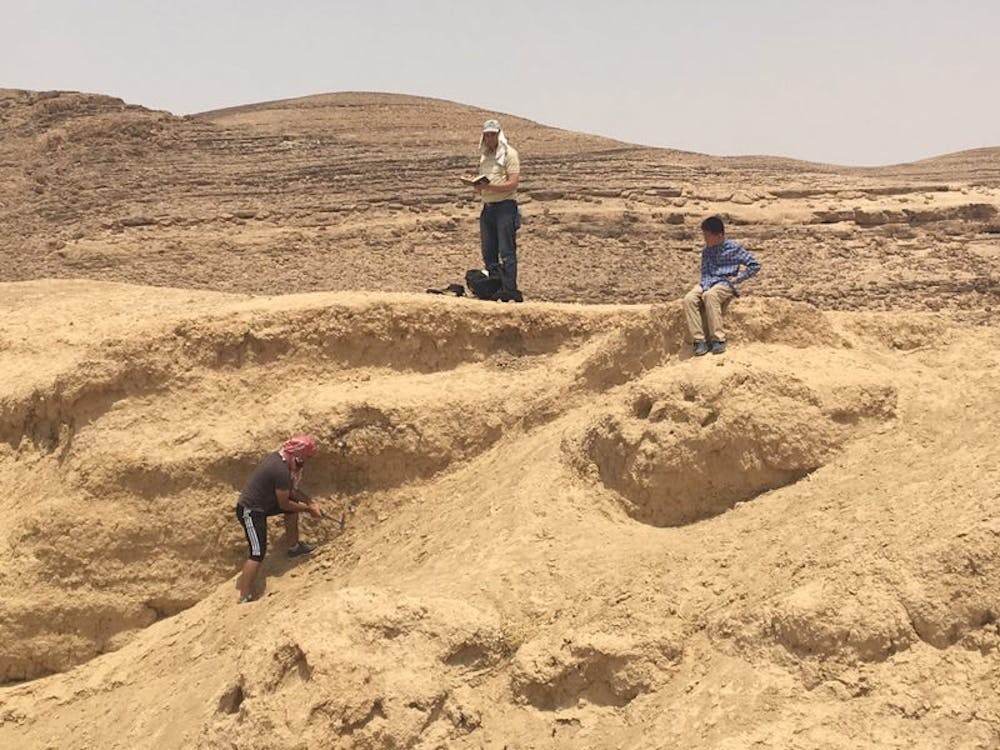 We collected samples for luminescence dating from the Wadi Hasa area in West Jordan. Pictured are Mahmoud Abbas, Mohammed Alqudah and Yuansen Lai.
Zhongping Lai/Shantou University
We collected samples for luminescence dating from the Wadi Hasa area in West Jordan. Pictured are Mahmoud Abbas, Mohammed Alqudah and Yuansen Lai.
Zhongping Lai/Shantou University
Collectively, our fieldwork in the Jordan Rift Valley demonstrates the valley once functioned as a 360-kilometre-long freshwater corridor that helped funnel humans northward into Western Asia and southward into the Arabian Peninsula.
Further evidence for a northward expansion comes from the famous Skhul and Qafzeh[6] cave sites in Israel. Fossils of Homo sapiens and Levallois stone tools have been found here.
Towards the south, fieldwork[7] in northern Saudi Arabia has also demonstrated a network of rivers and lakes was once present in the region. This allowed humans to penetrate a green Nefud Desert replete with savannahs and grassland.
In the heart of the Nefud, the lakeside site of Al Wusta has produced a human fossil and Levallois stone tools[8] dating to 85,000 years ago. These dates coincide with the 84,000-year-old Levallois stone tools found at Wadi Gharandal.
Read more: Major new research claims smaller-brained _Homo naledi_ made rock art and buried the dead. But the evidence is lacking[9]
Multiple migrations into South-West Asia
Our findings from the Jordan Rift Valley indicate there were multiple early human migrations from Africa, and into Asia, during favourable conditions. This opposes the theory of a single[10], rapid wave of human movement out of Africa 60,000 years ago[11].
Our results also suggest, together with the Levantine and Arabian evidence, that hunter-gatherers used inland river and wetland systems as they crossed South-West Asia. This contradicts a popular model suggesting they mainly used[12] coastal routes as super-highways.
Although ancient DNA evidence indicates Homo sapiens interbred with Neanderthals and Denisovans multiple times as they spread into Asia, on-the-ground evidence for these encounters has generally been lacking. Our findings provide further evidence this area served as the ground for these encounters.
Yet numerous questions remain unanswered. Large swathes of territory in South-West Asia have not yet been surveyed or dated – and few fossils of our ancestors have been found[13] to shore up arguments about how early humans really dispersed.
We’ll need to closely investigate more long-neglected areas such as the Jordan Rift Valley to accurately portray how humankind’s voyage out of Africa unfolded.
Read more: Research reveals humans ventured out of Africa repeatedly as early as 400,000 years ago, to visit the rolling grasslands of Arabia[14]
References
- ^ study (doi.org)
- ^ out of Africa (www.sciencedirect.com)
- ^ Wadi Gharandal (www.researchgate.net)
- ^ Wadi Hasa (livinginjordanasexpat.com)
- ^ Levallois method (link.springer.com)
- ^ Skhul and Qafzeh (en.wikipedia.org)
- ^ fieldwork (www.nature.com)
- ^ human fossil and Levallois stone tools (theconversation.com)
- ^ Major new research claims smaller-brained _Homo naledi_ made rock art and buried the dead. But the evidence is lacking (theconversation.com)
- ^ theory of a single (www.science.org)
- ^ 60,000 years ago (education.nationalgeographic.org)
- ^ suggesting they mainly used (www.newscientist.com)
- ^ ancestors have been found (www.science.org)
- ^ Research reveals humans ventured out of Africa repeatedly as early as 400,000 years ago, to visit the rolling grasslands of Arabia (theconversation.com)