How drone submarines are turning the seabed into a future battlefield
- Written by: Adam Bartley, Postdoctoral Fellow, RMIT Centre for Cyber Security Research and Innovation, RMIT University
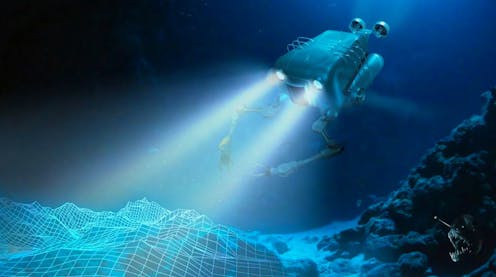
A 12-tonne fishing boat weighs anchor three kilometres off the port of Adelaide. A small crew huddles over a miniature submarine, activates the controls, primes the explosives, and releases it into the water. The underwater drone uses sensors and sonar to navigate towards its pre-programmed target: the single, narrow port channel responsible for the state’s core fuel supply …
You can guess the rest. A blockage, an accident, an explosion – any could be catastrophic for Australia, a country that conducts 99% of trade by sea[1] and imports more than 90% of its fuel.
As drone submarines or “uncrewed underwater vehicles” (UUVs) become cheaper, more common and more sophisticated, Australia’s 34,000km of coastline will face a significant future threat.
What can be done? Our assessment[2] – validated through workshops with experts from across Australia – shows the same technologies can aid our maritime security, if we build them into our planning from now on.
Seabed warfare
Australia is not alone in its rising concern for submarine security. In 2022, France launched its Seabed Warfare Strategy[3] to address autonomous underwater maritime threats. In February 2023, NATO established an Undersea Infrastructure Coordination Cell[4] in response to the sabotage of the Nord Stream gas line in September 2022.
The war in Ukraine has seen relatively small, cheap aerial drones play an outsized role. At a smaller scale, underwater drones[5] have also enabled Ukraine to conduct asymmetric attacks on Russian forces.
Current drones can be used in intelligence, surveillance, reconnaissance, mine countermeasures, antisubmarine warfare, electronic warfare, underwater sensor grid development and special operations, among other things.

However, their capabilities are likely to expand. China’s Haidou-1 project dived to a record depth[7] of 10,908 metres.
A Chinese underwater glider, the Haiyan, holds the drone sub endurance record with a 3,600km voyage over 141 days across the South China Sea. Russia boasts of having a prototype nuclear-powered, nuclear-armed undersea drone[8], although some analysts doubt[9] it really exists.
Nations are also developing broader programs to control underwater sea domains.
For instance, the United States’ proposed Advanced Undersea Warfare System envisions a network of fixed submarine stations able to deploy defensive and offensive drones. In the South China Sea, China is developing an “Underwater Great Wall[10]” of ships, bases and drone (both at surface level and beneath) to monitor the area and make it difficult for foreign navies to operate in international waters.
A new age of war at sea?
Some analysts argue these developments amount to the dawn of a “new age of naval warfare[11]”. Others suggest autonomous maritime systems, as they grow cheaper and more effective, may become preferred over crewed vehicles for national defence: by one estimate[12], uncrewed vessels may make up more than half of the US naval fleet by 2052.
The advent of sea drones may also encourage the further growth of hybrid or “grey zone” approaches to conflict, which avoid outright warfare, keep casualties low, and can inflict heavy costs on enemies. In this context, uncrewed marine vessels may offer states a deniable way to carry out aggressive actions to advance their aims without crossing the threshold of war.
Read more: Ukraine: how uncrewed boats are changing the way wars are fought at sea[13]
Put differently, drone submarines may lend themselves to creating apparent accidents and other actions that can’t be pinned on their instigators. It is worth quoting the French Seabed Warfare Strategy[14] on this point:
an attack on the underwater part of submarine cables is a potential cause of action, with possibilities ranging from a “convenient” accident in a coastal area, to deliberate military action. In this regard, the intrinsic features of the seabed make it the ideal theatre for non-attributable actions in “grey zones”.
The road ahead for Australia
Our new research[15] examined the threat to Australia’s trade posed by autonomous, uncrewed underwater vehicles.
With colleagues at the RMIT Centre for Cyber Security Research and Innovation, Charles Darwin University, and WiseLaw, we ran workshops with people from government, the Royal Australian Navy, Defence, industry and academia. We found a growing tension between efforts to protect ocean-borne trade and critical undersea infrastructure today, and more forward-looking strategies aimed at developing the next generation of maritime defence.
Under the AUKUS security pact, Australia has engaged the United Kingdom and the US to buy and build nuclear-powered submarines, and seeks to acquire and develop new systems “with additional undersea capabilities”. This is a good start, but the scale of the purchases has raised concerns[16] they will become all-consuming for Australia’s military.
Australia also engages in exercises such as Autonomous Warrior[17] to test new and emerging systems in maritime defence. However, these exercises under-examine threats to maritime trade that underwater drones are likely to produce in the future.
One result that emerged from our workshops is that mines are seen as an emerging challenge. Loitering drones with explosives – which could even be commercially available vessels carrying improvised explosives – could hold up commercial ports and traffic, bottle up naval assets, or disrupt maritime shipping routes. This would cause delays, loss of revenue, and increased insurance premiums.
As “set and forget” weapons, mines have an outsized impact as they can cause great damage for a low cost. And they are difficult and costly to find and neutralise.
For the time being, Australia is largely protected from the threat of underwater drones by distance. Current battery and communication technology mean drones would need to be deployed from relatively nearby, and Australia’s maritime environments would make operation difficult.
However, the technology is advancing quickly. The time available for the Australian Department of Defence to address the threat of underwater uncrewed vehicles is shrinking.
This article draws upon research funded under the Strategic Policy Grants Program run by the Department of Defence. The Strategic Policy Grants Program is an open and competitive mechanism for Defence to support independent research, events and activities. The views expressed herein are those of the authors and are not necessarily those of the Australian Government or Defence.
References
- ^ 99% of trade by sea (navalinstitute.com.au)
- ^ assessment (www.rmit.edu.au)
- ^ Seabed Warfare Strategy (www.archives.defense.gouv.fr)
- ^ Undersea Infrastructure Coordination Cell (www.nato.int)
- ^ underwater drones (www.9news.com.au)
- ^ Lee Jin-man / AP (photos.aap.com.au)
- ^ record depth (www.scmp.com)
- ^ undersea drone (en.wikipedia.org)
- ^ some analysts doubt (thebulletin.org)
- ^ Underwater Great Wall (maritimeindia.org)
- ^ new age of naval warfare (www.rand.org)
- ^ one estimate (theconversation.com)
- ^ Ukraine: how uncrewed boats are changing the way wars are fought at sea (theconversation.com)
- ^ French Seabed Warfare Strategy (www.archives.defense.gouv.fr)
- ^ new research (rmit.edu.au)
- ^ concerns (www.abc.net.au)
- ^ Autonomous Warrior (www.australiandefence.com.au)