Voice to Parliament referendum is heavily defeated nationally and in all states
- Written by: Adrian Beaumont, Election Analyst (Psephologist) at The Conversation; and Honorary Associate, School of Mathematics and Statistics, The University of Melbourne
The Voice to Parliament referendum has failed convincingly after the ABC projected[1] large victories for the “no” side in the national vote and all states.
The Poll Bludger[2] is currently projecting a 60.0–40.0% win for “no” in the national vote with 74% of enrolled voters counted.
The Poll Bludger’s current projections in the states are a “no” win in New South Wales (58.9–41.1%), Victoria (54.1–45.9%), Queensland (68.1–31.9%), Western Australia (63.2–36.8), South Australia (64.0–36.0%) and Tasmania (59.0–41.0%).
Read more: Voice to Parliament referendum defeated: results at-a-glance[3]
The referendum required a majority vote in a majority of the states (four of six), as well as a majority vote nationally, to succeed. Votes cast in the Northern Territory and ACT are only counted in the national vote.
The ACT is the only state or territory that will vote “yes”, by a 60.9–39.1% margin in the Poll Bludger projection. The NT is currently projecting for a 61.7–38.3% “no” vote.
Here is the latest aggregate poll graph that was updated with the final Newspoll and JWS polls and the provisional results.
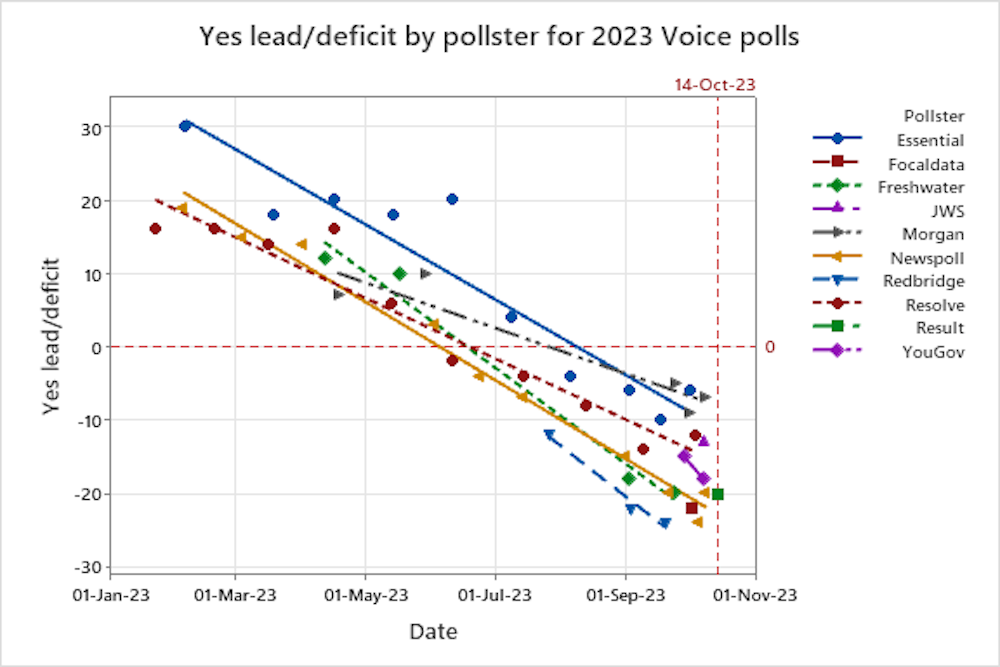
The pollsters were broadly correct – they have been projecting a win for the “no” side for months. However, the Morgan and Essential polls that had “no” ahead by just six and seven points greatly overstated “yes”.
Newspoll’s final poll had a 20-point lead for “no” and YouGov’s final poll an 18-point lead. These two polls were the most accurate compared with the current projected result of a 20-point “no” win. The worse polls for “yes” were more accurate.
In May, I wrote that just one of 25 Labor-initiated referendums had succeeded in winning the required majority of states, as well as a national majority. While not successful, Labor referendums held with general elections have performed far better than when held as a standalone referendum.
In view of this history, it was a blunder to hold this referendum as a standalone vote, rather than at the next general election.
Six of 18 referendums proposed by conservative governments have succeeded. The reason for the huge difference in success rate between Labor and conservative-initiated referendums is that Labor sometimes gives its support to conservative referendums, while the conservatives almost never do in reverse.
Read more: While the Voice has a large poll lead now, history of past referendums indicates it may struggle[4]
There were two late national polls not covered in Friday’s Voice polls’ article[5]. A Newspoll[6], conducted October 4–12 from a sample of 2,638, gave “no” a 57–37 lead, in from 58–34 in the October 3–6 Newspoll. A JWS poll for The Financial Review[7], conducted October 6–9 from a sample of 922, gave “no” a 52–39 lead.
The ABC has called “yes” wins[8] in 28 of the 151 federal seats, and “yes” leads in another five seats. “No” leads in three seats, while the remaining 115 seats have been called for “no”.
The best seats for “yes” were inner city seats where Labor and the Greens do well, such as Greens leader Adam Bandt’s Melbourne, Grayndler and Sydney in NSW and Canberra in the ACT.
References
- ^ projected (www.abc.net.au)
- ^ Poll Bludger (www.pollbludger.net)
- ^ Voice to Parliament referendum defeated: results at-a-glance (theconversation.com)
- ^ While the Voice has a large poll lead now, history of past referendums indicates it may struggle (theconversation.com)
- ^ Voice polls’ article (theconversation.com)
- ^ Newspoll (www.theaustralian.com.au)
- ^ Financial Review (www.afr.com)
- ^ called “yes” wins (www.abc.net.au)