Hello hay fever – why pressing under your nose could stop a sneeze but why you shouldn't
- Written by: Theresa Larkin, Associate professor of Medical Sciences, University of Wollongong

If you have hay fever[1], you’ve probably been sneezing a lot lately.
Sneezing is universal but also quite unique to each of us. It is a protective reflex action outside our conscious control, to remove irritants from inside our nose.
The pressure in the airways[2] during a sneeze is more than 30 times greater than heavy breathing during exercise. Estimates of how fast a sneeze travels range from 5 metres a second[3] to more than 150 kilometres per hour[4].
You can sometimes stop a sneeze by holding your nose or pressing underneath it. This is related to the gate control theory of pain[5] and the idea you can change neural responses with external stimulation. But given the velocity of a sneeze, it might not be a good idea to stop it after it has started.
Read more: How do hay fever treatments actually work? And what's best for my symptoms?[6]
An involuntary reflex
A sneeze is initiated when sensory nerves in our nose are stimulated by an irritant[7] such as allergens, viruses, bacteria or even fluid.
The sensory nerves then carry this irritant information to the brain.
When a threshold amount of irritant signals reach the brain, the sneeze reflex is triggered[8]. A sneeze first involves a deep intake of breath and a build-up of pressure inside the airways[9]. This is then followed by contraction of the diaphragm[10] and rib muscles, reflex closing of the eyes[11] and a strong exhalation.
These are the “ah” and the “tchoo” phases of a sneeze.
On the exhalation of a sneeze, your tongue is lifted to the roof of your mouth. This closes off the back of the mouth[12] so the air is forced mostly through your nose. The air expelled through the nose flushes out the irritants that caused the sneeze. The “tch” sound of a sneeze is the reflexive touching of the tongue to the roof of your mouth.

The trigeminal nerves
The trigeminal nerves are the largest of our 12 pairs of cranial nerves[14] and the largest sensory nerves in the body.
The left and right trigeminal nerves carry sensory information from the face to the brain. This includes touch, pain and irritation sensory information from the facial skin and from inside the nose and mouth. Within each trigeminal nerve are thousands of individual nerve branches that each carry a specific type of sensory information[15].
Read more: Our vagus nerves help us rest, digest and restore. Can you really reset them to feel better?[16]
Sensory nerves communicate in the spinal cord
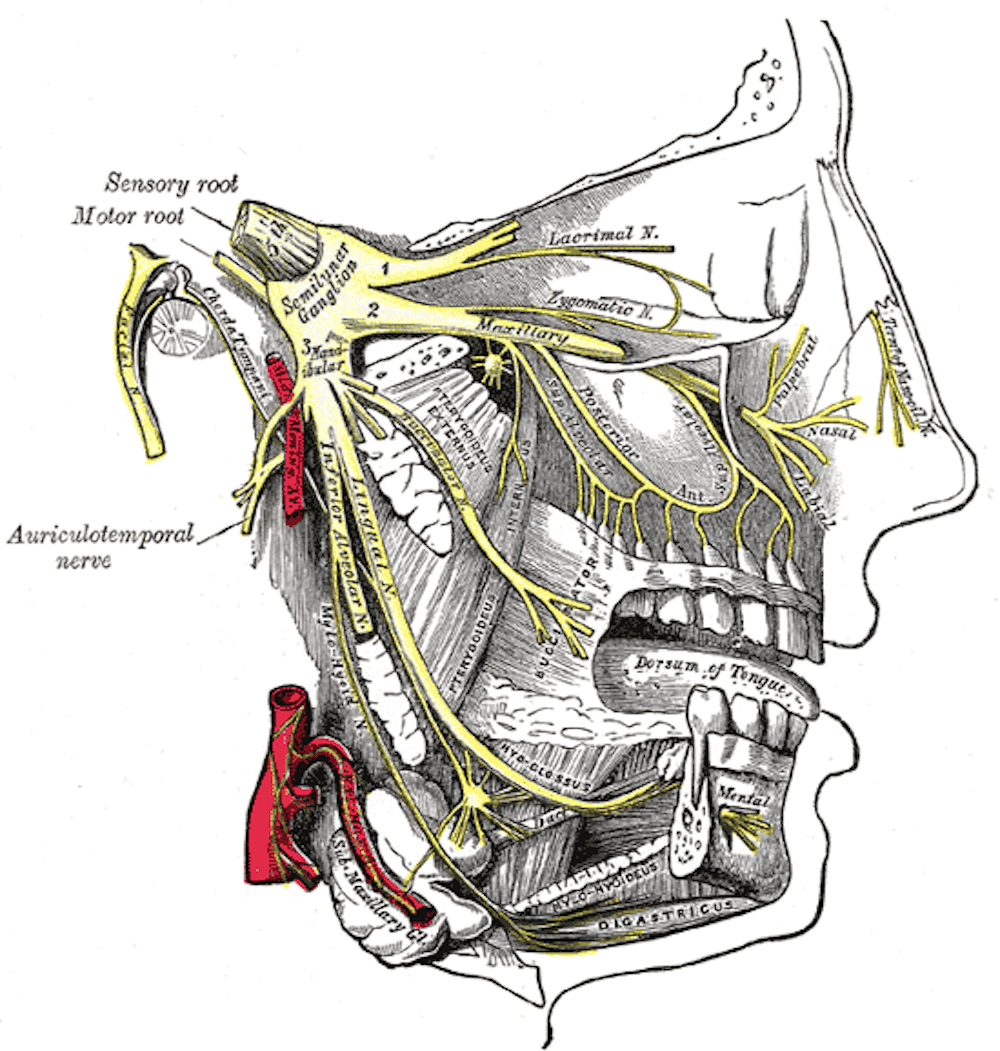 Henry Gray’s anatomical illustration of the trigeminal nerve.
Gray's Anatomy/Wikimedia Commons[17]
Henry Gray’s anatomical illustration of the trigeminal nerve.
Gray's Anatomy/Wikimedia Commons[17]
Sensory nerves travel to the brain via the spinal cord. The sensory nerves that carry pain and irritant signals are narrow, whereas those that carry touch information are wider and faster.
In the spinal cord, these nerves communicate with each other via interneurons before sending their message to the brain. The interneurons are the “gates” of the gate control theory of pain[18].
A nerve carrying a pain signal tells the interneuron to “open the gate” for the pain signal to reach the brain. But the larger nerves that carry touch information can “close the gate” and block the pain messages getting to the brain.
This is why rubbing an injured area can reduce the sensation of pain.
One study[19] showed stimulating the trigeminal nerves by moving the jaw reduced tooth pain. We can observe this in action when babies instinctively bite on things or pull their ear[20] when they are teething. These actions can stimulate the trigeminal touch nerves and reduce pain signals via the gate control mechanism.
So does putting your finger under your nose stop a sneeze?
There are many suggestions[21] of how to stop a sneeze. These include pulling your ear, putting your tongue to the roof of your mouth or the back of your teeth, touching your nose, or even sticking your finger in your nose.
All of these stimulate the trigeminal touch nerves with the goal of telling the interneurons to “close the gate”. This can block the irritant signals from reaching the brain and triggering a sneeze.
Read more: Forget nose spray, good sex clears a stuffy nose just as effectively — and is a lot more fun[22]
But should you stop a sneeze?
What if an irritant in your nose has triggered a sneeze response, but you’re somewhere it might be considered inappropriate to sneeze. Should you stop it?
Closing your mouth or nose during a sneeze increases the pressure in the airways five to 20 times more than a normal sneeze[23]. With no escape, this pressure has to be transmitted elsewhere[24] and that can damage your eyes, ears or blood vessels. Though the risk is low, brain aneurysm, ruptured throat and collapsed lung have been reported[25].
So it’s probably best to try and prevent the sneeze reflex by treating allergies or addressing irritants. Failing that, embrace your personal sneeze style and sneeze into a tissue[26].
Read more: Handkerchief or tissue? Which one's better for our health and the planet?[27]
References
- ^ hay fever (theconversation.com)
- ^ pressure in the airways (www.healthline.com)
- ^ 5 metres a second (journals.plos.org)
- ^ more than 150 kilometres per hour (pubmed.ncbi.nlm.nih.gov)
- ^ gate control theory of pain (www.sciencedirect.com)
- ^ How do hay fever treatments actually work? And what's best for my symptoms? (theconversation.com)
- ^ stimulated by an irritant (journals.sagepub.com)
- ^ sneeze reflex is triggered (www.ncbi.nlm.nih.gov)
- ^ build-up of pressure inside the airways (www.scientificamerican.com)
- ^ contraction of the diaphragm (www.healthline.com)
- ^ reflex closing of the eyes (www.ncbi.nlm.nih.gov)
- ^ closes off the back of the mouth (www.atsjournals.org)
- ^ Shutterstock (www.shutterstock.com)
- ^ largest of our 12 pairs of cranial nerves (my.clevelandclinic.org)
- ^ specific type of sensory information (journals.sagepub.com)
- ^ Our vagus nerves help us rest, digest and restore. Can you really reset them to feel better? (theconversation.com)
- ^ Gray's Anatomy/Wikimedia Commons (upload.wikimedia.org)
- ^ gate control theory of pain (www.physio-pedia.com)
- ^ One study (www.frontiersin.org)
- ^ bite on things or pull their ear (chaimommas.com)
- ^ many suggestions (www.healthline.com)
- ^ Forget nose spray, good sex clears a stuffy nose just as effectively — and is a lot more fun (theconversation.com)
- ^ five to 20 times more than a normal sneeze (pubmed.ncbi.nlm.nih.gov)
- ^ pressure has to be transmitted elsewhere (journals.sagepub.com)
- ^ reported (www.healthline.com)
- ^ sneeze into a tissue (theconversation.com)
- ^ Handkerchief or tissue? Which one's better for our health and the planet? (theconversation.com)