What does a building need to call itself 'accessible' – and is that enough?
- Written by: Ilan Wiesel, Associate Professor in Urban Geography, The University of Melbourne
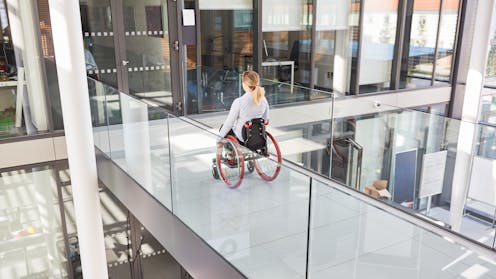
The National Disability Insurance Scheme (NDIS) review[1] and the disability royal commission’s final report[2] both highlighted the crucial role of accessible buildings and homes in ensuring the inclusion of people with disabilities.
But the experiences of people with disability show Australia is a very long way from achieving this. There are the stories from people with disability who can’t enjoy events[3] or venues[4]. And researchers say even accessible bathrooms are not usable[5] for half the people with disability.
What can be called an accessible building or home? And should standards be improved?
Read more: Here's why we need a disability rights act – not just a disability discrimination one[6]
What is accessibility?
The Convention on the Rights of Persons with Disability[7] includes the right to accessibility. Australia’s 1992 Disability Discrimination Act[8] includes premises standards to ensure people with disability have “dignified, equitable, cost-effective and reasonably achievable access to buildings, facilities and services”.
However, a building is exempt if the owners can demonstrate modifying a building would cause them “unjustifiable hardship”. The burden of making a complaint about an inaccessible building falls on people with disability and the act also does not apply to private homes.
Although experts follow different definitions of accessibility, they generally include some key principles:
easy entry and exit into a building
easy navigation and functionality in and around the building
potential for easy adaptation in response to changing needs of occupants.
An accessible building is one where people of all abilities are able move and carry out activities independently, safely, in comfort and with dignity.
For people with disabilities many buildings are inaccessible[9]. In these buildings, basic everyday activities such as taking a shower or preparing breakfast becomes difficult, tiring, uncomfortable and sometimes dangerous.
Some people have been injured[10] repeatedly in inaccessible homes, for example falling down a staircase. Such injuries may compound their disability. Many people with disabilities worry that if they’re injured at home, they will be forced to move permanently into a nursing home.
Studies[11] have found living in inaccessible homes severely harms the dignity, independence, social inclusion, employment, health and wellbeing of people with disabilities.
People become more reliant on family members for support, putting strain on their relationships. Difficulty getting in and out of the house for social activities worsens social isolation. A sense of fatigue also reduces the motivation and capacity to work.
Read more: Taken together, the NDIS review and the royal commission recommendations could transform disability housing[12]
Access through the front door
Dignity is a crucial aspect of accessibility but it is often forgotten. For example, many buildings’ front entry has stairs that make it inaccessible for wheelchair users. There may be an accessible ramp entry in the back of the building. The building is then considered accessible, since wheelchair users can enter and exit. But such a “backdoor treatment” can be experienced as an indignity and discrimination.
Accessible toilets are sometimes used for storage, locked or out of order[13]. Again, although the design meets accessibility standards, in practice the building is inaccessible because of poor management.
And accessibility is not exclusively about physical disabilities and physical barriers.
People with cognitive disabilities, for example, might struggle to find their way in a building if way-finding signs are difficult to understand. Communication accessibility[14] in building is achieved when the information needed to navigate and use the building is understood by everyone, no matter how they communicate.
Silver, gold and platinum standards
There are different levels of accessibility. In Australia, housing accessibility is most often assessed according to Livable Housing Australia[15]’s (LHA) three standards of silver, gold and platinum. Silver-level homes have minimal accessibility features, but are designed in a way that enables easy home modifications over time.
The silver standard of accessibility requires seven features:
• a step-free path of travel from the street or parking area
• at least one step-free entrance
• internal doors and corridors that allow comfortable movement, including for people using wheelchairs
• a toilet on the entry level with easy access
• a bathroom with a hobless shower recess, so there isn’t a step-over barrier to entry
• reinforced walls around the toilet, shower and bath. These allow installation of grabrails later if needed
• stairways designed to reduce the risk of injury and also enable future adaptation.
Gold-level homes have additional accessibility features. Platinum homes are designed for people with higher mobility needs and to allow ageing at home.
A patchwork of standards and what the NDIS review says
In 2021 Australian housing ministers agreed for the first time[16] to introduce minimum accessibility standards in the National Construction Code. It followed decades of campaigning by activist groups such as the Australian Network for Universal Housing Design[17], Rights and Inclusion Australia[18] and the Summer Foundation[19].
The code requires all new homes be built to silver standards. It does not apply to existing homes and exemptions will apply for some newly built homes because of site restrictions.
When the code was introduced, New South Wales and Western Australia announced they would not adopt the new code. Both the NDIS review and the disability royal commission recommended all states and territories immediately adopt[20] the code’s new accessibility standards.
A consistent application of the code’s new standards across Australia is a good start. But the code provides only the minimum standard of accessibility. To make buildings and homes truly accessible, we need to improve education on accessibility for designers, operators and consumers.
An urgent national priority
With Australia’s ageing population, most people will experience disability – or have a household member with disability – at some point.
Accessible homes and buildings can reduce pressure on the health system and improve quality of life. A consistent national construction code is just the first step urgently needed to improve building accessibility and inclusion so people with disability have autonomy and flourish.
References
- ^ National Disability Insurance Scheme (NDIS) review (www.ndisreview.gov.au)
- ^ final report (disability.royalcommission.gov.au)
- ^ can’t enjoy events (www.abc.net.au)
- ^ venues (www.abc.net.au)
- ^ accessible bathrooms are not usable (www.unsw.edu.au)
- ^ Here's why we need a disability rights act – not just a disability discrimination one (theconversation.com)
- ^ Convention on the Rights of Persons with Disability (www.ohchr.org)
- ^ Disability Discrimination Act (humanrights.gov.au)
- ^ many buildings are inaccessible (disability.unimelb.edu.au)
- ^ injured (disability.unimelb.edu.au)
- ^ Studies (www.sciencedirect.com)
- ^ Taken together, the NDIS review and the royal commission recommendations could transform disability housing (theconversation.com)
- ^ storage, locked or out of order (www.sbs.com.au)
- ^ Communication accessibility (theconversation.com)
- ^ Livable Housing Australia (livablehousingaustralia.org.au)
- ^ agreed for the first time (www.industry.gov.au)
- ^ Australian Network for Universal Housing Design (anuhd.org)
- ^ Rights and Inclusion Australia (riaustralia.org)
- ^ Summer Foundation (www.summerfoundation.org.au)
- ^ immediately adopt (disability.royalcommission.gov.au)