Fatigue? Unexplained weight gain and dry skin? Could it be Hashimoto's disease?
- Written by: Aakansha Zala, The University of Queensland
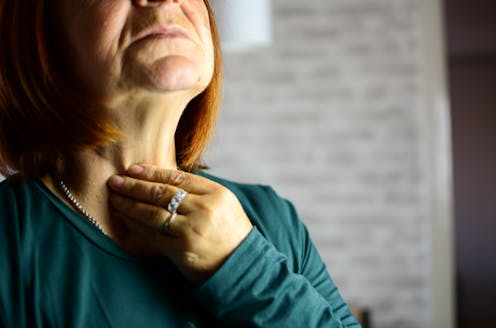
Maybe you feel worn out. Perhaps you’re also having trouble losing weight. Generally, you just don’t feel 100%.
Could it be Hashimoto’s disease? This common autoimmune thyroid disorder is when your immune system (which fights off viruses and bacteria), mistakenly attacks a part of your body. In this case, it’s your thyroid – a gland located at the base of your neck – and can cause low thyroid hormones levels (hypothyroidism).
Hypothyroidism[1] affects one in 33 Australians and Hashimoto’s is one of the most common thyroid conditions[2] in first-world countries.
While symptoms can be subtle, untreated Hashimoto’s can cause long-term problems with your heart, memory and fertility. Here is what you need to know.
Read more: My scan shows I have thyroid nodules. Should I be worried?[3]
What happens when you have Hashimoto’s?
Your thyroid gland[4] is a butterfly-shaped gland in the neck. It is essential in regulating things like muscle function, digestion, metabolism, the heart and lungs. In children, thyroid hormones are also needed for normal growth and development.
Hashimoto’s thyroid disease[5], named after the Japanese doctor who discovered it[6] in 1912, is also known as Hashimoto’s thyroiditis or chronic lymphocytic thyroiditis. The disease can cause the immune system to mistakenly produce proteins called antibodies (thyroid peroxidase and thyroglobulin). These can cause inflammation and long-term damage to the thyroid gland. Over time, as thyroid tissue is inflamed and/or destroyed, there can be a decrease in the production of thyroid hormones (hypothyroidism).
Hashimoto’s can present subtly at first. If you only have antibodies with no change in thyroid levels, it is likely you won’t have any symptoms.
However, as the disease progresses, you may experience fatigue, weight gain (or difficulty losing weight), increased sensitivity to the cold, constipation, dry skin, muscle aches, irregular or heavy menstrual cycles, enlarged thyroid (goitre) and occasionally hair loss, including at the ends of your eyebrows.
Read more: Why am I so tired and when is it time to see the doctor about it? A GP explains[8]
What causes Hashimoto’s thyroid disease?
Several risk factors can contribute to the development of Hashimoto’s including:
What are the long-term risks?
Long-term, untreated Hashimoto’s thyroiditis can cause heart issues[9], higher cholesterol levels[10], nerve damage (peripheral neuropathy), reduced cognition[11] and infertility[12].
In pregnancy, Hashimoto’s has a higher risk of pre-eclampsia (high blood pressure affecting several organs), premature birth, placental abruption (when the placenta separates from the inner wall of the uterus before birth) and, in severe cases, pregnancy loss[13].
The disease has also been linked with an increased risk (but low incidence) of the lymphocytes of the thyroid turning into cancer cells[14] to cause thyroid lymphoma.
How is Hashimoto’s diagnosed?
Diagnosis can be confirmed with a blood test to check thyroid levels and antibodies.
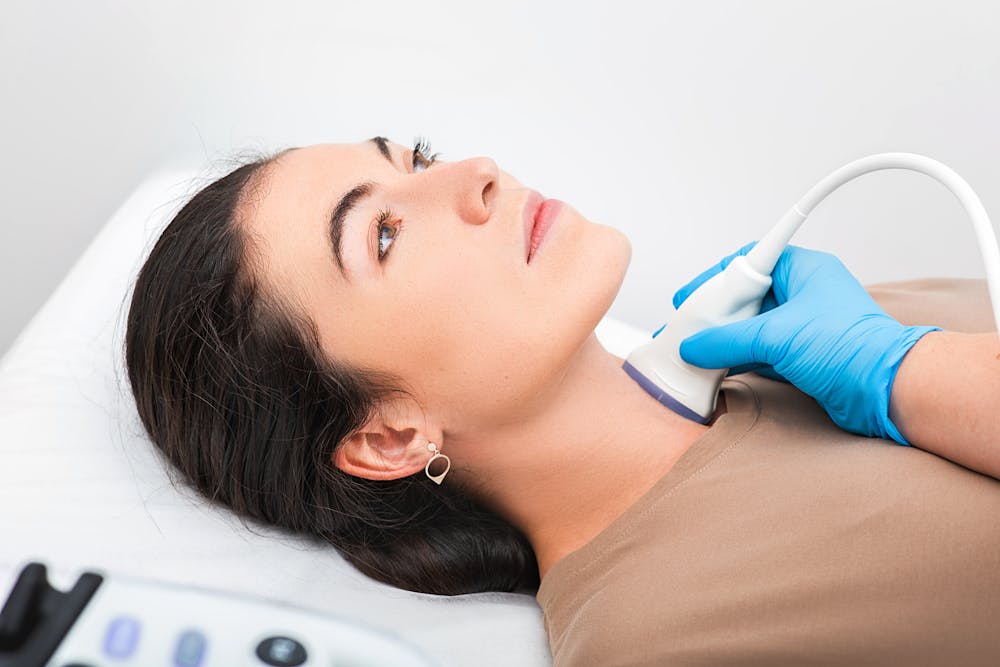
Thyroid peroxidase antibodies are commonly present but about 5% of patients test antibody-negative[15]. In those people, diagnosis depends on the thyroid levels, clinical presentation and ultrasound appearance of general inflammation. An ultrasound may not be required though, especially if the diagnosis is obvious.
Three hormone levels are tested to determine if you have Hashimoto’s.
Thyroid stimulating hormone (TSH) is produced by the brain to speak to the thyroid, telling it to produce two types of thyroid hormones – T3 and T4.
If you have either relative or absolute thyroid hormone deficiency, a test will show the stimulating hormones as high because the brain is trying to get the thyroid to work harder.
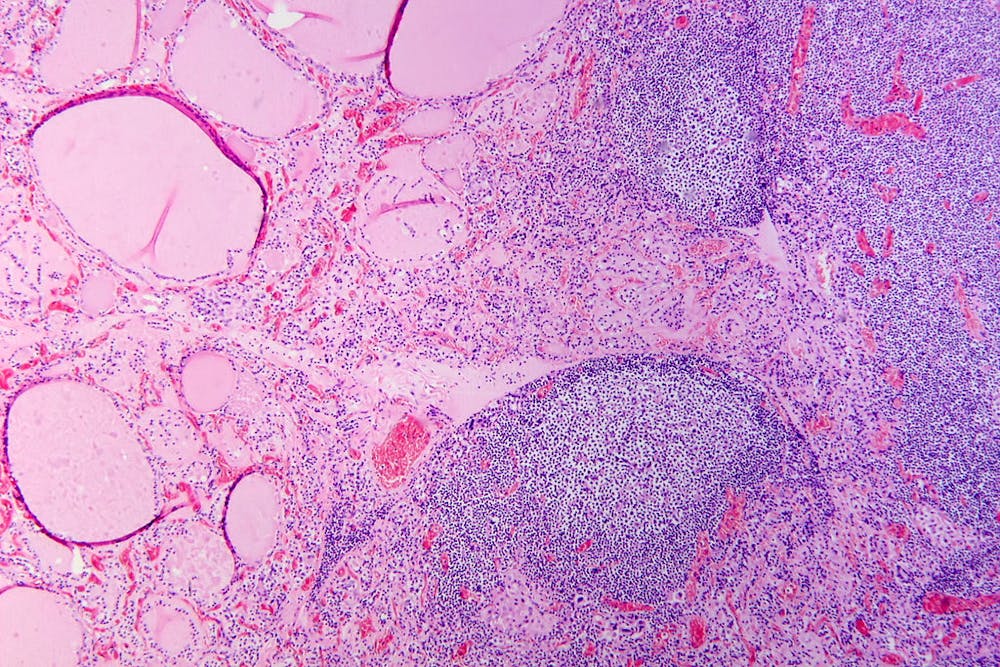 Hashimoto’s thyroiditis under the microscope. Antibodies against thyroid peroxidase and thyroglobulin were elevated.
Patho/Wikimedia Commons, CC BY-SA[16][17]
Hashimoto’s thyroiditis under the microscope. Antibodies against thyroid peroxidase and thyroglobulin were elevated.
Patho/Wikimedia Commons, CC BY-SA[16][17]
Can it be treated?
The management of Hashimoto’s depends on the severity of the thyroid levels. Up to 20% of the population can have antibodies but normal thyroid levels[18]. This is still Hashimoto’s thyroid disease, but it is very mild and does not require treatment. There is no current treatment to reduce antibody levels alone.
Because thyroid peroxidase antibodies increase the risk of abnormal thyroid levels in the future, regular thyroid testing is recommended.
When the thyroid stimulating hormone is high with normal thyroid hormone levels it is termed “subclinical hypothyroidism”. When it is paired with low hormone levels it is called “overt hypothyroidism”. The first is a mild form of the disease and treatment depends on the degree of stimulating hormone elevation[19].
Overt hypothyroidism warrants treatment[20]. The main form of this is thyroid hormone replacement therapy (levothyroxine) with the dose of the drug adjusted until thyroid levels are within the normal range. This is usually a lifelong treatment but, once the dose is optimised, hormone levels usually remain relatively stable.
In some people with very enlarged thyroid glands causing compressive symptoms (such as difficulty swallowing or breathing), thyroidectomy (surgical removal of the thyroid) is considered.
Hashimoto’s thyroiditis is a common condition caused by your body’s immune system incorrectly damaging to your thyroid and can go undetected. Long-term, untreated, it can cause issues with your heart, cognition, and fertility. It can be diagnosed with a simple blood test. Speak to your doctor if you have any concerns as early diagnosis and treatment can help prevent complications.
Read more: Long COVID should make us rethink disability – and the way we offer support to those with 'invisible conditions'[21]
References
- ^ Hypothyroidism (www.racgp.org.au)
- ^ most common thyroid conditions (www.ncbi.nlm.nih.gov)
- ^ My scan shows I have thyroid nodules. Should I be worried? (theconversation.com)
- ^ thyroid gland (www.healthdirect.gov.au)
- ^ Hashimoto’s thyroid disease (www.healthdirect.gov.au)
- ^ Japanese doctor who discovered it (www.jstage.jst.go.jp)
- ^ Shutterstock (www.shutterstock.com)
- ^ Why am I so tired and when is it time to see the doctor about it? A GP explains (theconversation.com)
- ^ heart issues (pubmed.ncbi.nlm.nih.gov)
- ^ higher cholesterol levels (pubmed.ncbi.nlm.nih.gov)
- ^ cognition (www.ncbi.nlm.nih.gov)
- ^ infertility (pubmed.ncbi.nlm.nih.gov)
- ^ pregnancy loss (www.frontiersin.org)
- ^ cancer cells (www.ncbi.nlm.nih.gov)
- ^ test antibody-negative (pubmed.ncbi.nlm.nih.gov)
- ^ Patho/Wikimedia Commons (commons.wikimedia.org)
- ^ CC BY-SA (creativecommons.org)
- ^ normal thyroid levels (pubmed.ncbi.nlm.nih.gov)
- ^ degree of stimulating hormone elevation (pubmed.ncbi.nlm.nih.gov)
- ^ warrants treatment (pubmed.ncbi.nlm.nih.gov)
- ^ Long COVID should make us rethink disability – and the way we offer support to those with 'invisible conditions' (theconversation.com)