Israel now ranks among the world’s leading jailers of journalists. We don’t know why they’re behind bars
- Written by: Peter Greste, Professor of Journalism and Communications, Macquarie University
Israel has emerged as one of the world’s leading jailers of journalists, according to a newly released census[1] compiled by the New York-based Committee to Protect Journalists.
Each year, the committee releases a snapshot of the number of journalists behind bars as of December 1 2023 was the second highest on record with 320 in detention around the world.
In a small way, that is encouraging news. The figure is down from a high of 363 the previous year.
But a troublingly large number remain locked up, undermining press freedom and often, human rights.
Read more: More than one journalist per day is dying in the Israel-Gaza conflict. This has to stop[2]
China takes out unenviable top spot
At the top of the list sits China with 44 in detention, followed by Myanmar (43), Belarus (28), Russia (22), and Vietnam (19). Israel and Iran share sixth place with 17 each.
While the dip in numbers is positive, the statistics expose a few troubling trends.
As well as a straight count, the Committee to Protect Journalists examines the charges the journalists are facing. The advocacy group found that globally, almost two-thirds are behind bars on what they broadly describe as “anti-state charges” – things such as espionage, terrorism, false news and so on.
In other words, governments have come to regard journalism as some sort of existential threat that has to be dealt with using national security legislation.
In some cases, that may be justified. It is impossible to independently assess the legitimacy of each case, but it does point to the way governments increasingly regard information and the media as a part of the battlefield. That places journalists in the dangerous position of sometimes being unwitting combatants in often brutally violent struggles.
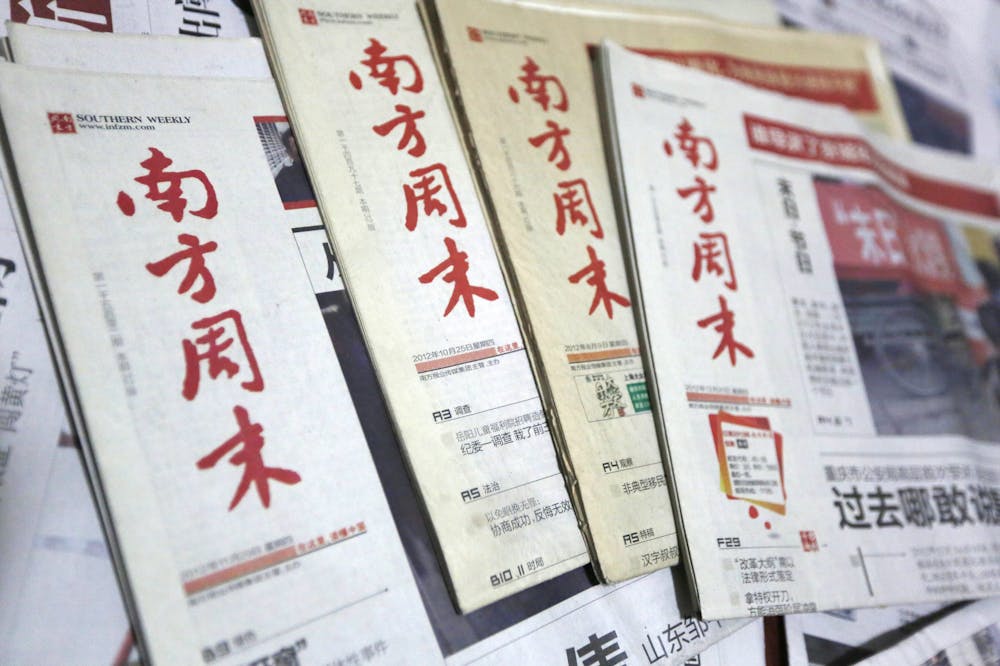
China’s top spot is hardly surprising. It has been there – or close to it – for some years. Censorship makes it extremely difficult to make an accurate assessment of the numbers behind bars, but since the crackdown on pro-democracy activists in 2021, journalists from Hong Kong have, for the first time, found themselves locked up. And almost half of China’s total are Uyghurs from Xinjiang, where Beijing has been accused of human rights abuses[3] in its ongoing repression of the region’s mostly Muslim ethnic minorities.
The rest of the top four are also familiar, but the two biggest movements are unexpected.
Iran had been the 2022 gold medallist[4] with 62 journalists imprisoned. In the latest census, it dropped to sixth place with just 17. And Israel, which previously had only one behind bars, has climbed to share that place.
That is positive news for Iranian journalists, but awkward for Israel, which repeatedly argues it is the only democracy in the Middle East and the only one that respects media freedom[5]. It also routinely points to Iran for its long-running assault on critics of the regime.
The journalists Israel had detained were all from the occupied West Bank, all Palestinian, and all arrested after Hamas’s horrific attacks from Gaza on October 7. But we know very little about why they were detained. The journalists’ relatives told the committee that most are under what Israel describes as “administrative detention”.
Read more: Gaza war: Israeli government has Haaretz newspaper in its sights as it tightens screws on media freedom[6]
17 arrests in Israel in less than 2 months
The benign term “administrative detention” in fact means the journalists have been incarcerated indefinitely, without trial or charge[7].
It is possible that they were somehow planning attacks or involved with extremism (Israel uses administrative detention to stop people they accuse of planning to commit a future offence) but the evidence used to justify the detention is not disclosed. We don’t even know why they were arrested.
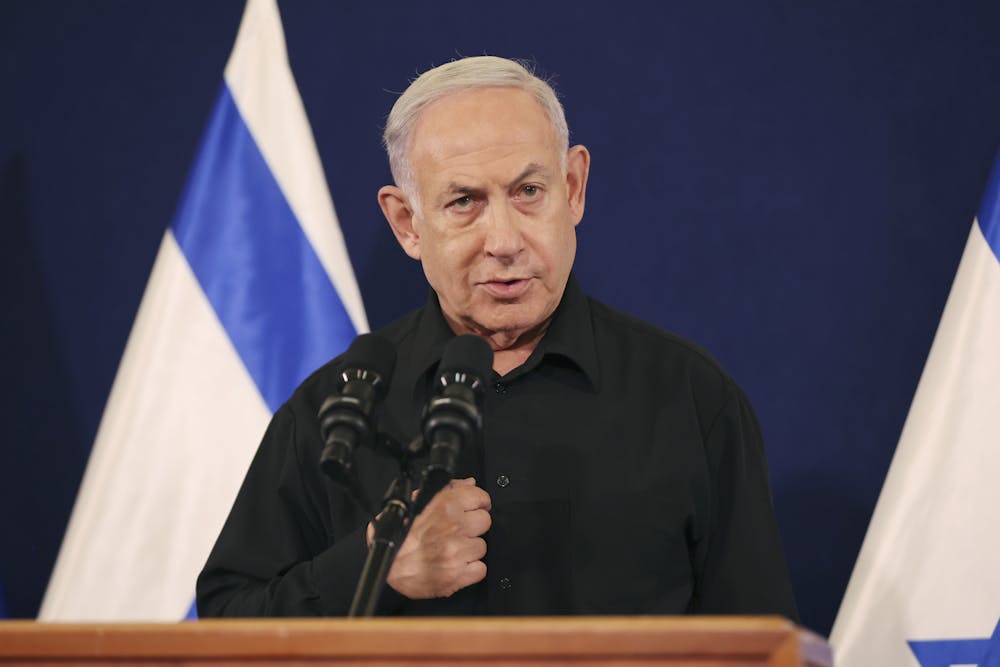 Israel, under the leadership of Prime Minister Benjamin Netanyahu, has imprisoned 17 journalists since October 2023.
Abir Sultan/AP
Israel, under the leadership of Prime Minister Benjamin Netanyahu, has imprisoned 17 journalists since October 2023.
Abir Sultan/AP
Israel’s place near the top of the Committee to Protect Journalists’ list exposes a difficult paradox. Media freedom is an intrinsic part of a free democracy. A vibrant, awkward and sometimes snarly media is a proven way to keep public debate alive and the political system healthy.
It is often uncomfortable, but you can’t have a strong democratic system without journalists freely and vigorously fulfilling their watchdog role. In fact, a good way to tell if a democracy is sliding is the extent of a government’s crackdown on the media.
This is not to suggest equivalence between Israel and Iran. Israel remains a democracy, and Israeli media is often savagely critical[8] of its government in ways that would be unthinkable in Tehran.
But if Israel wants to restore confidence in its commitment to democratic norms, at the very least it will need to be transparent about the reasons for arresting 17 journalists in less than two months, and the evidence against them. And if there is no evidence they pose a genuine threat to Israeli security, they must be released immediately.
Read more: At a time when journalism needs to be at its strongest, an open letter on the Israel/Hamas war has left the profession diminished[9]
References
- ^ newly released census (cpj.org)
- ^ More than one journalist per day is dying in the Israel-Gaza conflict. This has to stop (theconversation.com)
- ^ human rights abuses (www.ohchr.org)
- ^ 2022 gold medallist (cpj.org)
- ^ respects media freedom (www.jpost.com)
- ^ Gaza war: Israeli government has Haaretz newspaper in its sights as it tightens screws on media freedom (theconversation.com)
- ^ indefinitely, without trial or charge (www.btselem.org)
- ^ critical (www.timesofisrael.com)
- ^ At a time when journalism needs to be at its strongest, an open letter on the Israel/Hamas war has left the profession diminished (theconversation.com)