Why making players sit out for 21 days afterwards is a good idea
- Written by: Hunter Bennett, Lecturer in Exercise Science, University of South Australia
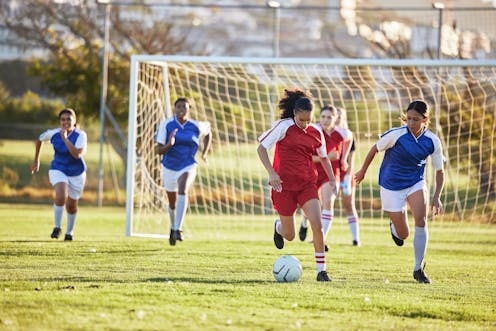
The Australian Institute of Sport (AIS) this week released new guidelines[1] for youth and community sport designed to change the way concussion is managed across the country.
While the guidelines contain a host of recommendations about on-field concussion management and identifying symptoms, the biggest changes relate to how a concussion is managed after it happens.
Specifically, all players who sustain a concussion should be symptom-free for at least 14 days before restarting contact training. This was already the advice for children, but now applies to community sport too. And notably, all players should wait a minimum 21 days after being concussed to return to competition.
This is in contrast to the previous recommendations made by many Australian sporting organisations, which typically enforce a ten to 14 day minimum period before a concussed athlete can return to competition[2].
The new guidelines address a number of recommendations from last year’s Senate inquiry[3] into concussions and repeated head trauma in contact sports. So what’s the rationale for having people sit out for longer?
Read more: Concussion risks aren't limited to the AFL. We need urgent action to make sure our kids are safe, too[4]
The dangers of concussion
Sport-related concussion has been defined[5] as:
a traumatic brain injury caused by a direct blow to the head, neck or body resulting in an impulsive force being transmitted to the brain that occurs in sports and exercise-related activities.
Concussion in sport has become an increasingly hot topic in recent years – and for good reason. The effects of a concussion can include blood flow changes and inflammation affecting the brain[6].
In the short term, concussion can cause fatigue, light sensitivity and nausea, as well as more severe symptoms[7] including behaviour change, loss of balance and coordination, and severe headaches.
There’s also some evidence to suggest repeated concussions can have long-term effects. These include lasting reductions in cognitive function[8] (how people think, make decisions, and process information), and in some instances, an increased risk of dementia[9] in older adulthood.
Concussion in kids
Children who have previously had a concussion are almost four times more likely[11] to get concussed in the future than those who have never been concussed before.
Similarly, our research[12] has shown adolescent athletes who return from concussion are around 50% more likely to suffer any type of future injury than other athletes. My colleagues and I also found most athletes were returning to competition after roughly 12 days, which may suggest insufficient recovery is increasing their injury risk after concussion.
We don’t know the exact reason children and adolescents take longer to recover from concussion, but it seems they do.
Recent evidence[13] has indicated that children, on average, may not be fully recovered and able to return to sport until around 20 days after concussion, while adults[14] may be recovered after closer to 14 days. However, this is not true for everyone, with some taking much longer to recover[15].
Read more: New study highlights the brain trauma risks for young athletes[16]
A step in the right direction
Taking these factors into consideration, I believe increasing the recovery period of concussion to 21 days is not only justified, but a positive step. While additional recovery time seems especially important for children, this change will also increase the likelihood adults playing community sport are ready to return, particularly if they don’t have access to medical guidance.
Most people in sport are happy to accept recovery from a muscle strain can take from four to eight weeks, so why wouldn’t they accept the brain (which is arguably a much more important part of the body) needs a shorter time?
Australia is not the first country to tighten up its guidelines.
In April 2023, the first concussion guidelines[18] for non-elite sport to cover the whole of the United Kingdom set out the same minimum recovery days.
Similar guidelines have also been implemented throughout New Zealand[19] for a range of sports.
There’s no research examining whether these updated guidelines have had a positive effect yet, but given coming back too early may pose a risk, they offer very little downside.
Implementing the guidelines
While these guidelines are positive for the health and welfare of athletes across the nation, there are also potential issues with their implementation – especially at the grassroots level where there may be few on-site medical staff.
The good news is, you don’t have to be an expert to reduce the effects of concussion.
The first step for those involved in community sport is simply being aware of the concussion management protocols the AIS proposes. This means making sure club staff know what the symptoms of concussion look like, and when to encourage their players to see a medical professional.
Read more: Hit your head while playing sport? Here's what just happened to your brain[20]
The second step, as recommended by the updated guidelines, is to introduce a “concussion officer[21]” to oversee the management of concussion. This person doesn’t need to be a concussion expert and is not expected to diagnose concussion. Like the role of a fire warden, the concussion officer ensures anyone diagnosed with concussion follows the agreed protocol.
Lastly, when it comes to young athletes, when in doubt, sit them out. A more conservative approach is always best.
References
- ^ new guidelines (www.sportaus.gov.au)
- ^ return to competition (play.afl)
- ^ Senate inquiry (www.aph.gov.au)
- ^ Concussion risks aren't limited to the AFL. We need urgent action to make sure our kids are safe, too (theconversation.com)
- ^ been defined (bjsm.bmj.com)
- ^ inflammation affecting the brain (bjsm.bmj.com)
- ^ symptoms (www.concussioninsport.gov.au)
- ^ reductions in cognitive function (www.liebertpub.com)
- ^ increased risk of dementia (jamanetwork.com)
- ^ TommyStockProject/Shutterstock (www.shutterstock.com)
- ^ more likely (pubmed.ncbi.nlm.nih.gov)
- ^ our research (www.sciencedirect.com)
- ^ Recent evidence (bjsm.bmj.com)
- ^ adults (bjsm.bmj.com)
- ^ longer to recover (www.jpeds.com)
- ^ New study highlights the brain trauma risks for young athletes (theconversation.com)
- ^ Monkey Business Images/Shutterstock (www.shutterstock.com)
- ^ concussion guidelines (sramedia.s3.amazonaws.com)
- ^ New Zealand (www.nzrugby.co.nz)
- ^ Hit your head while playing sport? Here's what just happened to your brain (theconversation.com)
- ^ concussion officer (www.youtube.com)