NASA is looking for commercial Mars missions. Do people still want to go to Mars?
- Written by: Steven Tingay, John Curtin Distinguished Professor (Radio Astronomy), Curtin University

Mars has been a source of myth, lore and inspiration since antiquity. It is also an interesting place to research – a legitimate candidate for us to find some form of alien life.
Since the 1960s, Mars has been a popular destination for space missions. Now, for the first time, NASA has invited the private sector[1] to submit proposals on commercial Mars missions.
These missions would range from carrying various payloads to the red planet, to providing communications relay services. No talk of a Mars astronaut just yet.
But do people still want to go to Mars? Absolutely. One question is, what is the best way to get people there? Another question – should we?
Modern exploration of Mars
Since 1960, there have been 50 missions[2] with scientific and technical objectives related to Mars. Thirty-one of these have been deemed successful, which is not a bad strike rate.
There have also been plenty of spectacular failures, like the crash of the Schiaparelli lander[3] in 2016.
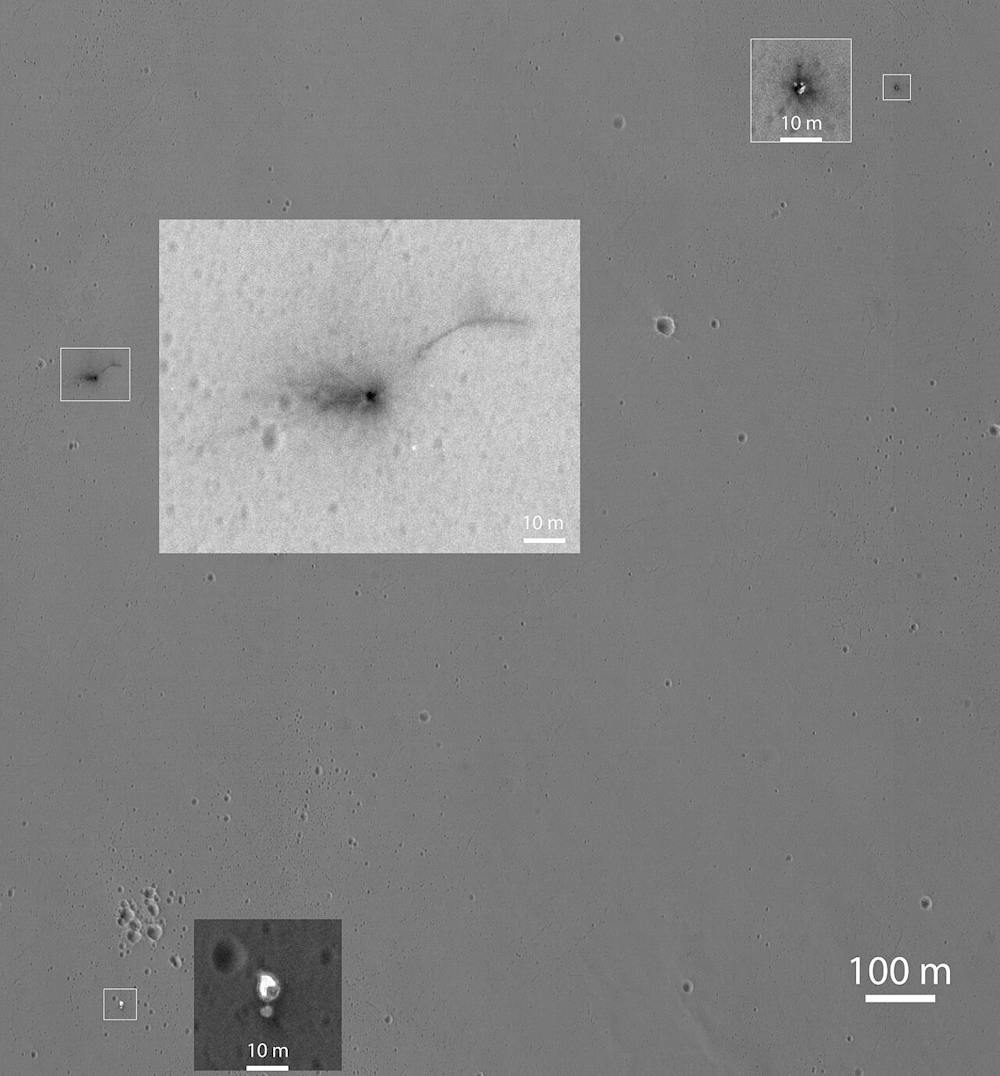
These missions have returned a wealth of information about Mars – its atmosphere, orbit, geology and more. According to some parts of the internet, they have also returned amazing images of “faces” on its surface[5], “doors” in rocky cliffs[6] and “fossilised bones[7]”.
In all cases, geologists had more mundane explanations (rocks). But such public interest shows that Mars truly occupies our imaginations.
A typical interplanetary space mission costs at least a billion US dollars[8], so the world’s major space agencies have spent no less than US$50 billion on Mars over the years. And this is just to send cameras, rovers and landers. To send people to Mars would be next level.
 The original image of a ‘face on Mars’, taken by the Viking 1 spacecraft in 1976.
NASA/JPL[9]
The original image of a ‘face on Mars’, taken by the Viking 1 spacecraft in 1976.
NASA/JPL[9]
Read more: Our long fascination with the journey to Mars[10]
A better way to do business?
NASA is starting to explore different ways to undertake space missions. For decades, NASA and other space agencies around the world have spent large sums on in-house planning, development, prototyping and production for space missions.
In the 2020s, the technologies that enable and support space exploration are increasingly being developed in the commercial world. An example most people will be familiar with is Elon Musk’s SpaceX[11]. Many of the SpaceX objectives have Mars[12] and beyond as the ultimate goal – “making humanity interplanetary[13]”.
The development of the Falcon rockets by SpaceX, Starlink satellites, and the Starship rocket could not be further from NASA’s historical model. Where the NASA approach has been conservative, SpaceX makes lots of changes fast, iterates quickly, and learns quickly from failure.
The SpaceX Starship rocket development.And SpaceX is not alone. There is a growing industry of commercial providers of access to space[14], particularly in the United States.
NASA’s current roadmap involves going “back to the Moon” to re-establish a human presence with the Artemis program[15], then on to a human presence on Mars[16]. In this roadmap, the concept of leveraging commercial providers has taken hold.
Instead of in-house development, NASA is moving in favour of specifying requirements and then assessing the solutions commercial providers might supply in a competitive process.
Read more: All-UK astronaut mission shows that private enterprise is vital to the future of space exploration[17]
Pros and cons
It appears that now, even compared to 20 years ago, such an approach has become much more viable, as demonstrated by SpaceX. In theory, it could be cheaper and more efficient.
Likely the bigger positive effect will be the substantial stimulus to the commercial sector. With companies innovating to meet the requirements of space missions, the technology spin-offs will potentially have more economic and social impact than getting to Mars itself[18].
There is a good history of this[19] from the development of technologies for space and from mega-science projects more generally.
However, it is very early days and the commercial approach has to prove itself. There is always an argument that once you start to cease in-house development at a place like NASA, capabilities start to gradually decay. Time will tell. The first steps – reaching the Moon – will go a long way in testing the approach.
Read more: Humans are going back to the Moon to stay, but when that will be is becoming less clear[20]
 NASA’s Curiosity Mars rover spotted a tiny flower-shaped rock while exploring the planet’s surface – one of many features geologists are learning about.
NASA/JPL-Caltech/MSSS[21]
NASA’s Curiosity Mars rover spotted a tiny flower-shaped rock while exploring the planet’s surface – one of many features geologists are learning about.
NASA/JPL-Caltech/MSSS[21]
But should humans go to Mars?
Mars entered the modern psyche as a place of mystery, promise and danger. This was illustrated vividly more than 100 years ago by H.G. Wells in the novel The War of the Worlds. The number of books, songs, TV shows and movies about Mars is enormous, containing some great (and not so great) art.
Should humans go to Mars? Musk wants to do it, sure. In the 2010s, the Dutch Mars One[22] startup selected 100 volunteers to travel to Mars on a one-way ticket and raised millions of dollars before going bankrupt in 2019. There will always be some cross-section of society wanting to live on Mars.
Some will argue that before humans become interplanetary and start to “mess up” another planet, we should make sure Earth is looked after. Others point out that space exploration should do more to include sustainability[23].
Despite this debate, if the history of human exploration is anything to go by, you only need a tiny fraction of the population to be motivated enough to do it. If they also have the capital, it will happen.
I can’t see that Mars will be much different.
References
- ^ NASA has invited the private sector (arstechnica.com)
- ^ 50 missions (en.wikipedia.org)
- ^ crash of the Schiaparelli lander (www.bbc.com)
- ^ NASA/JPL-Caltech/Univ. of Arizona (photojournal.jpl.nasa.gov)
- ^ faces” on its surface (www.space.com)
- ^ doors” in rocky cliffs (mars.nasa.gov)
- ^ fossilised bones (spaceexplored.com)
- ^ costs at least a billion US dollars (lasp.colorado.edu)
- ^ NASA/JPL (photojournal.jpl.nasa.gov)
- ^ Our long fascination with the journey to Mars (theconversation.com)
- ^ SpaceX (www.spacex.com)
- ^ SpaceX objectives have Mars (www.nytimes.com)
- ^ making humanity interplanetary (www.spacex.com)
- ^ growing industry of commercial providers of access to space (en.wikipedia.org)
- ^ Artemis program (www.nasa.gov)
- ^ a human presence on Mars (mars.nasa.gov)
- ^ All-UK astronaut mission shows that private enterprise is vital to the future of space exploration (theconversation.com)
- ^ economic and social impact than getting to Mars itself (managementconsulted.com)
- ^ good history of this (theconversation.com)
- ^ Humans are going back to the Moon to stay, but when that will be is becoming less clear (theconversation.com)
- ^ NASA/JPL-Caltech/MSSS (mars.nasa.gov)
- ^ Mars One (en.wikipedia.org)
- ^ do more to include sustainability (theconversation.com)